
Wood, Fire, Earth, Metal, and Water are not substances. They are patterns of change.
In Chinese metaphysics, the Five Elements — called Wu Xing — describe how energy moves, transforms, and interacts across every domain of life. The same Wood that shapes a visionary leader in BaZi also maps to the liver in Traditional Chinese Medicine and the east direction in Feng Shui. The same Water that represents deep wisdom in astrology corresponds to the kidneys in TCM and the north in spatial design.
Most people hear “the five elements” and think of chemistry class. Hydrogen. Oxygen. Carbon. But the wood fire earth metal water meaning in Chinese tradition is something entirely different. These five words describe phases of transformation, not physical materials.
By the end of this guide, you will understand exactly what each element represents across four Chinese traditions — BaZi, TCM, Feng Shui, and classical philosophy. You will know how the elements support and regulate each other. And you will see how to apply this knowledge to your health, career, and environment.
Want to see which elements dominate your personal chart? Calculate your free BaZi chart first, then read on to interpret what you find.
Key Takeaways
- Wood, Fire, Earth, Metal, and Water are phases of energy, not literal substances — Wu Xing translates more accurately to “Five Movements” or “Five Phases.”
- Each element carries distinct meaning across BaZi (personality and destiny), TCM (organs and emotions), Feng Shui (directions and colors), and classical philosophy.
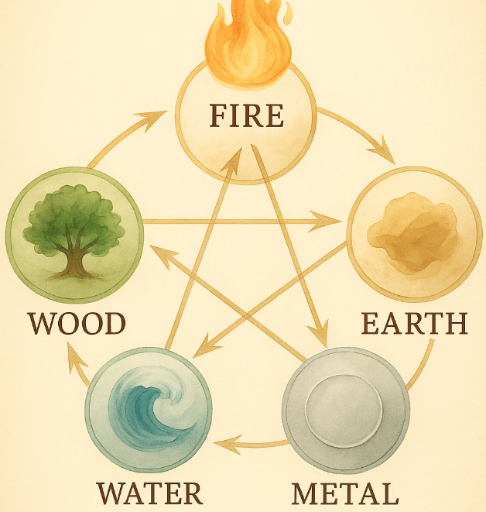
- The Production Cycle shows how elements nourish each other: Wood feeds Fire, Fire creates Earth, Earth bears Metal, Metal carries Water, Water grows Wood.
- The Control Cycle keeps the system in balance: Wood restrains Earth, Earth absorbs Water, Water extinguishes Fire, Fire melts Metal, Metal chops Wood.
- Understanding your personal element distribution through a BaZi chart reveals practical insights for career, health, and daily decisions.
What Is the Wood Fire Earth Metal Water Meaning? Wu Xing Explained
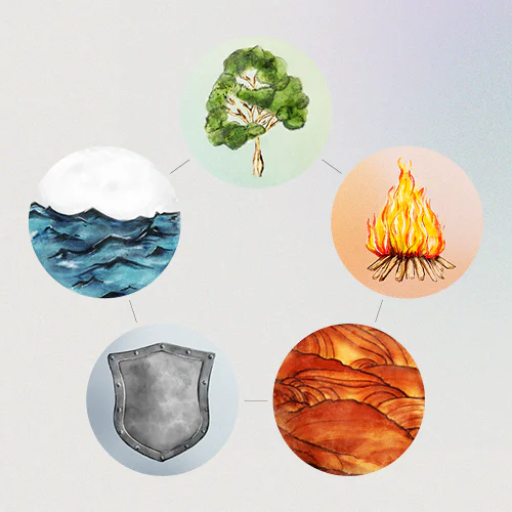
Wu Xing Means “Five Phases,” Not Five Substances
The Chinese term Wu Xing does not literally mean “five elements.” Xing means movement, process, or phase. A more accurate translation would be “Five Movements” or “Five Phases of Change.” Understanding wu xing meaning is the first step to grasping the deeper wood fire earth metal water meaning across Chinese traditions.
This distinction matters. When ancient Chinese thinkers described Wood, they were not talking about trees. They were describing the energy of growth, expansion, and upward movement — the force that pushes a seed through soil toward the sun.
When they described Water, they were not talking about H2O. They were describing the energy of flow, depth, and downward movement — the force that finds the lowest point and gathers there.
Understanding the wood fire earth metal water meaning starts with this reframe. These are dynamic forces, not static objects.
A 3,000-Year-Old Framework
The Five Elements framework dates back over 3,000 years to the Zhou Dynasty (1046–256 BCE), first codified in texts like the Book of Documents (Shu Jing) and the Yi Jing. For historical context, see the Wikipedia entry on Wuxing. It emerged not as mysticism but as an attempt to categorize and predict patterns of change in nature, society, and the human body — the foundation of five elements chinese philosophy.
Over the centuries, this framework split into specialized applications:
- BaZi (Four Pillars of Destiny) — uses element balance to analyze personality, career, and life timing
- Traditional Chinese Medicine (TCM) — uses element-organ-emotion mapping for diagnosis and treatment
- Feng Shui — uses elemental associations to optimize spatial energy (Qi)
- Classical Philosophy — uses the elements as a model for understanding cosmic and social order
If you want to understand how these elements function specifically within BaZi chart reading, see our complete Five Elements guide or our dedicated Four Pillars of Destiny breakdown.
How the Five Elements Differ From Western Elements
| Feature | Chinese Five Elements (Wu Xing) | Greek Four Elements |
|---|---|---|
| Nature | Phases of transformation | Fundamental substances |
| Count | 5 (Wood, Fire, Earth, Metal, Water) | 4 (Earth, Water, Air, Fire) |
| Focus | Relationships and cycles | Composition of matter |
| Application | Medicine, astrology, space design | Natural philosophy, alchemy |
| Key concept | Production and Control cycles | Opposition and combination |
The Greek system asks: “What is the world made of?” The Chinese system asks: “How does the world change?” Both are valid. But they answer different questions.
The wood fire earth metal water meaning you are searching for lives inside the Chinese framework — a system of relationships, not ingredients.
Wood: Growth, Vision, and Expansion
Wood is the energy of beginnings. It pushes upward, reaches outward, and refuses to stay still.
Wood Element Meaning in BaZi (Jia and Yi Day Masters)
In BaZi, Wood represents ambition, planning, and long-term vision. The Ten Heavenly Stems express Wood through two forms. A person with a strong Wood Day Master — Yang Wood (Jia) or Yin Wood (Yi) — tends to be growth-oriented, strategic, and persistent.
- Yang Wood (Jia) — like a tall tree. Strong, direct, principled. Takes time to grow but becomes unshakable.
- Yin Wood (Yi) — like a vine or flower. Flexible, creative, detail-oriented. Adapts to circumstances while still climbing.
The wood element meaning in BaZi centers on growth and initiative. Strong Wood in a chart often indicates leadership potential, entrepreneurial drive, or creative vision. Weak Wood can manifest as indecision, lack of direction, or difficulty starting projects.
Wood in TCM (Liver, Gallbladder, Anger and Kindness)
In Traditional Chinese Medicine, Wood governs the liver and gallbladder. The liver is called the “General” because it directs the smooth flow of Qi throughout the body. When Wood energy is balanced, a person feels purposeful and decisive. When it is blocked or excessive, frustration, irritability, and anger emerge.
The Huangdi Neijing (Yellow Emperor’s Inner Canon), the foundational text of TCM written over 2,000 years ago, links Wood to the emotion of anger and its virtuous counterpart, kindness. TCM practitioners often treat Liver Qi stagnation — a Wood imbalance — with movement, green foods, and practices that restore upward, outward flow.
Wood in Feng Shui (East, Green, Spring)
In Feng Shui, Wood corresponds to the east direction, the color green, and the spring season. It is the energy of new beginnings and fresh growth. Practitioners place Wood-element objects — plants, wooden furniture, green textiles — in the east sector of a space to stimulate vitality, creativity, and expansion.
Wood Attributes Across All Four Traditions
| Tradition | Wood Represents | Key Association |
|---|---|---|
| BaZi | Growth, vision, initiative | Jia and Yi Day Masters |
| TCM | Liver, Gallbladder | Anger / Kindness |
| Feng Shui | East, Green, Spring | New beginnings, vitality |
| Philosophy | Birth, sprouting, upward movement | The force of initiation |
For a full analysis of how elements affect compatibility, see our (element compatibility bazi guide).
Fire: Passion, Transformation, and Visibility
Fire is the energy of peak expression. It rises, illuminates, and transforms everything it touches.
Fire Element Meaning in BaZi (Bing and Ding Day Masters)
In BaZi, Fire represents visibility, passion, and influence. A Yang Fire (Bing) Day Master is like the sun — radiant, generous, impossible to ignore. A Yin Fire (Ding) Day Master is like a candle flame — intimate, precise, deeply perceptive.
The fire element meaning in BaZi centers on visibility and transformation. Strong Fire in a chart indicates charisma, leadership, and the ability to inspire others. It also brings speed — Fire-dominant people often think and act quickly. The downside of excess Fire is impulsiveness, burnout, or emotional volatility.
Our detailed guide on (element excess in BaZi) covers the full range of excessive element patterns and their effects.
Fire in TCM (Heart, Small Intestine, Joy)
TCM associates Fire with the heart and small intestine. The heart houses the Shen — the spirit or consciousness — making Fire the element most closely tied to mental and emotional clarity. Balanced Fire produces genuine joy, warmth, and connection.
Excess Fire can manifest as anxiety, insomnia, or manic excitement. Deficient Fire leads to flatness, social withdrawal, or lack of enthusiasm.
Fire in Feng Shui (South, Red, Summer)
Feng Shui places Fire in the south, the color red, and the summer season. Fire-element items — candles, red decor, triangular shapes, lighting — activate recognition, reputation, and social energy. The south sector of a home or office governs how you are seen by others.
When Sarah moved into her new apartment in 2024, she noticed she felt invisible at work. Her performance reviews were solid, but she kept getting passed over for visible projects. A Feng Shui consultant pointed out that her south sector — the Fire area — was completely empty. She added a small red lamp and a framed award. Within three months, her manager assigned her to lead a client-facing initiative. Sarah’s story is not magic. It is pattern recognition: her environment had no Fire, and her life reflected that absence.
Fire Attributes Across All Four Traditions
| Tradition | Fire Represents | Key Association |
|---|---|---|
| BaZi | Charisma, passion, speed | Bing and Ding Day Masters |
| TCM | Heart, Small Intestine | Joy |
| Feng Shui | South, Red, Summer | Reputation, visibility |
| Philosophy | Peak expression, transformation | The force of illumination |
Earth: Stability, Nurturing, and Grounding
Earth is the energy of centering. It holds, supports, and transforms — the element that receives and integrates all others.
Earth Element Meaning in BaZi (Wu and Ji Day Masters)
In BaZi, Earth represents reliability, practicality, and the ability to hold space for others. Yang Earth (Wu) is like a mountain — solid, protective, immovable. Yin Earth (Ji) is like garden soil — fertile, nurturing, adaptable.
The earth element meaning in BaZi centers on stability and support. Earth-dominant charts often indicate people who are natural caregivers, managers, or mediators. They excel at creating structure and ensuring others feel supported. However, excess Earth can lead to overthinking, worry, or becoming stuck in routines.
Earth in TCM (Spleen, Stomach, Worry and Empathy)
TCM associates Earth with the spleen and stomach — the organs of digestion and assimilation, both physical and mental. The Earth element processes not just food but also ideas and experiences. Balanced Earth produces empathy, stability, and grounded thinking. Imbalanced Earth manifests as worry, rumination, or digestive issues.
Mei, a TCM practitioner in Portland, noticed she had struggled with bloating and overthinking for years. Her BaZi chart showed heavy Earth with almost no Water to regulate it.
She began a Water-nourishing practice — swimming, dark-colored foods, and meditation. Within six months, both her digestion and her mental loops improved significantly. Her Earth was not the problem. It simply had no counterbalance.
Earth in Feng Shui (Center, Yellow, Late Summer)
Feng Shui places Earth at the center of the Bagua map, in the color yellow, and in the late summer season. Earth items — ceramics, square shapes, earthy tones — create stability and nourishment in a space. The center of a home represents the overall health and balance of the household.
Earth Attributes Across All Four Traditions
| Tradition | Earth Represents | Key Association |
|---|---|---|
| BaZi | Reliability, nurturing, structure | Wu and Ji Day Masters |
| TCM | Spleen, Stomach | Worry / Empathy |
| Feng Shui | Center, Yellow, Late Summer | Stability, nourishment |
| Philosophy | Reception, transformation, harvest | The force of integration |
Metal: Structure, Discipline, and Refinement
Metal is the energy of precision. It cuts, defines, and refines — the element that brings order out of chaos.
Metal Element Meaning in BaZi (Geng and Xin Day Masters)
In BaZi, Metal represents discipline, boundaries, and analytical power. Yang Metal (Geng) is like a sword — direct, decisive, unyielding. Yin Metal (Xin) is like fine jewelry — detailed, elegant, perfection-seeking.
The metal element meaning in BaZi centers on discipline and precision. Metal-dominant people excel in fields that require precision: law, finance, engineering, surgery. They are natural problem-solvers who cut through ambiguity. The challenge of strong Metal is rigidity — difficulty adapting when plans change.
James spent seven years in advertising, a Fire-heavy industry built on hype and visibility. He performed adequately but always felt drained.
When he finally generated his BaZi chart, he discovered his Day Master was Geng — Yang Metal. He pivoted to financial analysis, a field where precision, structure, and critical thinking dominate.
Within two years, he earned a promotion and reported feeling “like myself for the first time in my career.” James did not change who he was. He aligned his environment with his elemental nature.
Metal in TCM (Lungs, Large Intestine, Grief and Courage)
TCM links Metal to the lungs and large intestine — the organs of intake and release. The lungs breathe in fresh Qi; the large intestine eliminates what is no longer needed. This duality gives Metal its association with grief (letting go) and courage (taking in what is new). Metal imbalance often appears as respiratory issues, skin problems, or difficulty processing loss.
Metal in Feng Shui (West, White, Autumn)
Feng Shui places Metal in the west, the color white, and the autumn season. Metal objects — metal sculptures, white decor, round shapes — enhance clarity, precision, and completion energy. The west sector governs children, creativity, and legacy.
Metal Attributes Across All Four Traditions
| Tradition | Metal Represents | Key Association |
|---|---|---|
| BaZi | Discipline, precision, boundaries | Geng and Xin Day Masters |
| TCM | Lungs, Large Intestine | Grief / Courage |
| Feng Shui | West, White, Autumn | Clarity, completion |
| Philosophy | Definition, order, contraction | The force of refinement |
Water: Wisdom, Adaptability, and Depth

Water is the energy of flow. It finds the lowest point, adapts to any container, and wears down the hardest stone through persistence.
Water Element Meaning in BaZi (Ren and Gui Day Masters)
In BaZi, Water represents intelligence, adaptability, and depth. Yang Water (Ren) is like the ocean — vast, powerful, unstoppable. Yin Water (Gui) is like mist or rain — subtle, pervasive, intuitively precise.
The water element meaning in BaZi centers on adaptability and depth. Water-dominant people are strategic thinkers, often drawn to research, investigation, or roles requiring emotional intelligence. They read situations before acting. The risk of excess Water is overanalysis, fear-based hesitation, or emotional flooding.
Water in TCM (Kidneys, Bladder, Fear and Wisdom)
TCM associates Water with the kidneys and bladder. The kidneys store Jing — the body’s essential life force — making Water the root of vitality, reproduction, and longevity. Balanced Water produces wisdom, calm, and deep reserves of energy.
Imbalanced Water appears as chronic fear, lower back pain, or urinary issues. In TCM philosophy, fear and wisdom are two sides of the same Water coin: fear is water frozen, wisdom is water flowing.
Water in Feng Shui (North, Black, Winter)
Feng Shui places Water in the north, the color black or deep blue, and the winter season. Water features — aquariums, fountains, mirrors, wavy shapes — activate career energy, flow, and opportunity. The north sector governs career path and life journey.
Water Attributes Across All Four Traditions
| Tradition | Water Represents | Key Association |
|---|---|---|
| BaZi | Strategy, adaptability, depth | Ren and Gui Day Masters |
| TCM | Kidneys, Bladder | Fear / Wisdom |
| Feng Shui | North, Black, Winter | Career, flow, journey |
| Philosophy | Stillness, persistence, gathering | The force of return |
The Production Cycle: How Elements Support Each Other
The meaning of wood, fire, earth, metal, and water is incomplete without understanding how they interact. The Five Elements relate through two primary cycles. The first is the Production Cycle — the nourishing, generative relationship that keeps the system growing.
Wood Produces Fire
Wood fuels Fire. Without fuel, there is no flame. In BaZi, this means a Wood-heavy chart naturally supports Fire expression — the visionary (Wood) gains visibility (Fire). In TCM, healthy Liver (Wood) energy supports Heart (Fire) function.
Fire Produces Earth
Fire creates Earth. Ash becomes soil. In BaZi, Fire’s expression and activity generate the stability and results that Earth represents. In Feng Shui, the reputation sector (Fire) feeds the overall center (Earth) of a space.
Earth Produces Metal
Earth bears Metal. Minerals form in soil. In BaZi, stable Earth provides the foundation for Metal’s precision and discipline. In TCM, healthy Spleen (Earth) function supports Lung (Metal) immunity.
Metal Produces Water
Metal carries Water. Ore conducts and contains it. In BaZi, structured Metal thinking generates deep Water insights. In Feng Shui, Metal objects in the west can activate the flow of opportunity associated with Water’s north sector.
Water Produces Wood
Water grows Wood. Nothing sprouts without moisture. In BaZi, strategic Water thinking feeds Wood ambition. In TCM, Kidney (Water) essence nourishes Liver (Wood) blood.
Understanding the Production Cycle helps you identify what feeds your strengths. If your chart shows strong Wood but weak Fire, you may have big ideas but struggle to gain visibility. The solution is not to suppress Wood — it is to cultivate Fire through action, social engagement, and element-balancing practices.
For a deeper look at how the five elements connect to physical and emotional wellness, see our (bazi element health guide).
The Control Cycle: How Elements Regulate Each Other
The second cycle reveals another layer of what wood, fire, earth, metal, and water mean in practice. The Control Cycle is the restraining, moderating relationship that prevents any one element from dominating.
Wood Controls Earth
Tree roots break up soil and hold it in place. In BaZi, strong Wood prevents Earth from becoming stagnant or overly rigid. In TCM, Liver (Wood) energy regulates Spleen (Earth) digestion — too much worry (Earth) often stems from frustrated Wood.
Earth Controls Water
Soil absorbs and channels water. In BaZi, Earth stability prevents Water from flooding or scattering. In Feng Shui, Earth features can temper excessive Water energy in a space.
Water Controls Fire
Water extinguishes flame. In BaZi, strategic Water thinking cools impulsive Fire action. In TCM, Kidney (Water) deficiency often allows Heart (Fire) to rise unchecked, producing anxiety and insomnia.
Fire Controls Metal
Fire melts metal. In BaZi, passion and visibility (Fire) can soften Metal rigidity, making a person more adaptable. In TCM, Heart (Fire) warmth prevents Lung (Metal) from becoming cold and contracted.
Metal Controls Wood
Metal chops wood. In BaZi, discipline and precision (Metal) prune and shape ambition (Wood). Without Metal, Wood grows wild — lots of activity, little structure. This is why many entrepreneurs with strong Wood benefit from Metal systems: calendars, deadlines, and clear metrics.
The Control Cycle is not destructive. It is regulatory. Every element needs a check. Understanding how the Five Elements balance each other is essential for reading any BaZi chart accurately.
Complete Element Reference Table
| Element | BaZi Day Masters | TCM Organs | TCM Emotion | Feng Shui Direction | Feng Shui Color | Season | Core Quality |
|---|---|---|---|---|---|---|---|
| Wood | Jia (Yang), Yi (Yin) | Liver, Gallbladder | Anger / Kindness | East | Green | Spring | Growth |
| Fire | Bing (Yang), Ding (Yin) | Heart, Small Intestine | Joy | South | Red | Summer | Transformation |
| Earth | Wu (Yang), Ji (Yin) | Spleen, Stomach | Worry / Empathy | Center | Yellow | Late Summer | Stability |
| Metal | Geng (Yang), Xin (Yin) | Lungs, Large Intestine | Grief / Courage | West | White / Metallic | Autumn | Refinement |
| Water | Ren (Yang), Gui (Yin) | Kidneys, Bladder | Fear / Wisdom | North | Black / Deep Blue | Winter | Depth |
Use this table as a quick reference whenever you encounter an element in any Chinese metaphysical system. The wood fire earth metal water meaning becomes clearer when you see how consistently each element behaves across traditions.
How to Apply Wood Fire Earth Metal Water Meaning in Daily Life
In BaZi: Read Your Chart
The most direct application is generating your free BaZi chart and identifying your dominant and weak elements. Your Day Master — the Heavenly Stem of your Day Pillar — is your core element identity. But the full chart shows your complete element distribution, revealing which forces support you and which challenge you.
If you are new to chart reading, our guide to reading your BaZi chart walks through the process step by step.
In TCM: Understand Your Constitution
Your element balance offers clues about your constitutional tendencies. Excess Fire? Watch for anxiety and sleep disruption. Weak Water? Support your kidneys with adequate rest and hydration. Strong Metal? Your respiratory system is likely resilient, but grief may hit harder.
This is not a replacement for medical diagnosis. It is a framework for preventive awareness. For more on TCM research and safety, see the NIH overview of Traditional Chinese Medicine.
In Feng Shui: Optimize Your Space
Apply element knowledge to your home or workspace by placing representative objects in their corresponding sectors. Need more career momentum? Activate the north with Water features. Want better health? Strengthen the center with Earth tones. Seeking recognition? Enhance the south with Fire elements.
In Daily Life: Make Better Decisions
Element awareness improves decision-making across contexts. Choosing a career? Align with your dominant element’s strengths. Selecting a team? Balance elements for complementary skills. Planning a project? Time it according to seasonal element energy.
Understanding how the Five Elements shape your personality takes this knowledge from theory to personal strategy. For a deeper look at how element types behave in real life, explore our Five Elements personality profiles.
Frequently Asked Questions About Wood Fire Earth Metal Water Meaning
What is the meaning of Wu Xing?
Wu Xing literally translates to “Five Phases” or “Five Movements.” It is a Chinese framework describing five patterns of energy transformation — Wood, Fire, Earth, Metal, and Water — used across BaZi, TCM, Feng Shui, and philosophy to understand change, balance, and interaction.
Are the Five Elements literal substances?
No. Wood does not mean timber, and Water does not mean H2O. The wood fire earth metal water meaning is metaphorical, not material. Each element describes a type of energy movement: upward expansion (Wood), peak expression (Fire), stabilizing reception (Earth), contracting definition (Metal), and downward flow (Water).
Which element is the most powerful?
No single element is most powerful. Power in the Five Elements system comes from balance, not dominance. A chart or space with one overwhelming element is actually weakened because the Control Cycle cannot function. Learn more about identifying your dominant element and why balance matters more.
Can a person have all five elements?
Yes. Most BaZi charts contain all five elements to some degree. What varies is distribution — some elements dominate, others appear only slightly. Having all five present generally indicates adaptability and resourcefulness. Missing elements are common too; they indicate blind spots or areas requiring conscious development.
What happens if one element is missing?
A missing element in your BaZi chart is not necessarily bad. It simply means that element’s energy is not natively strong in your makeup. Some practitioners view missing elements as favorable voids — areas where you are not burdened by that element’s challenges. Others recommend environmental or lifestyle remedies to gently introduce the missing quality. Our weak element guide explains this in detail.
How are the Five Elements different from Western elements?
The Greek four-element system (Earth, Water, Air, Fire) asks what the world is made of. The Chinese Five Elements system asks how the world changes. The Chinese framework emphasizes relationships, cycles, and phases of transformation rather than fixed substances.
Do the Five Elements apply to Feng Shui?
Yes. Feng Shui uses the Five Elements extensively to balance spatial energy. Each element corresponds to a direction, color, season, and shape. Practitioners add or reduce elemental features in specific sectors to harmonize the flow of Qi in a built environment.
How do I know which element I am?
Your primary element in BaZi is your Day Master — the Heavenly Stem of your Day Pillar. You can calculate this by generating your Four Pillars chart from your birth date and time. The chart will also show your complete element distribution, revealing which elements are strong, weak, or missing.
Conclusion
Wood, Fire, Earth, Metal, and Water are not a list of materials. They are a language for describing how energy behaves — in your body, in your environment, in your decisions, and in your life.
The wood fire earth metal water meaning across BaZi, TCM, Feng Shui, and philosophy is remarkably consistent. Wood always grows. Fire always transforms. Earth always stabilizes. Metal always refines. Water always flows. Learn to read these patterns, and you learn to read the forces shaping your experience.
Here is what to do next:
- Calculate your free BaZi chart to see your personal element distribution
- Read our complete guide to the Five Elements in BaZi for deeper chart-specific analysis
- Explore how element balance affects your life outcomes and what to do about imbalance
Understanding wood fire earth metal water meaning gives you a framework for reading the patterns in your life. Your elements are not your fate. They are your foundation. Build from there.