


The process of learning to read bazi chart data consists of a straightforward six-step process which begins with Day Master identification and continues through five additional steps which include Five Element mapping and Ten God decoding and life domain analysis through pillar reading and Luck Pillar timing implementation. You do not need years of study. You need a system.
You have your chart in front of you. Your chart displays eight characters which are organized into four pillars and show a grid of elements that you find difficult to identify.
What should I do next?
Most guides dump terminology on you. The guide provides explanations about Heavenly Stems and Earthly Branches and the 60 JiaZi cycle but it fails to show you how to read the chart.
That is what this guide will do.
By the end, you will be able to pick up any BaZi chart, follow the six steps, and understand what it is saying about personality, career patterns, and life timing. If you have not generated your chart yet, use our free BaZi calculator first, then return here.
For a complete foundation on what these eight characters represent, see our complete guide to Four Pillars of Destiny.
Key Takeaways
- Your Day Master serves as the starting point for BaZi chart reading because it represents the Heavenly Stem which belongs to your Day Pillar. All other chart elements develop their meaning through their relationship with this central element.
- Your Day Master’s strength (strong, weak, or balanced) determines your optimal strategy, not your value; strong Day Masters thrive on independence, weak ones flourish with support.
- The Ten Gods show how people behave through five different areas of their lives which include wealth, authority, creativity, learning, and competition.
- Each pillar maps to a specific life area: Year (ancestry), Month (career), Day (self and spouse), Hour (legacy and children).
- Luck Pillars present an essential understanding of time because they demonstrate which 10-year periods will enhance your capabilities and which periods will need your careful attention.
Before You Start: What You Actually Need
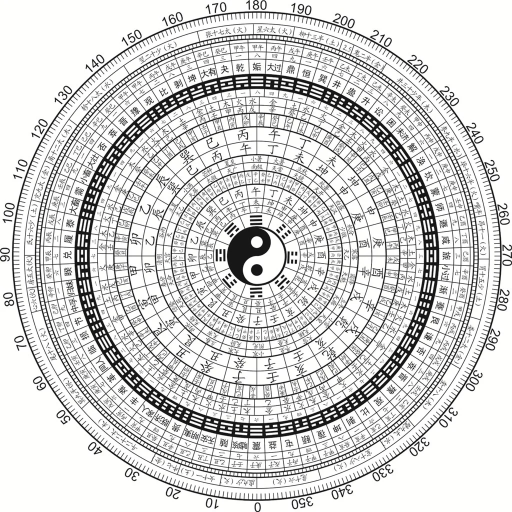
The skill of reading BaZi charts can be learned by anyone because it does not require any special talent.
You need three things:
- Accurate birth data: Exact date, time, and location. An incorrect hour changes your Hour Pillar and can alter your entire reading.
- A generated chart: Use a reliable calculator that applies true solar time. Not all tools are equal. Our free BaZi calculator guide compares the most accurate options.
- Patience for the first read: Your first chart reading will take 15 to 20 minutes. After five charts you will complete it in less than 10 minutes.
That is it. The requirement demands no memorization of 60 JiaZi combinations and no need to master classical Chinese texts. The system provides only basic structure.
Step 1: Find Your Day Master — The Center of Everything
If you remember only one thing from this entire guide, remember this:
Your Day Master is YOU.
The Day Pillar functions as your third pillar which contains its Heavenly Stem as its highest character. The Day Pillar, top character.
The Day Master represents your core identity: how you think, how you respond to pressure, what you need to thrive, and what drains you. The complete analysis of your chart begins from this point.
The following table displays 10 different Day Master options for quick reference.
| Day Master | Element | Polarity | Core Trait |
|---|---|---|---|
| Jia (甲) | Wood | Yang | Visionary, principled, growth-oriented |
| Yi (乙) | Wood | Yin | Adaptable, diplomatic, detail-focused |
| Bing (丙) | Fire | Yang | Expressive, charismatic, leadership-driven |
| Ding (丁) | Fire | Yin | Warm, illuminating, persistent |
| Wu (戊) | Earth | Yang | Stable, dependable, structured |
| Ji (己) | Earth | Yin | Nurturing, resourceful, reflective |
| Geng (庚) | Metal | Yang | Decisive, disciplined, results-oriented |
| Xin (辛) | Metal | Yin | Refined, precise, aesthetic |
| Ren (壬) | Water | Yang | Deep, adaptable, strategic |
| Gui (癸) | Water | Yin | Intuitive, subtle, insightful |
The first time Sarah attempted to read her chart she made the same basic error which beginners make. She examined the first pillar and identified Yang Wood (Jia) as her Year Stem then she believed that her identity had been established. She read every description of Yang Wood and thought, “This is not me at all.”
The Day Master of her chart was Yin Water (Gui) which she found inside the Day Pillar. The correct reference point for the chart re-reading process enabled her to understand all elements of the chart. The intuitive, subtle, deeply analytical description matched her personality precisely. She had been reading the wrong character for 20 minutes.
The Day Pillar serves as the starting point for all processes. The entire system develops from that initial point.
To understand which elements are favorable for you, read our detailed (day master bazi) guide.
Step 2: Assess Your Day Master’s Strength
Once you know your Day Master, the next question is simple:
Is it strong, weak, or balanced?
This is not a judgment. A weak Day Master is not bad. A strong Day Master is not better. They simply require different strategies.
How to Assess Strength
Check two things:
1. The Month Branch (season)
Your Month Branch reveals the season you were born in. Each element has seasons where it is strong, seasons where it is weak, and seasons where it is neutral.
| Season | Dominant Element | Day Masters Supported |
|---|---|---|
| Spring | Wood | Wood, Fire |
| Summer | Fire | Fire, Earth |
| Autumn | Metal | Metal, Water |
| Winter | Water | Water, Wood |
Born in summer with a Fire Day Master? Your Day Master is seasonally supported. Born in winter with a Fire Day Master? It is seasonally weakened.
2. Supporting elements across all pillars
Count how many elements in your chart support or produce your Day Master:
- Same element as Day Master = direct support
- Element that produces your Day Master = indirect support
- Element that controls your Day Master = pressure
- Element that drains your Day Master = depletion
If you see 4 or more supporting elements, your Day Master is likely strong. If you see 0 to 1 supporting element, it is likely weak. Two to three suggests balanced.
What Strength Means
| Strength | Characteristics | Optimal Strategy |
|---|---|---|
| Strong | Self-reliant, independent, confident | Thrives on challenge and output |
| Balanced | Flexible, cooperative, adaptable | Needs variety and partnership |
| Weak | Needs support, collaborative, receptive | Flourishes with structure and mentorship |
James possessed a weak Metal Day Master ability. He spent multiple years working as a solo founder because he made all choices himself while rejecting assistance from others. He experienced two complete work breakdowns. He rebuilt his business operations after understanding his chart required him to get support from others. The company experienced a threefold increase in revenue during the next 18 months. His weakness served as a guide to demonstrate his best work methods.
This is why strength assessment matters. It tells you how to operate, not who you are.
Step 3: Map the Five Elements Across Your Chart
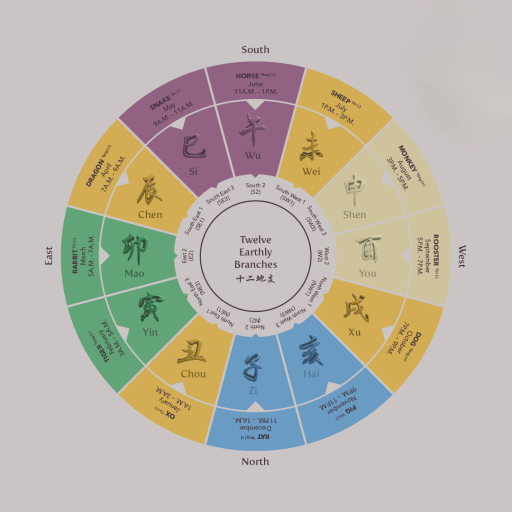
Your center now established, you should examine the complete landscape.
Count how many times Wood, Fire, Earth, Metal, and Water appear across all four pillars. The hidden stems of each Earthly Branch must be counted because they contain additional elements that need to be counted.
The Two Critical Cycles
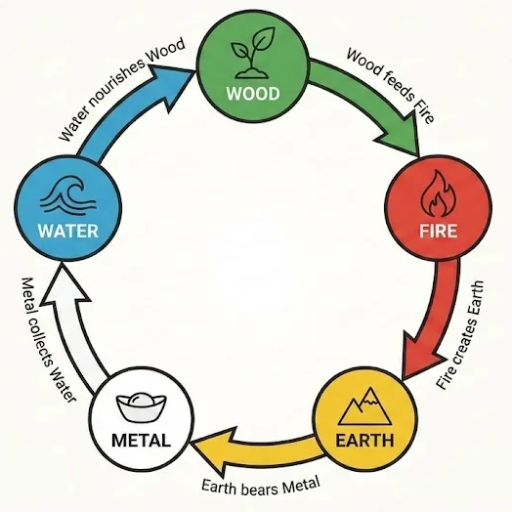
Production Cycle (Sheng):
Wood produces Fire. Fire produces Earth. Earth produces Metal. Metal produces Water. Water produces Wood.
Control Cycle (Ke):
Wood controls Earth. Earth controls Water. Water controls Fire. Fire controls Metal. Metal controls Wood.
What to Look For
- Dominant element: Which appears most frequently? This shapes your natural tendencies.
- Missing element: Which is absent or minimal? This reveals blind spots or underdeveloped areas.
- Excessive element: Which overwhelms the chart? This creates imbalance.
Someone with abundant Fire and almost no Water might be naturally expressive but chronically impulsive. Someone with dominant Metal and weak Wood might be highly disciplined but struggle to initiate new projects. The pattern should feel familiar.
For a complete breakdown of what each element represents, explore our (guide to Heavenly Stems and Earthly Branches).
Step 4: Decode the Ten Gods
The Ten Gods (Shi Shen) are the interpretive engine of BaZi. They transform raw elements into meaningful life patterns.
Here is the key insight: The Ten Gods are not mystical deities. They are relational archetypes. Each one describes how a specific element in your chart relates to your Day Master.
The Five Categories
| Category | Direct (Zheng) | Indirect (Pian) | Life Domain |
|---|---|---|---|
| Resource | Direct Resource | Indirect Resource | Learning, support, mentorship, wisdom |
| Companion | Friend | Rob Wealth | Peers, competition, independence |
| Output | Eating God | Hurting Officer | Creativity, expression, intelligence |
| Wealth | Direct Wealth | Indirect Wealth | Money, assets, financial opportunities |
| Officer | Direct Officer | Seven Killings | Authority, discipline, pressure, status |
How to Identify Them
For every other element in your chart, ask two questions:
- What is its relationship to my Day Master? (Does it produce, control, drain, or match it?)
- Is its Yin-Yang polarity the same or opposite to my Day Master?
The combination of relationship + polarity gives you the specific Ten God.
What They Reveal
- Heavy Wealth presence: Financial opportunities and material focus dominate your life themes.
- Strong Officer stars: Structure, authority, and career advancement are central.
- Dominant Output: Creativity, communication, and innovation drive your decisions.
- Abundant Resource: Learning, preparation, and support-seeking define your approach.
Maria found her chart to be controlled by Output stars which included Eating God and Hurting Officer. She had worked in four different professions during eight years because she wanted to pursue various creative interests. Her friends described her as someone who could not stay still. Her BaZi chart displayed her true personality to the world. The realization that her pattern functioned as a design element instead of a defect enabled her to create a portfolio career which allowed her to work on various artistic projects at the same time.
This is the power of bazi interpretation through the Ten Gods. They explain the why behind your behavioral patterns.
For a deeper exploration of this concept on our site, see our dedicated (guide on Ten Gods meaning) and identification.
Step 5: Read Each Pillar’s Life Area
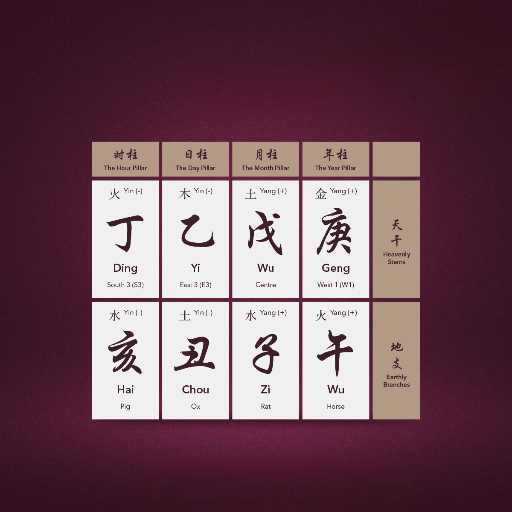
Your four pillars are not random data points. They are a timeline of your life, read from left to right.
| Pillar | Life Domain | What It Reveals |
|---|---|---|
| Year | Ancestry, early childhood | Family background, social environment, inherited tendencies |
| Month | Career, parents, authority | Work style, professional trajectory, relationship with authority |
| Day | Core self, spouse | Your identity, marriage, values, inner world |
| Hour | Children, legacy, later life | Ambitions, future direction, creative output |
Read them as a story: your origins, your formation, your core identity, and your legacy.
Practical Application
- A strong Wealth star in your Month Pillar suggests career paths where financial management or entrepreneurship is natural.
- A dominant Officer star in your Day Branch can indicate a structured approach to marriage and partnerships.
- Heavy Resource in your Hour Pillar might mean late-life focus on teaching, mentoring, or intellectual pursuits.
Each pillar is a chapter. Together, they form the narrative.
For a complete breakdown of element interactions, see our (five elements bazi) guide.
Step 6: Layer in Timing — Luck Pillars and Annual Flow
Your natal chart is static. Your life is not.
Two timing systems add motion to the fixed blueprint:
Luck Pillars (Da Yun) — 10-Year Cycles
Your life unfolds in approximately 10-year blocks. Each Luck Pillar brings a new Heavenly Stem and Earthly Branch that interact with your base chart.
- Favorable Luck Pillar: The elements support your Day Master. Growth flows more easily. Opportunities appear.
- Unfavorable Luck Pillar: The elements challenge your Day Master. Friction increases. This is a time for building character, not forcing outcomes.
Annual Pillars (Liu Nian) — Yearly Weather
Each calendar year carries specific elemental energy. A favorable year can create breakthroughs even within a challenging Luck Pillar. An unfavorable year can test you even during a strong cycle.
How to Use This
Do not ask, “Will I be successful?” Ask, “When is the wind at my back?”
Timing awareness changes how you approach major decisions. Starting a business during a favorable Wealth cycle is different from starting one during a challenging Officer cycle. Neither is impossible. But the strategy should differ.
Common Beginner Misreads (and How to Avoid Them)
The framework exists for beginners to follow but they still make the same mistakes which experts anticipate. The five most common errors people make are listed below:
Misread 1: Over-Relying on Zodiac Animals
The Earthly Branch animals (Rat Ox Tiger and other animals) exist as memorable elements which lack depth. Two people born in the Year of the Dragon can have completely different charts. The study should examine elements and Ten Gods instead of animals.
Misread 2: Ignoring Hidden Stems
Each Earthly Branch contains 1 to 3 hidden elements. A branch that looks like pure Metal on the surface might contain hidden Fire and Earth. These hidden stems can transform a chart’s interpretation entirely.
Misread 3: Judging by Element Count Alone
Raw counts mislead. A chart with three Fire elements might seem Fire-dominant, but if the Day Master is weak Water and the season is winter, those Fire elements are actually welcome warmth, not overwhelming heat. Context matters.
Misread 4: Treating “Weak” as Bad
This is the most damaging misconception. Weak Day Masters simply operate differently. They need collaboration, structure, and support. Many successful leaders have weak Day Masters because they learned early to build strong teams.
Misread 5: Making Instant Predictions
BaZi reveals tendencies and timing, not fixed outcomes. A chart with strong Wealth stars indicates financial opportunity patterns. It does not guarantee wealth. Your decisions, effort, and environment always matter.
For timing your biggest moves, see our (Luck Pillars and 10-year cycles guide).
What to Do With Your Reading
You have followed the six steps. You know your Day Master, its strength, your element balance, your dominant Ten Gods, and your current timing cycle. Now what?
Validate First
Does your reading feel accurate? Does the Day Master description resonate? Do the Ten Gods patterns match your lived experience?
If the reading feels completely off, double-check two things:
- Birth time accuracy: Were you born near an hour boundary? Was daylight saving time active? Did the calculator use true solar time?
- Day Master identification: Are you absolutely certain you read the Day Pillar stem, not the Year Pillar?
Identify One Actionable Insight
Do not try to act on everything. Pick one insight:
- If your chart shows dominant Output stars, explore creative or communication-focused career paths.
- If your Day Master is weak and your current Luck Pillar is favorable, this is a strong time to initiate projects with team support.
- If you lack Water element, cultivate adaptability through travel, fluid routines, or learning new skills.
Use Timing for Major Decisions
Before making significant career moves, relationship commitments, or investments, check your current Luck Pillar and annual flow. Favorable timing does not guarantee success, but it stacks probability in your direction.
Frequently Asked Questions
What is the first thing to look at in a BaZi chart?
The Day Master, which is the Heavenly Stem of your Day Pillar. It serves as the main foundation point which all chart elements depend on. The chart interprets all elements and Ten Gods through their connections to this core element.
How do I know if my Day Master is strong or weak?
The process begins with checking Month Branch for seasonal support and then proceeds to count all supporting elements through every pillar. The presence of four or more supports shows strong results. The range of zero to one support shows weak results. The presence of two to three support elements shows balanced results.
What are the Ten Gods in BaZi?
The Ten Gods create relational archetypes which show how chart elements interact with the Day Master. The five main categories include Resource (learning), Companion (peers), Output (creativity), Wealth (money), and Officer (authority).
Can I read my BaZi chart without knowing classical Chinese?
Yes. The framework employs systematic steps which start with Day Master identification and continue through strength assessment element mapping Ten God decoding pillar reading and timing analysis. The use of modern calculators and guides enables people to access this information without needing to study classical texts.
How long does it take to learn how to read bazi chart data accurately?
The time needed for basic reading takes 10 to 15 minutes after you learn the framework. The six-step method in this guide provides you with functional literacy while deep interpretive skill development requires months of practice.
Why do different sources give different interpretations?
BaZi has multiple schools of thought. The Ziping school, rooted in the classical text Yuan Hai Zi Ping, emphasizes Day Master strength and favorable elements. The blind-school tradition focuses on chart structure and special combinations. The core framework is consistent, but advanced interpretation varies by tradition.
What should I do if my chart reading feels wrong?
First, verify your birth data: exact time, location, and whether the calculator used true solar time. Second, confirm you identified the correct Day Pillar. If both are correct, remember that BaZi shows patterns, not fixed traits. Some aspects manifest more subtly than others.
Conclusion
Reading a BaZi chart is not memorization. It is pattern recognition.
You started with eight unfamiliar characters. Now you have a framework:
- Find your Day Master. It is the center of the chart.
- Assess its strength. This tells you how to operate.
- Map the elements. Look for balance, excess, and gaps.
- Decode the Ten Gods. They reveal your behavioral patterns.
- Read the pillars. Each maps to a life domain.
- Layer in timing. Know when the wind is at your back.
Your chart does not control your life. It reveals the patterns that shape your decisions. And once you see those patterns, you stop reacting randomly and start choosing intentionally.
Ready to read your own chart?
Generate your free BaZi chart now and apply what you have learned.
Your blueprint is waiting. You just need to read it.