


Five elements balance in BaZi is the most important framework for understanding how your chart works. Every BaZi chart contains Wood, Fire, Earth, Metal, and Water in different proportions. The way these elements interact determines your personality strengths, career direction, and life patterns. But here’s what most people get wrong: knowing which elements exist in your chart is only half the picture. The real insight comes from understanding how they balance relative to your Day Master.
Most guides describe the five elements in abstract, mystical terms. They tell you Wood means “growth” and Water means “wisdom” without showing you how to actually count, diagnose, and work with the elements in your own chart. That’s the gap this guide fills.
By the end of this article, you’ll know how to tally every element in your chart (including the hidden ones most people miss). You’ll understand whether your element balance serves or undermines your Day Master. And you’ll know which elements to strengthen, which to leave alone, and why.
Generate your free BaZi chart now and follow along as you read.
Key Takeaways
- Your BaZi chart contains 8 visible characters plus 12+ hidden stems, each mapped to one of five elements
- Element balance is not universal — what is balanced for one chart may be imbalanced for another, depending on your Day Master
- A missing element is not always a problem; if the element is unfavorable for your Day Master, its absence can actually help
- Practical balance strategies include career alignment, environment design, and timing with Luck Pillars
- Special chart structures (Follower and Dominant patterns) break the normal balance rules entirely
What the Five Elements Actually Are
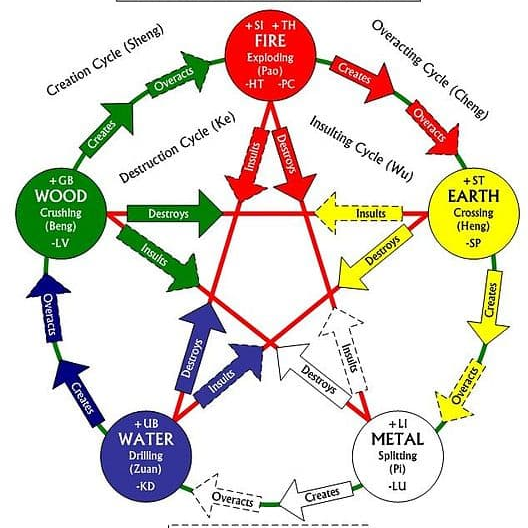
The five elements in BaZi — Wood, Fire, Earth, Metal, and Water — are not physical substances. They are energetic patterns that describe how forces interact, grow, and regulate each other. In Chinese astrology, five elements form the core framework for understanding personality and life patterns. Think of them as personality archetypes rather than materials. If you want a deeper breakdown of what each element stands for on its own, our guide on the wood fire earth metal water meaning walks through every element in detail.
In Chinese philosophy, this system is called Wu Xing (五行), and it has been used for over 2,000 years to explain patterns in nature, health, and human behavior (Wikipedia: Wu Xing). In BaZi specifically, the five elements form the DNA of your chart. Every character in your Four Pillars maps to one of these five forces.
The Five Elements at a Glance
| Element | Core Quality | Personality Expression | Season |
|---|---|---|---|
| Wood | Growth | Purpose-driven, creative, ambitious | Spring |
| Fire | Expression | Warm, visible, passionate | Summer |
| Earth | Stability | Grounded, nurturing, reliable | Late Summer |
| Metal | Structure | Disciplined, principled, precise | Autumn |
| Water | Wisdom | Flexible, strategic, insightful | Winter |
Yin and Yang: Ten Archetypes, Not Five
Each element splits into Yin and Yang expressions, giving you 10 distinct archetypes. Yang Fire (丙) is bold, visible, and leadership-driven. Yin Fire (丁) is subtle, intuitive, and strategically warm. These distinctions matter when reading personality patterns in your chart.
The 10 Heavenly Stems are:
| Stem | Element | Polarity | Archetype |
|---|---|---|---|
| 甲 Jiǎ | Wood | Yang | The Pioneer |
| 乙 Yǐ | Wood | Yin | The Diplomat |
| 丙 Bǐng | Fire | Yang | The Leader |
| 丁 Dīng | Fire | Yin | The Strategist |
| 戊 Wù | Earth | Yang | The Builder |
| 己 Jǐ | Earth | Yin | The Nurturer |
| 庚 Gēng | Metal | Yang | The Warrior |
| 辛 Xīn | Metal | Yin | The Refiner |
| 壬 Rén | Water | Yang | The Visionary |
| 癸 Guǐ | Water | Yin | The Sage |
The Production and Control Cycles
The five elements do not exist in isolation. They interact through two fundamental cycles:
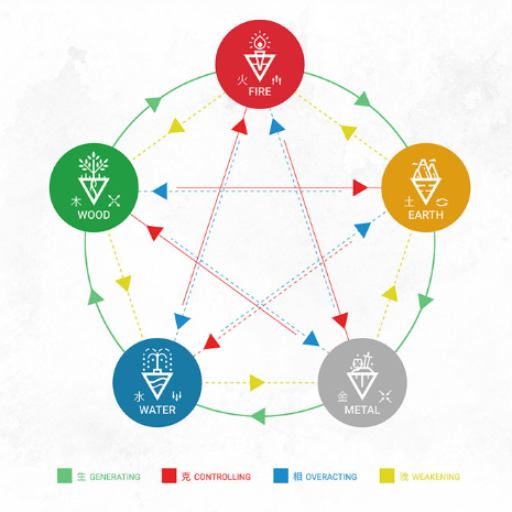
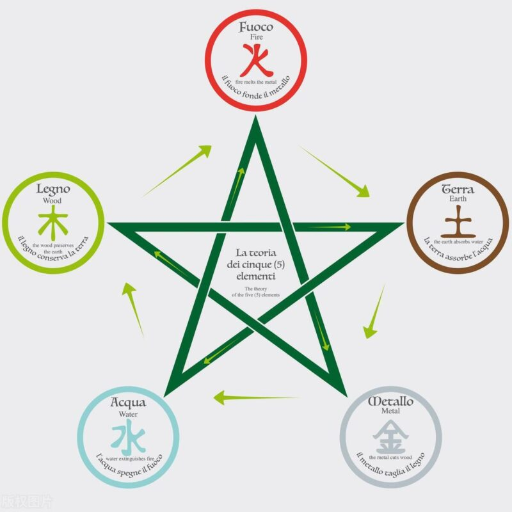
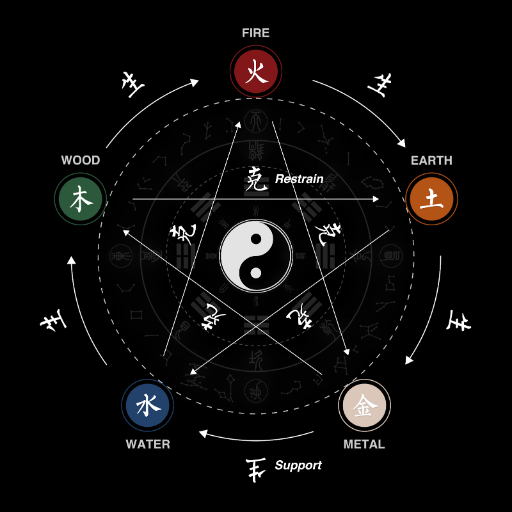
Production Cycle (Sheng): Wood feeds Fire, Fire creates Earth (ash), Earth bears Metal (minerals), Metal collects Water (condensation), Water nourishes Wood. This is the cycle of support and growth.
Control Cycle (Ke): Wood penetrates Earth (roots), Earth dams Water, Water extinguishes Fire, Fire melts Metal, Metal chops Wood. This is the cycle of regulation and restraint.
Understanding these cycles is essential for five elements balance in BaZi. When one element is excessive, the element that controls it provides natural regulation. When one element is weak, the element that produces it can strengthen it. This Wu Xing BaZi framework is the foundation of all element analysis.
How to Read Element Balance in Your Chart
This is the section most guides skip. They describe what the elements mean but never show you how to actually count them in a chart. Here’s the counting method for five elements balance in BaZi. Once you’ve tallied your elements, you can determine whether you have a dominant element or a weak element that needs attention.
Step 1: List All 8 Characters
Your BaZi chart has four pillars — Year, Month, Day, and Hour. Each pillar contains a Heavenly Stem on top and an Earthly Branch below. That gives you 8 visible characters.
For example, a chart might look like:
| Year | Month | Day | Hour | |
|---|---|---|---|---|
| Stem | 甲 (Yang Wood) | 丙 (Yang Fire) | 庚 (Yang Metal) | 壬 (Yang Water) |
| Branch | 寅 (Tiger) | 午 (Horse) | 申 (Monkey) | 子 (Rat) |
Step 2: Translate Each to Its Element
Map each visible character to its element:
- 甲 = Wood, 丙 = Fire, 庚 = Metal, 壬 = Water
- 寅 = Wood, 午 = Fire, 申 = Metal, 子 = Water
So far: Wood 2, Fire 2, Metal 2, Water 2, Earth 0.
Step 3: Count Hidden Stems Inside Each Branch
This is where most beginners stop — and where most guides stop teaching. Each Earthly Branch contains 1 to 3 hidden elements called “hidden stems.” These represent deeper layers of elemental energy in your chart.
| Branch | Hidden Stems | Elements |
|---|---|---|
| 子 (Rat) | 癸 | Water |
| 丑 (Ox) | 己, 癸, 辛 | Earth, Water, Metal |
| 寅 (Tiger) | 甲, 丙, 戊 | Wood, Fire, Earth |
| 卯 (Rabbit) | 乙 | Wood |
| 辰 (Dragon) | 戊, 乙, 癸 | Earth, Wood, Water |
| 巳 (Snake) | 丙, 庚, 戊 | Fire, Metal, Earth |
| 午 (Horse) | 丁, 己 | Fire, Earth |
| 未 (Goat) | 己, 丁, 乙 | Earth, Fire, Wood |
| 申 (Monkey) | 庚, 壬, 戊 | Metal, Water, Earth |
| 酉 (Rooster) | 辛 | Metal |
| 戌 (Dog) | 戊, 辛, 丁 | Earth, Metal, Fire |
| 亥 (Pig) | 壬, 甲 | Water, Wood |
Using the sample chart above:
- 寅 (Tiger) hides: Wood, Fire, Earth
- 午 (Horse) hides: Fire, Earth
- 申 (Monkey) hides: Metal, Water, Earth
- 子 (Rat) hides: Water
Hidden stem totals: Wood 1, Fire 2, Earth 3, Metal 1, Water 2.
Step 4: Tally the Totals
Combine visible and hidden elements:
| Element | Visible | Hidden | Total |
|---|---|---|---|
| Wood | 2 | 1 | 3 |
| Fire | 2 | 2 | 4 |
| Earth | 0 | 3 | 3 |
| Metal | 2 | 1 | 3 |
| Water | 2 | 2 | 4 |
In this sample chart, Fire and Water are the strongest elements (4 each), while Wood, Earth, and Metal are balanced at 3 each. Earth appears zero times in the visible characters but has significant hidden presence.
Step 5: Factor in Seasonal Strength
Your birth month affects element strength. A chart born in summer (Fire season) gives Fire an additional 30-50% boost beyond its raw count. A chart born in winter (Water season) strengthens Water the same way.
This matters because a “balanced” count can become imbalanced once seasonal support is factored in.
Step 6: Identify Dominant, Weak, and Missing Elements
Based on the tally:
- Dominant: An element appearing in 3 or more of the 8 visible characters (or 5+ total with hidden stems)
- Weak: An element appearing in only 1 visible character
- Missing: An element with zero visible characters (it may still exist in hidden stems)
If your count points to one force taking over your chart, our guide on the dominant element bazi shows you exactly how to interpret that pattern. And when the tally reveals a force that barely registers, our breakdown of the weak element bazi explains what that thin presence means for you.
Want to skip the manual counting? Generate your free BaZi chart and the calculator will map your element distribution instantly.
What Element Balance Means for Your Day Master
Here’s the insight that separates beginners from intermediate practitioners: element balance isn’t universal. It’s relative to your Day Master.
Your Day Master is the Heavenly Stem of your Day Pillar. It represents you: your core identity, your default mode of operating. Everything else in the chart is read in relation to this element.
Favorable vs. Unfavorable Elements
Not all missing elements are problems. Not all dominant elements are strengths. Whether an element helps or hurts depends on its relationship to your Day Master.
If your Day Master is weak (born out of season, lacking support), then elements that produce or support your Day Master are favorable. Elements that drain or control your Day Master are unfavorable.
If your Day Master is strong (born in season, well-supported), then elements that drain or control your Day Master become favorable — they provide necessary regulation.
The Useful God (Yong Shen) Concept
Classical BaZi uses the term “Yong Shen” (用神) — the Useful God — to describe the single element your chart needs most for harmony. This is the element that balances your chart’s specific configuration.
Finding your Yong Shen is the key to understanding which elements to strengthen and which to leave alone.
When Missing Is Actually Good
When Alex got his first BaZi reading, he was alarmed to see that his chart had zero visible Fire. A popular blog post told him this meant “lack of passion and visibility.” But Alex’s Day Master was weak Water, born in winter. Fire was his Wealth element — the element that drains Water. Adding Fire to his chart would have weakened him further, not strengthened him.
The missing Fire was not a flaw. It was protection. His chart was doing exactly what it needed to do.
This is why generic “missing element = problem” advice is misleading. You need to know whether that missing element is favorable or unfavorable for your specific Day Master before deciding whether to address it. Learn more in our guides on (what missing elements mean) .
The Five Elements: Complete Balance Profiles
Each element expresses differently depending on whether it is balanced, excessive, or weak in your chart. Here is what each pattern looks like in practice.
Wood — Growth and Vision
Balanced Wood: You are purpose-driven, resilient, and creative. You set long-term goals and pursue them with patience. You adapt to obstacles without losing direction. People see you as someone with vision.
Excessive Wood: You become rigid, impatient, and forceful. You push too hard, too fast. You may struggle with anger or frustration when things do not move at your pace. Relationships suffer because you dominate rather than collaborate.
Weak or Missing Wood: You lack direction. Starting projects feels overwhelming. You may cycle through interests without committing. Decision-making stalls because you cannot see a clear path forward.
Fire — Expression and Passion
Balanced Fire: You are warm, inspiring, and naturally visible. You communicate clearly and energize the people around you. Leadership comes naturally because others are drawn to your confidence.
Excessive Fire: You burn out. You become impulsive, dramatic, and reactive. You may seek attention in unhealthy ways or make decisions based on emotion rather than logic. Your energy scatters across too many projects.
Weak or Missing Fire: You struggle to express yourself. You may feel invisible or overlooked. Social situations drain you. You have ideas but lack the force to communicate them effectively.
Earth — Stability and Nurturing
Balanced Earth: You are grounded, trustworthy, and patient. People rely on you because you are consistent. You create stability in chaotic environments. You nurture others without losing yourself.
Excessive Earth: You become stubborn, resistant to change, and heavy. You over-commit to routines and miss opportunities that require flexibility. You may take on too much responsibility for others.
Weak or Missing Earth: You feel scattered and insecure. Commitment is difficult. You may change jobs, relationships, or locations frequently without building lasting foundations. Emotional stability is a constant challenge.
Metal — Structure and Precision
Balanced Metal: You are disciplined, clear, and principled. You set boundaries easily. You value quality over quantity. Your thinking is sharp and your standards are high.
Excessive Metal: You become harsh, critical, and inflexible. You judge yourself and others too rigidly. Perfectionism blocks progress. Relationships suffer because you cannot bend.
Weak or Missing Metal: You lack boundaries. You may be vague, inconsistent, or unable to say no. Your standards drop, and you accept less than you deserve. Structure feels suffocating rather than supporting.
Water — Wisdom and Adaptability
Balanced Water: You are flexible, insightful, and resourceful. You read situations quickly and adapt your approach. You think strategically and find solutions others miss.
Excessive Water: You become indecisive, evasive, and emotionally flooded. You overthink everything. Fear and anxiety replace clarity. You may manipulate situations rather than face them directly.
Weak or Missing Water: You are rigid and disconnected from your intuition. You rely too heavily on logic and miss the emotional currents around you. Adaptability is low. You may struggle in unfamiliar environments.
For a deeper look at how elements shape personality, see our (Five Elements personality guide).
When Elements Are Excessive
Most guides focus on missing elements. But excessive elements deserve equal attention. When one element dominates your chart, it creates specific patterns that can be just as limiting as a missing element. Our detailed guide on (element excess in BaZi) covers the full range of excessive element patterns and their effects.
What “Too Much” Looks Like
An element is excessive when it appears in 4 or more of the 8 visible characters, or when it receives heavy seasonal support on top of a strong count. The personality patterns described above under “Excessive” for each element become pronounced.
The Control Cycle as Natural Regulation
The Ke (control) cycle provides natural balance. If your chart has excessive Fire, the Water element in your chart (or introduced through timing, environment, or career) naturally moderates it. Metal controls Wood. Wood controls Earth. The system has built-in self-regulation.
The problem arises when the controlling element is also weak or missing. In that case, the excessive element runs unchecked.
Special Patterns: When Balance Rules Break
Some charts do not follow normal balance rules at all.
Follower Structure (Cong Ge): Your Day Master is extremely weak and surrounded by a single overwhelming force. Instead of fighting the dominant element, your Day Master “follows” it. In this case, strengthening your Day Master would actually harm you. You need to go with the dominant flow.
Dominant Structure (专旺格): One element is so overwhelmingly strong that it dominates the entire chart. Normal balance remedies do not apply. You work with the dominant element, not against it.
These special structures appear in roughly 5-10% of all BaZi charts. If standard balance advice does not seem to work for you, a special structure might be the reason.
When Lisa had her chart analyzed, she discovered excessive Metal cutting her weak Wood. She’d spent 12 years in corporate finance — a Metal-heavy career — and felt creatively blocked and constantly critical of herself. Her chart was screaming for Wood energy: creativity, growth, flexibility.
She transitioned to product design, and within a year, her energy and satisfaction shifted dramatically. The excessive Metal wasn’t the problem. The lack of Wood was.
Practical Ways to Balance Your Elements
Once you know your element distribution and which elements are favorable for your Day Master, you can apply five elements balance strategies across multiple areas of life. For a comprehensive list of practical remedies, see our (BaZi element remedies guide).
Career Alignment
Your career environment carries elemental energy. Working in an industry aligned with your favorable elements supports your chart naturally.
| Element | Aligned Industries |
|---|---|
| Wood | Education, publishing, fashion, design, agriculture, startups |
| Fire | Media, entertainment, technology, energy, marketing, public speaking |
| Earth | Real estate, construction, agriculture, HR, management, mining |
| Metal | Finance, law, engineering, automotive, military, precision manufacturing |
| Water | Logistics, shipping, travel, import/export, consulting, research |
If your chart needs more Water energy, a career in logistics, consulting, or international trade naturally introduces that element into your daily life.
If you’re not sure which field fits your chart best, our guide on choosing your (bazi career element) breaks down how to match your favorable element to the right line of work.
Daily Routines and Activities
- Need Wood? Spend time in nature, take up gardening, practice creative arts, read and learn continuously
- Need Fire? Increase social interaction, take on leadership roles, practice public speaking, exercise in the morning
- Need Earth? Establish routines, cook at home, practice mindfulness, organize your physical space
- Need Metal? Declutter, set clear boundaries, practice martial arts or structured fitness, refine your skills
- Need Water? Meditate, swim, travel to new places, study philosophy or strategy, spend time near water
Environment: Colors, Directions, and Shapes
Classical Feng Shui provides a quick-reference system for element balance:
| Element | Colors | Directions | Shapes |
|---|---|---|---|
| Wood | Green, teal | East, Southeast | Rectangular, tall |
| Fire | Red, orange, purple | South | Triangular, pointed |
| Earth | Yellow, brown, beige | Center, Southwest, Northeast | Square, flat |
| Metal | White, silver, gold | West, Northwest | Round, dome |
| Water | Black, dark blue | North | Wavy, irregular |
Surrounding yourself with the colors, shapes, and directional orientations of your favorable elements creates a supportive environment.
Social Connections
The people around you carry elemental energy too. If your chart needs more Earth, spending time with Earth-dominant people (grounded, stable, reliable) naturally supports you. This is not mysticism — it is about behavioral patterns and energy alignment.
Timing: Luck Pillars and Annual Cycles
Your Luck Pillars explain how temporary elemental energy layers onto your chart. A 10-year period dominated by your favorable element creates opportunities. A period dominated by your unfavorable element creates challenges.
This is where BaZi becomes a timing tool. You cannot change your natal chart, but you can align your actions with the elemental energy of your current Luck Pillar and annual cycles.
When NOT to Balance
This is the section most guides will never include. They assume balance is always the goal. It’s not.
If your chart is a Follower Structure, adding the “missing” element can disrupt the flow your Day Master needs. If a missing element is unfavorable for your Day Master, its absence is doing you a favor.
Sam learned this the hard way. He read online that missing Fire in his chart meant “low energy and invisibility.” So he spent two years forcing himself into high-visibility leadership roles, wearing red, and orienting his desk south. His anxiety skyrocketed.
What he didn’t know was that Fire was his Output element — the element that drains weak Water. His chart needed to conserve energy, not burn it. Once he stopped chasing Fire and leaned into his natural Water strengths (strategy, research, adaptability), his career stabilized.
The lesson: balance is functional, not numerical. A chart that looks “imbalanced” on paper might be perfectly configured for your specific Day Master.
Element Balance and Relationships
The five elements also shape how you interact with other people. Understanding element dynamics helps you communicate better, avoid unnecessary conflict, and build stronger connections. For a full analysis of how elements affect compatibility, see our (element compatibility bazi guide).
Production Cycle Pairings
Relationships where one person’s dominant element produces the other’s tend to be supportive. A Wood-dominant person naturally energizes a Fire-dominant person. An Earth-dominant person grounds a Metal-dominant person. These pairings feel easy and nourishing.
Control Cycle Tensions
Relationships where one person’s dominant element controls the other’s create tension — but also growth. A Metal-dominant person may feel critical of a Wood-dominant person’s lack of structure. A Water-dominant person may frustrate a Fire-dominant person with their indecisiveness.
These dynamics are not deal-breakers. They are awareness tools. When you understand why you clash with someone, you can adjust your approach instead of blaming personality.
Element Balance and Health
Traditional Chinese Medicine (TCM) maps each element to specific organ systems (NIH: Traditional Chinese Medicine). While BaZi is not a medical diagnostic tool, understanding these correlations can support proactive wellness decisions. Our (BaZi element health guide) explores these connections in depth.
| Element | Organs | Imbalance Signs |
|---|---|---|
| Wood | Liver, Gallbladder | Tension, headaches, eye strain, irritability |
| Fire | Heart, Small Intestine | Anxiety, insomnia, palpitations, circulation issues |
| Earth | Spleen, Stomach | Digestive problems, fatigue, worry, weight fluctuation |
| Metal | Lungs, Large Intestine | Respiratory issues, skin problems, grief, rigidity |
| Water | Kidneys, Bladder | Lower back pain, fear, fatigue, hormonal imbalances |
If your chart shows excessive Wood, paying attention to liver health and stress management makes sense. If Water is weak, kidney support through hydration, rest, and warming foods may help.
These are preventive strategies, not prescriptions. Use them alongside professional medical advice.
FAQ: Five Elements Balance Questions Answered
What are the five elements in BaZi?
The five elements are Wood, Fire, Earth, Metal, and Water. They are energetic patterns from Chinese philosophy (Wu Xing) that describe how forces interact in nature and in your BaZi chart. Each element represents a set of personality traits, behaviors, and life dynamics.
How do I find my dominant element?
Count the elements across all 8 visible characters (4 Heavenly Stems + 4 Earthly Branches) and their hidden stems. The element with the highest count is your dominant element.
What if an element is missing from my chart?
A missing visible element doesn’t necessarily mean a problem. It may still exist in hidden stems. More importantly, if the missing element is unfavorable for your Day Master, its absence can actually support your chart’s balance. Always check whether the element is favorable or unfavorable before trying to “fix” it.
Can you change your element balance?
Your natal chart is fixed, but you can influence your elemental environment through career choices, daily routines, colors, directions, social connections, and timing with Luck Pillars. You’re not changing the chart — you’re aligning your life with it.
Which element is best for career?
There is no universally “best” element. The best element for your career is the one your chart needs — your favorable element or Yong Shen. A Wood Day Master benefits from Water (Resource) and Wood (Companion) energy in their career environment.
How accurate is element analysis?
Element analysis is based on structured time-calculation systems refined over 1,000+ years. Accuracy depends on correct birth data and proper interpretation. The counting methodology in this guide produces consistent, verifiable results.
Does my element balance change over time?
Your natal chart is permanent, but Luck Pillars and annual cycles layer temporary elemental energy on top of it. That’s why your luck and circumstances shift over time even though your birth chart stays the same.
Is a balanced chart always better?
No. Special structures like Follower and Dominant patterns thrive on apparent imbalance. A chart that looks “unbalanced” on paper may be perfectly configured for its Day Master. Balance is about function, not symmetry.
Your Next Step
The five elements are not abstract concepts. They are measurable forces in your chart that shape how you think, decide, and respond to the world.
Start by knowing your numbers. Generate your free BaZi chart and count your elements using the five elements balance method in this guide. Identify your dominant element. Check which elements are missing. Then ask the critical question: does this balance serve my Day Master?
Your blueprint already exists. The five elements are the language it is written in. Once you learn to read them, the patterns become clear — and the decisions get easier.