


The five elements bazi system uses Wood Fire Earth Metal Water as energetic patterns which create your personality and shape your behavior and determine your life outcomes. Your Four Pillars chart shows each element through its Yin (receptive) and Yang (active) forms. You can practice BaZi theory to gain self-knowledge through your chart which shows your dominant elements and missing elements.
People use unclear terms to explain their personality. “I am creative.” “I am analytical.”These words mean something, but they do not explain how you operate.
BaZi offers something more precise.
Your chart contains a measurable elemental blueprint. Your chart shows your identity together with your cognitive processes and decision-making methods and stress response patterns. Your strengths become clear to you once you learn to read it.
The guide explains what elements represent their relationships and how to interpret your chart’s element distribution. If you have not generated your chart yet, use our free BaZi calculator first, then follow along.
For a complete foundation on what these eight characters represent, see our (complete guide to Four Pillars of Destiny).
Key Takeaways
- The Five Elements in BaZi (Wood Fire Earth Metal Water) represent energetic patterns that operate through Yin and Yang to generate different character traits.
- Your chart shows three main elements which include your primary element and your absent element to show your inherent traits and your hidden weaknesses.
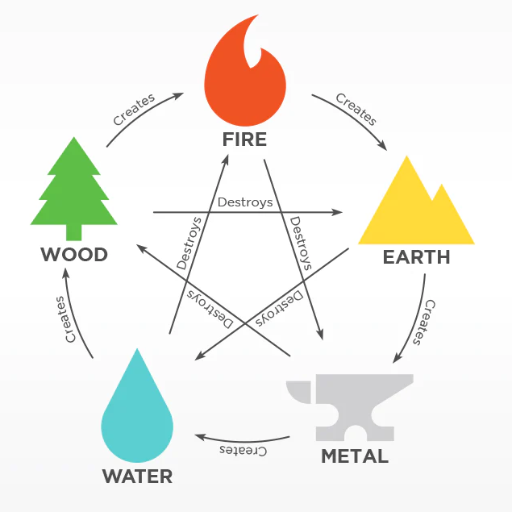
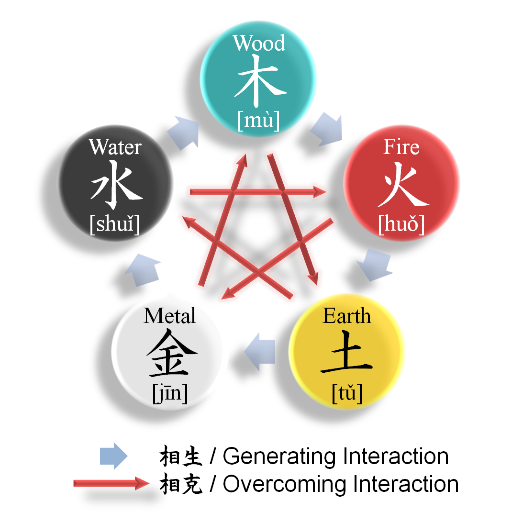
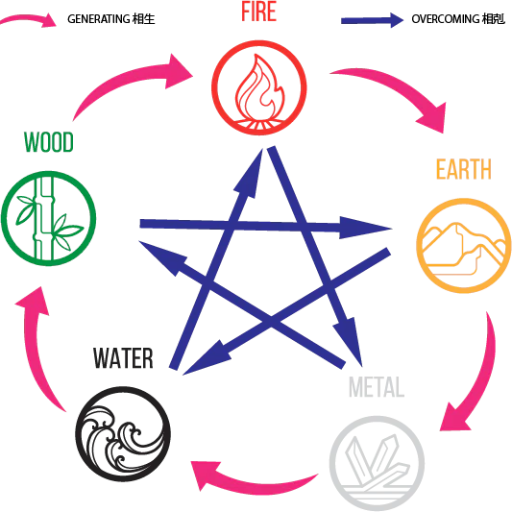
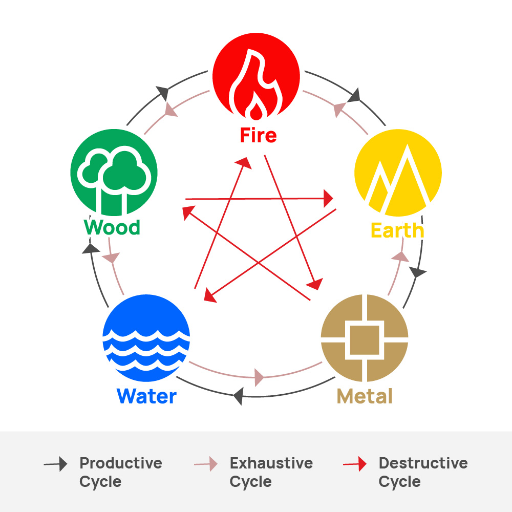
- The Production Cycle shows how elements support each other through their sequence which starts with Wood creating Fire and continues until Water creates Wood.
- The Control Cycle shows how elements regulate each other through their sequence which starts with Wood controlling Earth and ends with Metal controlling Wood.
- Your Day Master requires specific elements which you should avoid because they will not support your needs.
What the Five Elements Actually Are
The Five Elements (Wu Xing, 五行) are not literal. They are not wood you burn or water you drink.
They are patterns of energy. Each one describes a specific way that force moves, interacts, and expresses itself in a person.
- Wood expands upward and outward. It is growth, vision, and initiative.
- Fire radiates. It is expression, passion, and visibility.
- Earth anchors. It is stability, nurturing, and reliability.
- Metal concentrates. It is structure, precision, and discipline.
- Water descends and flows. It is wisdom, adaptability, and depth.
Each element has two faces. Yang is active, outgoing, and assertive. Yin is receptive, internal, and responsive. Yang Wood is a towering tree. Yin Wood is a vine. Both are Wood, but they behave differently.
This means there are not five personality types. There are ten.
Alex maintained that his planning abilities showed significant weakness. He spent several years which he dedicated to self-blame. He tested all available productivity systems together with every planner and every app. He found nothing which would help him. The BaZi chart showed clear evidence that his eight characters displayed almost total Water and Metal elements while Earth elements remained absent.
Earth functions as the element that brings about order and scheduled activities while providing a stable foundation. Alex demonstrated planning abilities which exceeded ordinary skills. His chart needed specific elemental elements which would create a natural planning experience. Rigid systems stopped working for him after he learned about this system. He created adaptable routines which matched his Water-dominant design. His productivity rate experienced a twofold increase.
Reading your element distribution shows you power in understanding your work pattern. The reading shows you your work style instead of showing you whom you must become.
DeepOracle and other modern practitioners have established data-driven frameworks which link elemental patterns to specific personality profiles. These frameworks validate the ancient personality descriptions which traditional texts have documented for centuries.
For the building blocks that make up your chart, explore our guide to (Heavenly Stems and Earthly Branches).
The Five Elements: Complete Profile
Here is what each element looks like in its balanced, excessive, and weak states.
Wood (Growth and Vision)
Yang Wood (Jia, 甲): Like a towering tree. Principled, visionary, structured, and upright. Yang Wood people build things from the ground up. They need long-term goals and visible progress.
Yin Wood (Yi, 乙): Like a vine or flower. Adaptive, diplomatic, creative, and timing-driven. Yin Wood people excel at reading the room and finding elegant paths around obstacles.
| State | Expression |
|---|---|
| Balanced | Purpose-driven, resilient, growth-oriented, compassionate |
| Excessive | Rigid, impatient, forceful, stubborn, scattered |
| Weak/Missing | Indecisive, stagnant, lacking direction, frustrated |
Career alignment: Education, design, healthcare, startups, environmental work, strategic planning.
Fire (Expression and Passion)
Yang Fire (Bing, 丙): Like the sun. Bold, generous, charismatic, and far-reaching. Yang Fire people light up rooms. They thrive on recognition and purpose.
Yin Fire (Ding, 丁): Like a candle. Refined, subtle, persuasive, and quietly influential. Yin Fire people connect deeply one-on-one. Their warmth is intimate, not broadcast.
| State | Expression |
|---|---|
| Balanced | Warm, inspiring, visible, enthusiastic |
| Excessive | Burnout-prone, impulsive, dramatic, ego-driven |
| Weak/Missing | Low energy, guarded, flat affect, hard to motivate |
Career alignment: Marketing, media, leadership, technology, hospitality, coaching, performance.
Earth (Stability and Nurturing)
Yang Earth (Wu, 戊): Like a mountain. Steady, dependable, resilient, and protective. Yang Earth people are the backbone of any team. They do not flinch under pressure.
Yin Earth (Ji, 己): Like fertile soil. Caring, empathetic, adaptable, and detail-oriented. Yin Earth people nurture relationships and environments. They notice what others miss.
| State | Expression |
|---|---|
| Balanced | Grounded, trustworthy, patient, practical |
| Excessive | Stubborn, resistant to change, heavy, prone to worry |
| Weak/Missing | Scattered, insecure, unanchored, unstable |
Career alignment: Real estate, HR, accounting, government, logistics, wellness, nutrition.
Metal (Structure and Precision)
Yang Metal (Geng, 庚): Like a sword. Decisive, competitive, just, and direct. Yang Metal people cut through complexity. They value fairness and clarity above all.
Yin Metal (Xin, 辛): Like a jewel. Elegant, strategic, refined, and poised. Yin Metal people excel at precision work. They bring aesthetic sensibility to everything they touch.
| State | Expression |
|---|---|
| Balanced | Disciplined, clear, principled, organized |
| Excessive | Harsh, critical, inflexible, emotionally cold |
| Weak/Missing | Vague, inconsistent, poor boundaries, indecisive |
Career alignment: Finance, law, engineering, surgery, data analysis, editing, quality assurance.
Water (Wisdom and Adaptability)
Yang Water (Ren, 壬): Like the ocean. Ambitious, independent, broad, and deep. Yang Water people think in systems. They see patterns others miss.
Yin Water (Gui, 癸): Like mist or rain. Perceptive, intuitive, graceful, and subtle. Yin Water people process information deeply. They read between the lines effortlessly.
| State | Expression |
|---|---|
| Balanced | Flexible, insightful, resourceful, strategic |
| Excessive | Indecisive, evasive, emotionally flooded, overthinking |
| Weak/Missing | Rigid, disconnected, dry in expression, stuck |
Career alignment: Consulting, research, writing, diplomacy, logistics, therapy, intelligence analysis.
How the Five Elements Interact
No element exists in isolation. Their power comes from how they relate to each other.
The Production Cycle (Sheng)
This is the cycle of nourishment and support:
Wood produces Fire. Fire produces Earth. Earth produces Metal. Metal produces Water. Water produces Wood.
Think of it as a relay. Each element fuels the next. When this cycle flows smoothly in your chart, you experience natural momentum. Wood-dominant people who also have strong Fire find that their ideas translate into action easily.
The Control Cycle (Ke)
This is the cycle of regulation and balance:
Wood controls Earth. Earth controls Water. Water controls Fire. Fire controls Metal. Metal controls Wood.
Control is not destruction. It is necessary discipline. Without Metal to control it, Wood grows wild and unstructured. Without Water to control it, Fire burns out.
Lisa’s chart told this story perfectly. She was a Wood-dominant creative who had spent five years in corporate finance, a Metal-heavy environment. Metal controls Wood, and the control was excessive. Every idea she proposed was analyzed, critiqued, and delayed. She blamed herself for feeling stifled. Her chart revealed the truth: the environment was structurally incompatible with her elemental design. When she moved into a design role at a startup, her creativity returned within months.
The Weakening Cycle
When an element produces another, it loses some of its own energy. Wood weakens itself by feeding Fire. Fire weakens itself by creating Earth. This helps explain why an apparently strong element may still feel ineffective; it might be spending all its energy supporting something else.
How to Read Element Balance in Your Chart
Knowing what the elements mean is only half the work. The other half is learning to count them in your own chart.
Here is the method.
Step 1: List All Eight Characters
Your BaZi chart contains four pillars. Each pillar has one Heavenly Stem (top) and one Earthly Branch (bottom). That is eight characters total.
Step 2: Translate Each Character to Its Element
Use this reference:
| Element | Heavenly Stems | Earthly Branches |
|---|---|---|
| Wood | Jia (甲), Yi (乙) | Yin (寅), Mao (卯) |
| Fire | Bing (丙), Ding (丁) | Si (巳), Wu (午) |
| Earth | Wu (戊), Ji (己) | Chen (辰), Xu (戌), Chou (丑), Wei (未) |
| Metal | Geng (庚), Xin (辛) | Shen (申), You (酉) |
| Water | Ren (壬), Gui (癸) | Zi (子), Hai (亥) |
Step 3: Count Hidden Stems
Each Earthly Branch contains one to three hidden elements. These are not visible at first glance, but they count. For example, the Tiger (Yin, 寅) branch contains Jia Wood, Bing Fire, and Wu Earth.
Step 4: Tally the Totals
Count every element appearance across all stems, branches, and hidden stems. A typical chart might look like this:
| Element | Visible | Hidden | Total |
|---|---|---|---|
| Wood | 2 | 1 | 3 |
| Fire | 1 | 2 | 3 |
| Earth | 1 | 2 | 3 |
| Metal | 2 | 1 | 3 |
| Water | 2 | 2 | 4 |
Step 5: Identify Patterns
- Dominant element: The highest total. This shapes your default tendencies.
- Missing element: Zero total. This creates a blind spot.
- Weak element: One or two total. This is present but underdeveloped.
- Excessive element: Six or more total. This can overwhelm the chart.
What Element Balance Means for You
The guide provides an explanation of element meanings and element counting methods but it fails to direct users on how to utilize those details.
This section does.
Dominant Element: Your Natural Tendency
Your dominant element shows your most natural behavior. People will first perceive your automatic responses which exist as your most fundamental form of being.
A Water-dominant person processes information before acting. A Fire-dominant person acts before processing. Both procedures operate correctly. Your dominant element identification enables you to comprehend why specific activities require no effort while other tasks become exhausting.
Missing Element: Your Blind Spot (Not Always Bad)
A missing element gets attention, but it is not automatically a problem.
The critical question is whether that missing element is favorable or unfavorable for your specific Day Master. If your Day Master is weak Water and Fire is missing, Fire might actually be welcome warmth. But if your Day Master is strong Wood and Metal is missing, that absence might be exactly what keeps your chart healthy.
Sam discovered this the hard way. His chart was “missing” Fire, and he spent a year trying to “fix” it through red clothing, southern-facing workspaces, and passion-project scheduling. Nothing improved. When he consulted a proper reading, he learned that Fire was actually unfavorable for his weak Water Day Master. The missing element was not a bug. It was a feature. He stopped fighting his chart and focused on strengthening his actual favorable element instead.
To understand which elements are favorable for you, read our detailed (day master bazi) guide.
Excessive Element: Your Potential Imbalance
An excessive element creates the opposite problem. Too much Fire burns out. Too much Metal becomes rigid. Too much Water floods everything else out.
The solution is usually not to eliminate the excessive element. It is to introduce its controlling element. Excessive Fire benefits from Water. Excessive Wood benefits from Metal. The Control Cycle is your tool for restoring balance.
Practical Ways to Balance Your Elements
Once you know your element distribution, you can make targeted adjustments.
Career and Work Environment
Align your work with your elemental needs, not just your skills. Nova Masters Consulting provides detailed career-path mapping by element, showing how specific industries either amplify or deplete your natural energy.
- Need more Wood? Seek roles with growth potential, autonomy, and creative output. Avoid stagnant hierarchies.
- Need more Fire? Choose visible, dynamic environments. Marketing, leadership, and performance roles feed Fire.
- Need more Earth? Prioritize stability, clear routines, and supportive teams. Avoid chaotic startup environments.
- Need more Metal? Look for structured systems, measurable outcomes, and high standards. Ambiguity drains you.
- Need more Water? Find work with variety, intellectual depth, and strategic scope. Repetition kills your energy.
BaZi career analysis is best used as a framework for self-reflection. It helps you understand where you naturally shine and what environments might drain you. For a deeper exploration of timing your career moves, see our (Bazi Career Analysis Guide).
Daily Routines and Lifestyle
Small habits shift elemental energy over time. Divineway explores the deeper lifestyle and wellness connections between the Five Elements and daily practice, including TCM-inspired routines that support long-term balance.
| Element | Activities | Colors | Directions |
|---|---|---|---|
| Wood | Gardening, hiking, creative writing, early mornings | Green | East |
| Fire | Social events, public speaking, passion projects | Red, purple | South |
| Earth | Cooking, organizing, meditation, routines | Yellow, brown | Center |
| Metal | Structured planning, breathing exercises, precision crafts | White, gold, silver | West |
| Water | Swimming, journaling, meditation, travel | Black, blue | North |
Social Environment
Surround yourself with people whose elemental strengths complement yours. A Fire-dominant person benefits from Earth friends who ground their intensity. A Metal-dominant person benefits from Water friends who add flexibility to their rigidity.
When NOT to Balance
The most important rule: do not balance blindly. If a missing element is unfavorable for your Day Master, leave it absent. Forcing balance where none is needed creates problems, not solutions.
Frequently Asked Questions
What are the five elements in BaZi?
The five elements of BaZi include Wood Fire Earth Metal and Water which exist as energetic patterns that do not require physical existence. Your Four Pillars chart displays both elements which manifest through their Yin and Yang forms and these elements determine your personality traits and life patterns.
What should I do when my BaZi chart lacks an element?
A missing element is not always bad. Your Day Master requires supplementation only when you want to make it better. You can make the missing element stronger by using your career choices and daily routines and environmental factors. The missing element brings you benefits because you need to avoid the complete element presence.
How do the five elements interact?
The Five Elements interact through three cycles. The Production Cycle demonstrates how Wood produces Fire which in turn generates Earth that creates Metal to produce Water which results in Wood production. The Control Cycle demonstrates how Wood controls Earth which Earth controls Water that Water controls Fire, which Fire controls Metal and Metal controls Wood. The Weakening Cycle demonstrates how one element leaks its energy to produce another element.
What happens when one element dominates all others in a system?
The presence of an excessive element in your chart creates a strong effect which makes all negative aspects of that element more visible. The excessive presence of Fire leads to people experiencing both exhaustion and sudden behavioral changes. The excessive presence of Metal leads people to develop extreme behaviors which include both inflexible thinking and harsh treatment of others. The solution requires you to use the element which controls your excessive element instead of trying to remove it.
How do I balance my BaZi elements?
Start by counting your element distribution using the method in this guide. Your dominant element needs to be identified together with your weak element and your missing element.
Can you change your element balance?
The natal chart remains unchanged because it establishes your elemental balance at birth. Your elemental energy interactions depend on your choices which enable you to control their manifestation. Your daily life expressions of chart energy become active through your career path and environmental conditions and your daily routines and social connections.
Conclusion
Your personality is not random. It is elemental.
The five elements bazi system provides you with a language to understand your authentic nature. Wood expands. Fire radiates. Earth anchors. Metal structures. Water flows. Every element in your chart performs a function, and no single element is superior to the others.
The goal is not perfection. The goal is awareness.
Your chart elements show you which ones control your behavior. Your blind spots become clear when you identify the elements that are absent. Your understanding of their interaction helps you identify which environments bring you energy and which ones exhaust you.
Your chart is not a prison. It is a map.
Ready to see your own elemental blueprint?
Generate your free BaZi chart now and discover which elements shape your decisions.
Your pattern is already there. You just need to read it.