


Your personality is elemental.
The Five Elements, formally the Wu Xing (五行), make up the categories in your chart in ba zi (八字) Chinese astrology. Wood, Fire, Earth, Metal, and Water denote how energy moves through your life and not which fate you get slapped with. Each element looks into your chart with varying power, polarity, and role. They together explain why you act, react, or grow like you do.
This guide is for anyone looking for a clearer path and clarity rather than any mystery. Beyond, one is left wondering the implications of each element, how they interact with each other, and how to demonstrate which elements are dominant and missing in their own chart and latter be brought into balance.
Getting your free chart first would be nice if you haven’t, so you can visually place your own elements through the forthcoming instructions.
What the Five Elements Are in BaZi
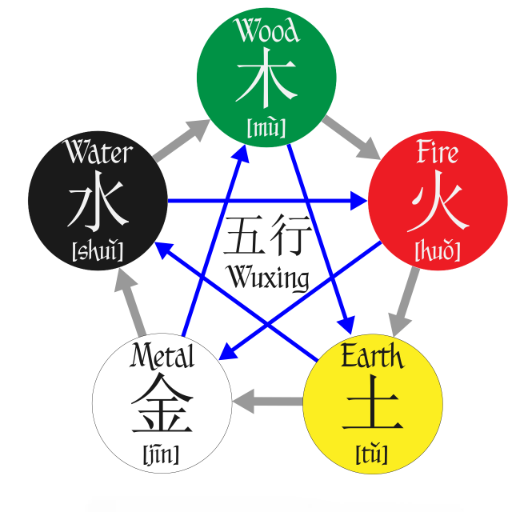
The Five Elements in BaZi are not literal substances. They are five energetic patterns that classical Chinese philosophy used to describe change. Each element has a flavor, a season, an organ, a direction, and a personality signature.
| Element | Chinese | Quality | Season | Direction |
|---|---|---|---|---|
| Wood | 木 (Mu) | Growth, vision | Spring | East |
| Fire | 火 (Huo) | Expression, drive | Summer | South |
| Earth | 土 (Tu) | Stability, care | Late summer | Center |
| Metal | 金 (Jin) | Structure, clarity | Autumn | West |
| Water | 水 (Shui) | Wisdom, flow | Winter | North |
The beauty of a BaZi chart is that it consists of eight characters, made up of four Heavenly Stems at the top and four Earthly Branches at the bottom. These characters correspond to one of the Five Elements. While twelve references to elements could be inferred when the hidden stems inside the branches’ are included. The element also qualifies as the dominant bazi if more instances of the single element appear than that of any of the other elements. On the contrary, a missing element bazi is said not to appear at all.
The ten Heavenly Stems are also presented in Yum and Yanm forms. A very big difference: Yang Wood is a large tree, Yin Wood is a vine resembling the Yang Wood. But they are in the same family. Nevertheless, this difference might matter a lot when observed in personality traits.
Each Element’s Personality (Wood, Fire, Earth, Metal, Water)
Every element has a Yin form and a Yang form, plus three states: balanced, excessive, and weak or missing. These are the keys to element personality bazi readings.
Wood (木): Growth and Vision
- Yang Wood (Jia 甲): Towering tree. Principled, structured, mission-driven.
- Yin Wood (Yi 乙): Vine or flower. Adaptive, diplomatic, creative.
- Balanced: Resilient, purposeful, future-focused.
- Excessive: Rigid, impatient, pushes too hard.
- Weak or missing: Indecisive, stagnant, lacks direction.
Wood thrives when it has Water to feed it and Earth to root in. Strong Wood types make natural strategists and builders.
Fire (火): Expression and Drive
- Yang Fire (Bing 丙): Sun. Bold, generous, charismatic.
- Yin Fire (Ding 丁): Candle. Refined, focused, influential.
- Balanced: Warm, inspiring, visible.
- Excessive: Burns out fast, impulsive, dramatic.
- Weak or missing: Low energy, guarded, flat in tone.
Fire feeds on Wood and melts Metal. People with strong Fire often lead from the front, but they need rest to keep the flame steady.
Earth (土): Stability and Care
- Yang Earth (Wu 戊): Mountain. Steady, protective, reliable.
- Yin Earth (Ji 己): Fertile soil. Caring, detail-oriented, patient.
- Balanced: Grounded, trustworthy, dependable.
- Excessive: Stubborn, slow to change, possessive.
- Weak or missing: Scattered, unanchored, insecure.
Earth holds the chart together. Without enough Earth, ambitions can drift without follow-through.
Metal (金): Structure and Clarity
- Yang Metal (Geng 庚): Sword. Decisive, competitive, principled.
- Yin Metal (Xin 辛): Jewel. Elegant, strategic, refined.
- Balanced: Disciplined, clear, fair.
- Excessive: Harsh, critical, inflexible.
- Weak or missing: Vague, inconsistent, poor boundaries.
Metal cuts Wood and is produced by Earth. Strong Metal types value precision and standards. They make excellent analysts, surgeons, and editors.
Water (水): Wisdom and Flow
- Yang Water (Ren 壬): Ocean. Ambitious, independent, broad-minded.
- Yin Water (Gui 癸): Mist or rain. Perceptive, intuitive, subtle.
- Balanced: Flexible, insightful, resourceful.
- Excessive: Evasive, indecisive, emotionally flooded.
- Weak or missing: Rigid, dry in expression, slow to adapt.
Water nourishes Wood and extinguishes Fire. Strong Water types think in systems and see around corners.
How the Five Elements Interact: Generative and Controlling Cycles
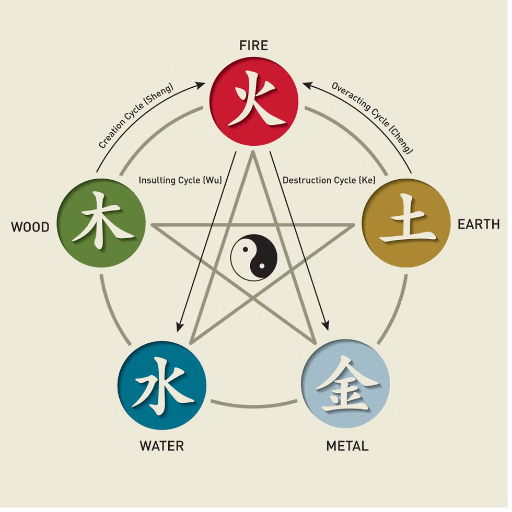
The Five Elements are not isolated. They move through two main cycles that classical practitioners call Sheng (生) and Ke (克).
Generative Cycle (Sheng, 生), one element feeds the next:
- Wood feeds Fire.
- Fire creates Earth (ash).
- Earth produces Metal.
- Metal carries Water (condensation).
- Water nourishes Wood.
Controlling Cycle (Ke, 克), one element checks the next:
- Wood breaks Earth.
- Earth absorbs Water.
- Water extinguishes Fire.
- Fire melts Metal.
- Metal cuts Wood.
There are also two stress cycles that matter in advanced reading: weakening (the reverse of generation, where the child drains the parent) and insulting (when a weak element fights back against the one that controls it). For a beginner, the Sheng and Ke cycles are enough.
These cycles explain compatibility, conflict, and timing. If your chart is heavy on Wood, a Luck Pillar that adds more Wood will feel stiff and overgrown. A Metal Luck Pillar may feel uncomfortable at first but bring discipline. Bazi element balance is dynamic. Your chart changes its needs every 10 years.
How to Find Your Element in a BaZi Chart
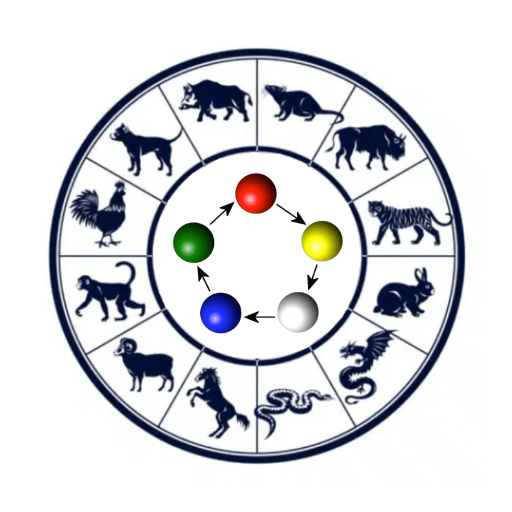
Forget the “year ending in 0 means you are Metal” shortcut. That rule looks at one of eight characters and ignores the other seven. To read your real elemental profile, follow these five steps.
Step 1: Generate Your Chart
Use a free BaZi calculator that accounts for true solar time and longitude. You will see four pillars: Year, Month, Day, and Hour, each with a Heavenly Stem on top and an Earthly Branch below.
Step 2: Identify Your Day Master
The Heavenly Stem in your Day Pillar is your Day Master. This is the element that represents you. If it is Yang Fire (Bing), you are Yang Fire by nature. Everything else in the chart is read in relation to this anchor.
Step 3: Translate Each Character to an Element
Map every Stem and Branch to its element. Stems are straightforward. Branches each carry one main element plus one to two hidden stems.
Step 4: Count Your Elements
Tally the totals. A simple template:
| Element | Count |
|---|---|
| Wood | __ |
| Fire | __ |
| Earth | __ |
| Metal | __ |
| Water | __ |
Give each visible Stem and Branch one point. Add half-points for hidden stems. Most beginner charts end up with one or two dominant elements and one missing or weak element.
Step 5: Compare Against Your Day Master
The same element distribution means different things depending on your Day Master. Heavy Water is a gift for a Yang Wood Day Master who needs nourishment. The same Water is a flood for a Yin Fire Day Master who needs warmth.
Want a worked example? Imagine a chart with three Wood stems, two Fire stems, one Earth, one Metal, and one Water. Wood is dominant. Metal is weak. If the Day Master is Yang Wood, the chart needs more Metal to shape it. If the Day Master is Water, this chart already feels balanced.
What Your Element Balance Means
Reading element counts is only half the picture. Interpreting them in light of your Day Master is where the real insight lives.
- Dominant element: Your default operating mode. You lean on this energy without thinking.
- Weak element: Underrepresented. It can become a blind spot or a development edge.
- Missing element: Not present in any pillar. Sometimes a blessing, sometimes a gap.
- Excessive element: Too much of a good thing. Often the source of friction in life patterns.
Here is the key insight most guides skip: a missing element is not automatically bad. If the missing element is unfavorable for your Day Master, its absence is a relief. If it is favorable, the gap explains a recurring struggle.
Modern research on classical Chinese systems treats the Five Elements as a framework for pattern recognition, not prediction. A 2025 comparative study published on ScienceDirect examined the Five Movements and Six Qi alongside Western astrology and noted how the elemental framework continues to inform health and behavioral models today.
How to Balance Your Five Elements in Daily Life
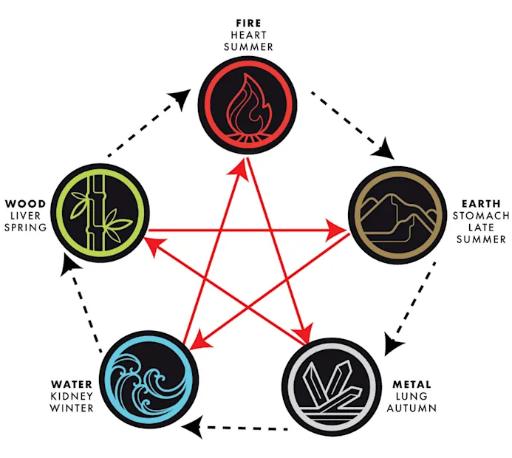
You are unable to change the elements in your birth chart, but you can select environments, habits, or times that strengthen the elements you need. Instead of by destiny, approach it as if it were a design.
- Wood: Get outside, in green places. Establish goals for growth in every season. Courage green and teal. Face east when you are working.
- Fire: Add fire light-from the sun, candle fire, or red terra cotta, your choice. Exercise to shift out energy that’s stagnating. Speak publicly; for Fire, this is about expressing.
- Earth: Cook at home. Have some barefoot outdoors. Befriend any of the colors that are beige, ochre, and clay. Pop into working schedules.
- Metal: Clean up the mess of alchemy from your failing alchemical experiments; declutter for a while. Wear white, silver, or gray, in style. Listen to anything instrumental to focus on your Metal nature. Bring some boundaries to light.
- Water: Layout a swimming pool, a fish tank, or a humidifier, or go black-and-blue. You will read, think deeply, and write. Try to head north in whatever you do.
These adjustments can be paired with your current 10-year Luck Pillar as well. In the case Luck Pillar already gives what is required, this power can give much support. If Luck Pillar amplifies a superfluity, balancing is very painful.
Frequently Asked Questions
What are the five elements in BaZi and how do they relate to Wu Xing?
Wu Xing(五行) is the name given to the constitution of The Five Elements (Wood, Fire, Earth, Metal, Water) known in BaZi. It’s about the patterns of changes in energy than a specific substance. All elements have a pair in the circle of Life; In this circle, there are two aspects, Yin and Yang, being manifested through a productive cycle or a controlling one.
How do the Five Elements link with personality?
Each element oversees behavioral traits. Wood symbolizes vision and growth. Fire symbolizes expression and decision making. Earth calls for support and nurture. Metal stands for structure and precision. Water is recognized by adaptation and perception. The dominant predilections are the behaviors present within the individual by way of their own element.
How the elemental allocation of years in the BaZi stands out.
There is a Yang or Yin element allocated to a birth year by a Heavenly Stem each year. In other words, years ending in 0 or 1 fall under Metal. 2 or 3 fall under Water. 4 or 5 fall under Wood. 6 or 7 fall under Fire. 8 or 9 fall under Earth. This is not enough, though: The year is only one of the four pillars, and all eight characters will be used; this means a total reading.
What does it mean if an element is absent in a chart under BaZi?
An absent element means it is not a part of any of the eight characters. Its effect on the Day Master would be what is important. A missing element of importance would really not be harmful and may even be an antidote. But a missing element required for your growth would be a point to work on through surrounding, career, and lifestyle choices.
What is the link between Yin and Yang and the Five Elements?
Every element has a Yin form and Yang form giving us ten Heavenly Stems. Yang Wood takes the shape of the tree. Yin Wood is represented by the vine. Yang Fire takes the shape of the sun. Yin Fire represents the candle. The way in which the element appears through personality and behavior is actually refined by the combination of these Yin and Yang Objects.
Conclusion
There are Five Elements in BaZi that are part of a system, not superstition at all. Representations of how your energy is disbursed and how it fluctuates over time, Wood, Fire, Earth, Metal, and Water could and should be put to use afterwards, as you can clearly see from your chart in terms of elemental balance.
Three takeaways to carry forward:
- Your dominant element bazi signature is your default. Lean into it for strengths.
- Your missing element bazi signature is context-dependent. Not every gap needs filling.
- Bazi element balance is dynamic. Your needs shift with every 10-year Luck Pillar.
Ready to see your own elemental blueprint? Generate your free BaZi chart and find your dominant element in seconds.
Reference Sources
- “The five elements and Chinese-American mortality”. APA PsycNet.
- “Chinese astrology: Exploring the Eastern zodiac”. Google Books.