

If you have ever wondered what is bazi and why so many people are studying their birth charts, here is the short answer: Four Pillars of Destiny — also called BaZi — is a structured Chinese metaphysical system that maps your personality, strengths, and life patterns using eight characters derived from your exact birth date and time to create your Chinese birth chart.
Most people discover BaZi and feel overwhelmed.
Eight characters. Strange symbols. A wall of terminology.
But here is the truth:
Your BaZi chart is not complicated. It is simply unfamiliar.
Once you understand the structure, it becomes one of the most powerful tools for self-awareness and decision-making.
In this guide, you will learn exactly what Four Pillars of Destiny contains, how each component works, and how to start reading your own chart today — even if you are starting from zero. For a complete methodology on interpreting any destiny chart once you understand the basics, see our (complete BaZi chart reading guide).
Key Takeaways
- Bazi chart explained simply: Four Pillars of Destiny uses your birth year, month, day, and hour to create eight characters that map your life patterns.
- Your Day Master — the Heavenly Stem of your Day Pillar — is the single most important element in your chart.
- The Five Elements (Wood, Fire, Earth, Metal, Water) show your inherent strengths and weaknesses together with your potential development areas.
- The Ten Gods explain how all elements from your chart interact with your Day Master through specific behavior patterns that do not function as supernatural abilities.
- Luck Pillars create 10-year periods that show you when to take action and when to remain still while indicating when your innate abilities will reach their peak.
- BaZi presents its predictions through patterns and probabilities because it functions as a decision-support system that does not predict actual outcomes.
What Is Four Pillars of Destiny?
BaZi literally means “Eight Characters.”
These eight characters are organized into four pairs called pillars:
- Year Pillar → Your background and early environment
- Month Pillar → Your career foundation and social structure
- Day Pillar → You (this is the most important)
- Hour Pillar → Your ambitions, children, and later life
Each pillar contains two elements:
- A Heavenly Stem (visible, surface-level energy)
- An Earthly Branch (hidden, foundational energy)
Together, the four pillars create a complete energetic blueprint.
Think of it like this:
Your chart is a photograph taken at the exact moment of your birth. It captures the elemental “weather” of that moment — the positions of the five elements in relation to each other. That weather shapes your tendencies, your relationships, and the terrain you navigate throughout life.
But it does not control you.
The system was refined over 1,000 years ago by Master Xu Ziping during the Song Dynasty. He built on earlier work by Li Xuzhong from the Tang Dynasty and shifted the analytical focus to the Day Master — the central reference point that makes the entire system logical and consistent. For a thorough historical overview, Travel China Guide provides an encyclopedic introduction to Four Pillars.
Classical texts like Yuanhai Ziping and Sanming Tonghui document this methodology in detail. The system is not magic. It is a time-based calculation framework rooted in Yin-Yang theory, the Five Elements, and the 60-year sexagenary cycle.
Many beginners search for bazi meaning and find conflicting definitions. Some sources call it fortune-telling. Others call it a philosophy. Here is what Four Pillars of Destiny actually is — and what it is not.
What BaZi Is Not
Let us clear this up immediately.
BaZi is not fortune-telling in the Western sense. The system does not forecast particular events which include the statement “you will get married on June 14th.” The method uses weather patterns to forecast probabilities which show that people should bring umbrellas without predicting exact rainfall times.
BaZi is not fatalism. Your chart shows your starting terrain. You still choose how to navigate it.
And BaZi is not your Chinese zodiac year animal. That is the most common misconception beginners have — and it misses 85% of what your chart actually contains.
Ready to see your own chart? Generate your free Four Pillars analysis in seconds — no expertise required.
Four Pillars of Destiny Explained: Your Life’s Layers
Every pillar represents a different layer of your life in a Four Pillars of Destiny reading. Understanding what each one governs is the first step to reading any chart.
| Pillar | Governs | Life Phase |
|---|---|---|
| Year | Ancestry, family background, early childhood | Birth to ~15 |
| Month | Career foundation, parents, mentors | ~15 to ~30 |
| Day | Self-identity, spouse, partnerships | Core adult life |
| Hour | Children, future ambitions, later years | ~50 onward |
Year Pillar: Your Foundation
The Year Pillar contains your birth year animal — the Chinese zodiac sign most people know.
But here is what most guides will not tell you:
The Year Pillar is the least important pillar in your chart.
It governs your ancestry, family background, and early childhood environment. It shapes the world you were born into — not who you became.
When Sarah first discovered BaZi, she was convinced her “Year of the Dragon” defined her entire personality. She read dragon traits online and felt partially aligned but strangely incomplete. When she generated her full chart and discovered her Day Master was actually Yin Water, everything shifted. The introspective, adaptive, strategic nature of Yin Water described her far more accurately than any zodiac description ever had.
This is the discovery most beginners need to make.
Your year animal is a fun starting point. It is not your chart.
Month Pillar: Your Career and Season
The Month Pillar is far more influential than the Year Pillar.
It reveals:
- The season you were born in (which determines whether your Day Master is strong or weak)
- Your career foundation and work style
- Your relationship with parents and authority figures
- The elemental “climate” that shaped your formative years
The Month Pillar also determines the direction of your Luck Pillars — whether they move forward or backward through the 60 JiaZi cycle.
If you need help generating your chart, our (free BaZi calculator guide) compares the most accurate tools available.
Day Pillar: The Center of Everything
The Day Pillar is the core of your chart.
It contains:
- Your Day Master (the Heavenly Stem — your core identity)
- Your Spouse Palace (the Earthly Branch — your relationship dynamics)
Everything in BaZi revolves around this pillar. Every other element in your chart is analyzed in relation to the Day Master. Every Ten God is derived from it. Every strength and weakness is measured against it.
If you learn nothing else from this guide, learn this:
Find your Day Master. Understand it. Everything else follows.
Hour Pillar: Your Future and Hidden Potential
The Hour Pillar governs your later years, your children, and your deepest ambitions.
It is also the pillar most commonly miscalculated by online tools.
Why? Because the Hour Pillar depends on true solar time — not the clock time on your birth certificate.
Marcus was born in Denver at 11:47 p.m. Mountain Time. Most calculators used his clock time and assigned him a Zi Rat Hour Pillar. But after adjusting for solar time — accounting for Denver’s longitude offset from the timezone meridian — his actual birth time shifted to 11:23 p.m. solar time. That placed him in the previous hour, changing his Hour Pillar entirely.
The difference? A completely different set of Ten Gods, hidden stems, and future timing.
This is why accuracy matters. And it is why BaZi Web calculates true solar time automatically when you generate your chart. BaZi practitioner Master Sean Chan emphasizes solar time accuracy as essential for any credible reading.
Heavenly Stems and Earthly Branches: The Alphabet of BaZi
Before you can read a Four Pillars of Destiny chart, you need to understand the two building blocks: Heavenly Stems and Earthly Branches.
The system uses its basic elements which function as its alphabet. The letters provide you with the ability to begin reading complete words.
The 10 Heavenly Stems
Heavenly Stems show the outermost forces which appear in your chart. They show the internal energies which people express through their external behavior.
| Stem | Element | Polarity | English Name |
|---|---|---|---|
| Jia (甲) | Wood | Yang | Yang Wood |
| Yi (乙) | Wood | Yin | Yin Wood |
| Bing (丙) | Fire | Yang | Yang Fire |
| Ding (丁) | Fire | Yin | Yin Fire |
| Wu (戊) | Earth | Yang | Yang Earth |
| Ji (己) | Earth | Yin | Yin Earth |
| Geng (庚) | Metal | Yang | Yang Metal |
| Xin (辛) | Metal | Yin | Yin Metal |
| Ren (壬) | Water | Yang | Yang Water |
| Gui (癸) | Water | Yin | Yin Water |
Each stem has a distinct personality:
- Yang Wood (Jia) is like a tall tree — upright, structured, leadership-driven.
- Yin Wood (Yi) is like a vine — flexible, creative, detail-oriented.
- Yang Fire (Bing) is like the sun — expressive, charismatic, visible.
- Yin Fire (Ding) is like a candle flame — focused, warm, precise.
Your Day Master is always one of these ten stems.
The 12 Earthly Branches
The Earthly Branches function as concealed fundamental energies which exist as hidden foundational forces. They show your true personality which extends to your fundamental origins and to the hidden parts of your being.
The branches of the system link each zodiac animal to various hidden elemental influences which only become apparent after particular conditions are met.
| Branch | Animal | Element | Hidden Stems |
|---|---|---|---|
| Zi (子) | Rat | Water | Gui (Water) |
| Chou (丑) | Ox | Earth | Ji, Xin, Gui |
| Yin (寅) | Tiger | Wood | Jia, Bing, Wu |
| Mao (卯) | Rabbit | Wood | Yi |
| Chen (辰) | Dragon | Earth | Wu, Yi, Gui |
| Si (巳) | Snake | Fire | Bing, Wu, Geng |
| Wu (午) | Horse | Fire | Ding, Ji |
| Wei (未) | Goat | Earth | Ji, Ding, Yi |
| Shen (申) | Monkey | Metal | Geng, Ren, Wu |
| You (酉) | Rooster | Metal | Xin |
| Xu (戌) | Dog | Earth | Wu, Xin, Ding |
| Hai (亥) | Pig | Water | Ren, Jia |
The hidden stems are critical. A chart may look like it lacks Wealth on the surface. But if the hidden stems inside an Earthly Branch contain Wealth elements, that resource is simply stored — waiting for the right Luck Pillar to unlock it.
This is why surface-level readings often miss the full picture.
Understanding these building blocks is essential to reading any Four Pillars of Destiny chart accurately.
The Day Master: Your Core Identity
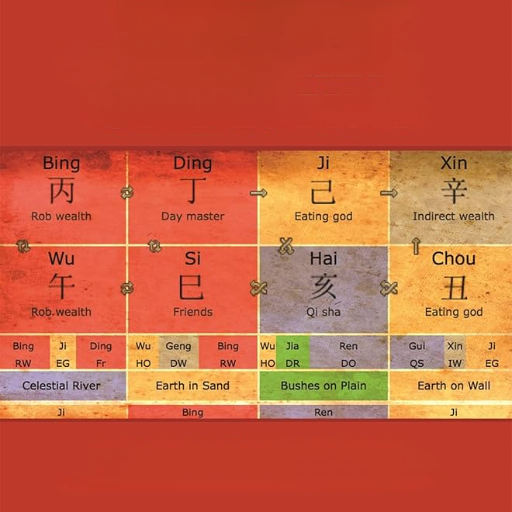
If the Four Pillars are the structure of your Four Pillars of Destiny chart, the Day Master is its heartbeat.
Your Day Master is the Heavenly Stem of your Day Pillar. It represents your core identity — how you think, act, respond to challenges, and express yourself in the world.
Everything in BaZi is analyzed in relation to the Day Master.
- The Five Elements are judged as supportive or challenging relative to it.
- The Ten Gods are derived from its perspective.
- Luck Pillars are favorable or unfavorable based on its strength.
How to Find Your Day Master
- Generate your BaZi chart using your exact birth date, time, and location.
- Locate the Day Pillar (the third pillar from the left, labeled “Day” or “日”).
- The top character (Heavenly Stem) is your Day Master.
That is it. One simple step unlocks the entire framework.
To understand which elements are favorable for you, read our detailed (day master bazi) guide.
The 10 Day Masters at a Glance
| Day Master | Core Trait | Strength | Blind Spot |
|---|---|---|---|
| Jia Wood | Leadership | Visionary, principled | Stubborn, inflexible |
| Yi Wood | Adaptability | Creative, diplomatic | Indecisive, scattered |
| Bing Fire | Charisma | Expressive, inspiring | Impulsive, attention-seeking |
| Ding Fire | Focus | Warm, precise, loyal | Overcritical, isolated |
| Wu Earth | Stability | Reliable, nurturing | Stubborn, slow to change |
| Ji Earth | Service | Detail-oriented, supportive | Self-sacrificing, anxious |
| Geng Metal | Discipline | Strategic, decisive | Rigid, cold |
| Xin Metal | Refinement | Elegant, analytical | Perfectionist, fragile |
| Ren Water | Intelligence | Adaptive, strategic | Escapist, overthinking |
| Gui Water | Intuition | Deep, reflective, wise | Withdrawn, secretive |
Understanding your Day Master is like understanding your operating system. It does not limit what you can do. It reveals how you naturally function — so you can work with your strengths instead of against them. Any credible bazi reading begins here.
The Five Elements (Wu Xing) in Your Chart
The Five Elements are the energetic language of Four Pillars of Destiny.
Wood. Fire. Earth. Metal. Water.
These are not physical substances. They are patterns of energy that describe how forces interact, support, and control each other in every Chinese birth chart.
What Each Element Represents
Wood represents growth, expansion, and vision.
Strong Wood people think long-term. They initiate. They build. Weak Wood lacks direction and struggles to start.
Fire represents energy, expression, and visibility.
Strong Fire people are charismatic and influential. Too much Fire burns out — impulsive, scattered, exhausted.
Earth represents stability, support, and grounding.
Strong Earth people are reliable and practical. Weak Earth lacks structure and feels unstable.
Metal represents precision, discipline, and control.
Strong Metal people are organized and strategic. Too much Metal becomes rigid and controlling.
Water represents intelligence, adaptability, and flow.
Strong Water people are flexible and insightful. Weak Water is fearful and indecisive.
For a complete breakdown of element interactions, see our (five elements bazi) guide.
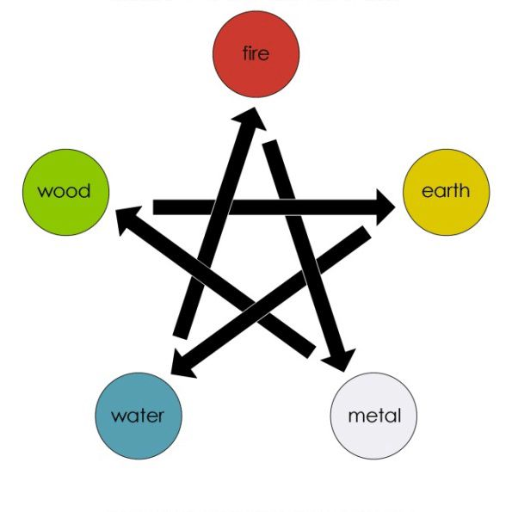
The Two Cycles
Elements interact through two primary cycles:
Generating Cycle (supportive):
Wood feeds Fire → Fire creates Earth (ash) → Earth produces Metal (minerals) → Metal carries Water → Water nourishes Wood.
Controlling Cycle (regulating):
Wood penetrates Earth → Earth absorbs Water → Water extinguishes Fire → Fire melts Metal → Metal chops Wood.
Neither cycle is “good” or “bad.” Both are necessary. The generating cycle builds. The controlling cycle prevents any one force from dominating.
Element Balance in Your Chart
Your BaZi chart shows the distribution of all five elements across your four pillars.
The question is not “Which element am I?” The question is:
Which elements support my Day Master? Which overwhelm it? Which are missing entirely?
A strong Day Master with too much support becomes arrogant and unbalanced. A weak Day Master without enough support struggles to assert itself.
The goal is harmony — not perfection.
The Ten Gods: How Elements Become Meaning
The Ten Gods are the bridge between raw elements and real-life meaning in Four Pillars of Destiny.
They are not deities. They are relationship labels that describe how every other element in your chart interacts with your Day Master.
The Five Families
| Family | Relationship to Day Master | What It Governs |
|---|---|---|
| Resource | Element that produces you | Learning, support, mentors, knowledge |
| Output | Element you produce | Creativity, expression, talents, children |
| Wealth | Element you control | Money, opportunities, resources, spouse (for men) |
| Officer | Element that controls you | Authority, discipline, rules, spouse (for women) |
| Companion | Same element as you | Friends, peers, competition, self-reliance |
Each family has two versions:
Direct — Same Yin-Yang polarity as your Day Master. It represents stable and mainstream and conventional behavior.
Indirect — The system displays opposite Yin-Yang polarity. The system displays dynamic behavior through its unconventional approach which generates high intensity.
For example, if your Day Master is Yang Wood (Jia):
Direct Resource = The system uses Yin Water (Gui) to provide mainstream learning through academic mentors who deliver stable knowledge.
Indirect Resource = The system uses Yang Water (Ren) to provide users with both unconventional wisdom and metaphysical knowledge and immediate understanding.
The 10 Gods in Real Life
Direct Officer (正官) – Your dedication to rules leads to your ability to succeed in structured environments. You ascend through organizational ranks. The people around you consider you a trustworthy individual.
Seven Killings / Indirect Officer (七杀) – You perform best when faced with demanding situations. Your personality consists of competitive nature and ambitious spirit which drives you to take on new challenges. The situation becomes harmful when the situation exists without any restrictions.
Direct Wealth (正财) – You achieve income through your employment which provides regular and dependable work schedule. Your primary focus centers on maintaining stable conditions.
Indirect Wealth (偏财) – You draw in new business chances together with financial backing and unexpected monetary gains. You possess an entrepreneurial spirit.
Eating God (食神) – You use diplomatic language to communicate your thoughts to others. Your personality finds pleasure in experiencing food and artistic expressions and maintaining peaceful relationships.
Hurting Officer (伤官) – You use your critical thinking skills to analyze information while challenging established social norms. Your personality combines eloquence with creativity but you demonstrate rebellious tendencies.
Direct Resource (正印) – The traditional educational system serves as your primary method of gaining knowledge. The system provides you access to educational support from both educators and learning institutions.
Indirect Resource (偏印) – You acquire knowledge through methods that do not follow standard educational procedures. Your interests include metaphysics, spiritual matters, and nontraditional forms of knowledge acquisition.
The Companion (比肩) – You demonstrate personal independence through your ability to work alone. You work together with others from a position of equal authority.
Rob Wealth (劫财) – You engage in competitive activities against your coworkers. You strive to access more valuable assets. Your strong drive leads to conflicts with other people.
The Ten Gods of your destiny chart provide you with direct access to their actual existence. Your actual behavior patterns show the way you make decisions and establish relationships and select career paths and your hidden weaknesses.
(Read our full Ten Gods guide) for a complete breakdown of each god with chart examples.
Luck Pillars: Your Life’s Timeline
Your birth chart is static. It captures one moment in time.
But your life moves.
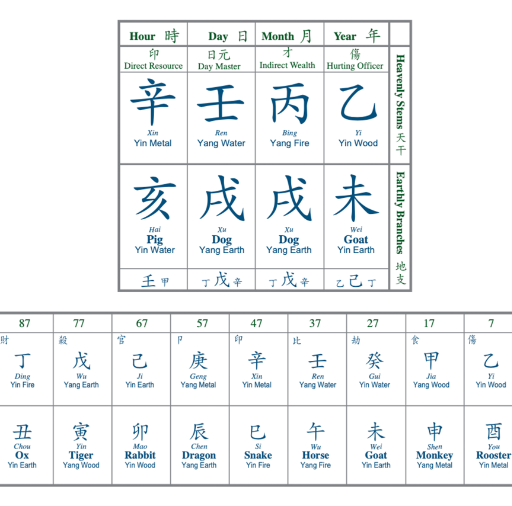
The Luck Pillars of the Da Yun system reveal elemental changes that occur during 10-year cycles according to Four Pillars of Destiny. The system shows the times when your abilities reach their highest point, when you will encounter difficulties and when you need to use timing as a strategic advantage.
How Luck Pillars Work
Each Luck Pillar contains one Heavenly Stem and one Earthly Branch — just like your natal pillars.
But these elements are temporary. They describe the “weather” of a 10-year period, not your permanent structure.
Think of it this way:
- Your natal chart = the car you are driving
- Your Luck Pillar = the road you are on
The same car handles differently on a highway than on a muddy trail. The road does not change the car. It changes how the car performs.
Forward vs Backward
Luck Pillars move from your Month Pillar, but the direction depends on two factors:
- The Yin-Yang polarity of your birth year’s Heavenly Stem
- Your gender
Forward: Yang-year males / Yin-year females
Backward: Yin-year males / Yang-year females
Forward follows the normal 60 JiaZi cycle. Backward reverses it.
Direction is mechanical. It does not mean “good” or “bad.” It simply determines which elements arrive in which order.
Reading Your Current Luck Pillar
To read your current Luck Pillar:
- Identify which 10-year range you are in (e.g., ages 33–42).
- Note the Heavenly Stem and Earthly Branch of that pillar.
- Map them to Ten Gods relative to your Day Master.
- Assess whether those elements support or challenge your Day Master strength.
A favorable Luck Pillar brings elements your chart needs. Life tends to flow. This is a time for expansion, risk-taking, and growth.
An unfavorable Luck Pillar brings elements that stress your chart. This is a time for consolidation, learning, and patience — not aggressive moves.
The key insight:
You cannot control which Luck Pillar you are in. But you can control your strategy within it.
Master Luck Pillars with our complete timing guide, or explore our comprehensive Luck Pillars methodology for advanced timing analysis.
For timing your biggest moves, see our (Luck Pillars and 10-year cycles guide).
How to Read a BaZi Chart in 6 Steps
The process of reading BaZi charts consists of six essential steps. The practical framework for chart reading starts with your understanding of Four Pillars of Destiny components. The section provides you with bazi chart explanation through simple actionable steps.
Step 1: Calculate With True Solar Time
Your birth certificate shows clock time. BaZi requires true solar time — the actual position of the sun at your birth location.
The reason exists because modern time zones originate from political decisions. The entire Chinese nation operates on Beijing Time which maintains a time offset of UTC+8. The solar difference between Shanghai and Urumqi exceeds two hours. The two infants who were born at identical clock time in those locations experience completely different solar conditions.
The correction requires:
- Longitude adjustment: Every degree away from the timezone meridian shifts time by 4 minutes.
- Equation of Time: Earth’s elliptical orbit causes up to 16 minutes of seasonal variation.
Step 2: Identify Your Day Master
Locate the Heavenly Stem of your Day Pillar.
This is your reference point for everything. Write it down. Know its element and polarity.
Step 3: Assess Your Season of Birth
Check your Month Pillar. The season you were born in determines whether your Day Master is naturally strong or weak.
- Spring (Wood season) strengthens Wood Day Masters.
- Summer (Fire season) strengthens Fire Day Masters.
- Autumn (Metal season) strengthens Metal Day Masters.
- Winter (Water season) strengthens Water Day Masters.
- Late summer/transition (Earth seasons) strengthens Earth Day Masters.
A Day Master born in its own season is naturally strong. Born in a controlling season, it is naturally weak.
Step 4: Analyze Element Balance
Count the Five Elements across all four pillars.
Ask:
- Which element appears most?
- Which is missing or weakest?
- Does your Day Master have enough support?
- Is any element so dominant it overwhelms the others?
This balance reveals your natural terrain.
Step 5: Map Your Ten Gods
For every other stem and branch in your chart, determine its Ten God relative to your Day Master.
Look for:
- Where your Wealth stars appear
- Where your Officer stars appear
- Where your Resource stars appear
- Where your Output stars appear
These placements tell you where in your life each pattern shows up — not just what the pattern is.
Step 6: Layer In Your Current Luck Pillar
Find your current 10-year Luck Pillar.
Ask:
- Does this pillar support or challenge my Day Master?
- Are there clashes or combinations with my natal pillars?
- What Ten Gods does this pillar activate?
Elena was considering a major career change at age 34. Her natal chart showed strong Indirect Wealth — an entrepreneurial pattern. But her current Luck Pillar was a Resource cycle, not a Wealth cycle. Instead of quitting her job to start a business, she used those years to build skills, earn certifications, and develop her network. When her Wealth cycle arrived at 35, she launched with momentum — and succeeded.
Timing is not everything. But it is more than most people realize.
What Can BaZi Actually Tell You?
A thorough bazi analysis is a pattern-recognition system. It does not predict exact events. It reveals tendencies, timing, and terrain.
Here is what it can illuminate:
Career Direction
Your chart reveals which elements and Ten Gods dominate your career palace. This points toward industries, work styles, and roles where you naturally thrive.
- Strong Officer stars → management, authority, structured environments
- Strong Wealth stars → entrepreneurship, sales, finance
- Strong Output stars → creative fields, teaching, expression
- Strong Resource stars → research, academia, advisory roles
For a deeper exploration of timing your career moves, see our (Bazi Career Analysis Guide).
Relationship Dynamics
Your Day Branch (Spouse Palace) and the Ten Gods in your chart reveal relationship patterns:
- What you seek in a partner
- How you express affection
- Where conflict tends to arise
- Timing for major relationship decisions
Health Tendencies
Each element correlates with organ systems in Traditional Chinese Medicine:
- Wood → Liver, gallbladder
- Fire → Heart, eyes
- Earth → Spleen, stomach
- Metal → Lungs, skin
- Water → Kidneys, bladder
An imbalanced or missing element can signal areas to pay attention to preventively. These correlations are documented extensively in Traditional Chinese Medicine resources.
Life Timing
Luck Pillars and Annual Pillars reveal when specific energies are activated. This helps you:
- Time major decisions
- Know when to push and when to pause
- Prepare for challenging periods instead of being blindsided
What BaZi Cannot Do
- Predict exact dates or events
- Guarantee outcomes
- Replace free will or personal effort
- Tell you what you “should” do — only what patterns suggest
BaZi reveals the terrain. You choose the path.
Are you also doubting the authenticity of Bazi? Please see our (Is Bazi Real or Fake) guide to find out the truth.
Common Myths About Four Pillars of Destiny
Misconceptions about BaZi are everywhere. Let us address the biggest ones.
Myth 1: “Your Fate Is Fixed”
Reality: Your chart shows patterns, not prisons.
A chart with challenging elements is not a curse. It is a map of terrain that requires a specific strategy. Some of the most successful people have “difficult” charts — because they learned to navigate their terrain intentionally.
Myth 2: “BaZi Predicts Exact Events”
Reality: BaZi reveals probabilities and timing, not specifics.
It might indicate a 10-year cycle favorable for wealth accumulation. It will not tell you that you will win the lottery on March 3rd. The system is strategic, not supernatural.
Myth 3: “Some Charts Are ‘Bad'”
Reality: Every chart has strategy.
There is no universally “good” or “bad” BaZi chart. A chart with abundant Wealth but no Officer might create a wealthy but chaotic life. A chart with strong Officer but weak Wealth might create a respected but financially constrained life. Each configuration has its own path.
Myth 4: “You Need Years of Study to Benefit”
Reality: You can start with your Day Master today.
Understanding your core element and whether it is strong or weak gives you more self-awareness than most people ever develop. Everything else is refinement.
Myth 5: “Online Calculators Are Always Wrong”
Reality: Accuracy depends on methodology.
Basic calculators that ignore solar time, use the lunar calendar, or fail to account for historical daylight saving time rules will produce errors. Professional-grade tools that apply true solar time, use the correct solar calendar, and validate birth location are highly accurate.
For a deeper understanding of the (history of Bazi), please refer to our related guides.
BaZi vs Western Astrology: What Is Different?
BaZi and Western Astrology show different systems which use birth details to create personality profiles that show upcoming life events.
The two systems work with different fundamental principles.
Birth Data
Western astrology uses planetary positions which include the Sun Moon planets and houses and aspects.
BaZi uses time-based elemental cycles which include Heavenly Stems Earthly Branches and Five Elements.
For a complete breakdown of what each element represents, explore our (guide to Heavenly Stems and Earthly Branches).
Chart Structure
Western astrology creates a circular wheel which displays 12 houses and their corresponding planetary positions.
BaZi produces a grid of eight characters that arrange into four pillars.
Predictive Methodology
Western astrology uses planetary transits and progressions to forecast trends.
BaZi uses elemental cycles which include Luck Pillars and Annual Pillars to map timing.
Philosophical Foundation
Western astrology traces its origins to Greco-Roman celestial mythology.
BaZi is based on Chinese Yin-Yang theory and the Five Elements and the sexagenary cycle.
Practical Output
Western astrology tends to provide descriptive personality insights about people.
BaZi provides life strategy guidance which includes career timing and wealth patterns and decision-making frameworks.
Which Is More Accurate?
This is the wrong question.
Both systems are frameworks for pattern recognition. Both have practitioners who use them skillfully and practitioners who oversimplify them. The value depends on the depth of the analysis and the skill of the interpreter — or the quality of the algorithm.
Want to know the differences between Bazi and Western astrology? Please see our (Bazi vs Western Astrology guide).
Get Your Free Four Pillars of Destiny Chart
You now understand what your Four Pillars of Destiny chart contains, how the components work, and how to start reading your own Chinese birth chart.
The next step is simple.
Generate your chart.
Here is what you need:
- Your birth date (year, month, day)
- Your birth time (hour and minute, as accurately as possible)
- Your birth location (city and country — for true solar time calculation)
What you will receive:
- Your complete Four Pillars chart with all eight characters
- Your Day Master identification
- Five Elements breakdown
- Ten Gods mapping
- Current Luck Pillar analysis
- Personalized insights on career, relationships, and timing
No signup required. Results in seconds.
Conclusion
Four Pillars of Destiny is not fortune-telling. It is a structured system for understanding your natural patterns, strengths, and timing.
Your chart does not control you. It maps the terrain you were born into — so you can navigate it with clarity instead of guessing.
Here is what to remember:
- Start with your Day Master. It is the center of everything.
- Understand your Five Elements balance. Harmony matters more than perfection.
- Map your Ten Gods. They reveal how you interact with the world.
- Watch your Luck Pillars. Timing amplifies strategy.
- Do not fall for fatalism. Your chart shows patterns. You choose the path.
Ready to read your own chart?
Generate your free Four Pillars analysis now and apply everything you have learned.
Your blueprint already exists. You just need to read it.
Frequently Asked Questions
What is Four Pillars of Destiny?
Four Pillars of Destiny is a Chinese metaphysical system which creates eight character elements from your birth year and month and day and hour. The system uses five elemental interactions to create three personality types which show the main aspects of your life.
Is Four Pillars of Destiny the same as Chinese zodiac?
The Chinese zodiac includes multiple components which include the Year Pillar that represents your Year animal. Four Pillars of Destiny analyzes all four pillars, plus the Day Master, Five Elements balance, Ten Gods, and Luck Pillars. The system provides more detailed information about your personality than the year animal.
How accurate is Four Pillars of Destiny?
The accuracy of the system depends on two factors which include accurate birth information and expert analysis of the data. The calculation itself is mathematically precise. The system uses patterns to create probabilities because it does not predict specific events. The system works best as a strategic framework which provides guidance instead of telling the future.
Can I learn to read my own BaZi chart?
Yes. The guide starts with six steps which include true solar time calculation, Day Master identification, season of birth assessment, element balance analysis, Ten Gods mapping, and current Luck Pillar addition.