


The yin water personality in BaZi belongs to Gui Water (癸水), the mist, rain, and gentle streams of the Ten Heavenly Stems. It describes people who are deeply perceptive, creatively adaptive, and quietly influential — but who may struggle with inconsistency, boundary loss, and overthinking without the right structure. If you have ever been called “too sensitive,” “hard to read,” or “brilliant but scattered,” your BaZi chart may hold the explanation.
Most BaZi content describes Yin Water in mystical terms: dreamlike intuition, emotional depth, destined sensitivity. This guide does something different. We map Gui Water as a system of cognitive and behavioral patterns you can actually use — for career alignment, relationship management, and converting your natural perceptiveness into decisive action. By the end, you will understand how to read this pattern in your chart and, more importantly, how to use it.
This article is part of our complete series on element personality in BaZi. Each of the Ten Heavenly Stems has its own pattern.
Key Takeaways
- Yin Water (Gui Water) is the most Yin of all Ten Heavenly Stems: perceptive, creative, and diplomatic, but vulnerable to boundary loss and scattered focus.
- Strengths include pattern recognition, emotional intelligence, and lateral problem-solving. Weaknesses include over-analysis, conflict avoidance, and absorbing others’ stress.
- Strong Gui Water expresses as confident insight and creative authority. Weak Gui Water shows up as indecision, people-pleasing, and emotional withdrawal.
- Metal supports Yin Water through structure and precision. Excessive Fire or Earth can destabilize or block its flow.
- The most common mistake Yin Water people make is treating their sensitivity as a flaw rather than a data-collection system.
Not sure if you are Yin Water? Calculate your BaZi chart first. Your Day Master is the starting point. Everything else builds from there.
What Is Yin Water? The Mist as a Behavioral Model
Yin Water (Gui / 癸水) is the feminine, receptive expression of the Water element in BaZi. It is symbolized by rain, morning mist, dew on leaves, underground springs, and still ponds — forms of water that are gentle, pervasive, and quietly transformative rather than forceful or visible.
Yin Water is your Day Master when the Heavenly Stem of your Day Pillar is Gui — making you a yin water day master. The gui water personality is one of the most intellectually complex patterns in the Ten Heavenly Stems. It represents your core energetic identity: how you process information, relate to others, and adapt to change. Unlike Yang Water (Ren / 壬水), which behaves like the open ocean, Gui Water is subtle, elusive, and deeply observant. The mist does not announce its arrival. It simply fills the space, revealing details that were invisible before.
Your Day Master is one of ten Heavenly Stems — not a zodiac sign. It is the foundation of your chart, but it is only one layer. The full picture includes your Month Branch, the other three pillars, and how all five elements interact. Think of your Day Master as your default operating system. The rest of your chart determines which apps are running and how much memory you have available. If you are new to chart reading, our guide to reading a BaZi chart breaks down each pillar and what it means.
For a detailed technical breakdown of Gui Water’s interactions with other stems and branches, CM Centre provides an authoritative reference on how this Day Master functions within the Four Pillars framework.
Yin Water vs Yang Water: The Critical Distinction
Understanding your polarity matters. Yang Water and Yin Water share the Water element, but they express it in completely different ways.
| Trait | Yang Water (Ren / 壬水) | Yin Water (Gui / 癸水) |
|---|---|---|
| Symbol | Ocean, great rivers, currents | Mist, rain, dew, underground springs |
| Visibility | Public, expansive, hard to miss | Private, subtle, easy to overlook |
| Thinking style | Strategic, big-picture, systems | Intuitive, detail-oriented, reflective |
| Social style | Broad network, charismatic | Selective bonds, diplomatic |
| Movement | Constant, large-scale, restless | Cyclical, evaporating and condensing |
| Communication | Persuasive, eloquent, wide-ranging | Perceptive, nuanced, emotionally intelligent |
| Core challenge | Aimlessness, overwhelm, drift | Overthinking, boundary loss, elusiveness |
| At best | Visionary leader, strategic innovator | Wise advisor, creative depth-diver |
If you are Yang Water, you are the ocean. If you are Yin Water, you are the mist. Both are Water. Both are essential. They are simply not the same.
The Yin Water Personality: Core Traits
Gui Water personalities are not random. They follow a predictable structure of strengths and blind spots. Understanding both sides is what turns self-knowledge into self-optimization.
The Mist Profile: Core Strengths
Pattern recognition and cause-and-effect tracing. Yin Water people do not think in straight lines. They trace long chains of cause and effect, noticing how small shifts produce large outcomes. This is not abstract intuition — it is structured analytical depth. You see what others miss because you are looking at connections, not just data points.
Emotional and social intelligence. Research from TalentSmart shows that EQ is responsible for 58% of performance across all job types. Yin Water personalities are naturally equipped here. You read emotional undercurrents, sense shifts in group dynamics, and adapt your communication in real time. This makes you an exceptional listener, mediator, and advisor.
Creative and lateral problem-solving. Like mist finding its way around every obstacle, the yin water personality approaches problems from unexpected angles. You connect ideas across domains. Where others see dead ends, you see alternative routes. This shows up in writing, design, research, and strategic thinking.
Diplomatic communication. You do not force agreement. You guide people toward it. The yin water personality excels in contexts where buy-in matters more than compliance. Your words are precise, your timing is careful, and your influence is felt more than seen.
Quiet resilience. Despite appearing soft or elusive, Gui Water people are internally tenacious. Like rain wearing down stone over time, you persist through difficulty without dramatic displays. Your resilience is steady, not loud.
The Shadow Side: Where Patterns Become Problems
Inconsistency and scattered focus. Without enough structure, Yin Water drifts. Your interests change quickly. You may start projects with enthusiasm and abandon them when the novelty fades. The mist moves constantly, and without a container, it disperses.
Boundary permeability. You absorb others’ emotions the way mist absorbs temperature. This makes you deeply empathetic, but it also means you can lose your own identity in relationships, workplaces, or social situations. You feel what others feel — sometimes before they do — and that data can overwhelm your own signal.
Conflict avoidance and emotional withdrawal. Your desire for harmony is an asset until it prevents necessary confrontation. Under stress, you tend to shut down emotionally rather than express yourself. Partners and colleagues may find you suddenly distant, even when the relationship is stable.
Analysis paralysis. Your ability to see complexity and uncertainty can lead to overthinking. You trace so many possible outcomes that you miss timing windows. The same depth that makes you brilliant can also make you immobile.
Eccentricity and visibility issues. Because you think differently and follow less-traveled paths, you may be seen as unconventional or hard to pin down. Your instinct to remain behind the scenes can hinder careers that require overt self-promotion or public leadership.
A Modern Yin Water Archetype
Lena had worked as a market researcher for three years when she noticed a pattern no one else had seen. While her team was chasing quarterly trends, she traced a chain of demographic shifts that predicted a major consumer behavior change eighteen months out. She presented the findings quietly in a single slide during a routine meeting. The director dismissed it. Eighteen months later, the shift arrived exactly as Lena had mapped it. By then, she had already left the company — not because she was disloyal, but because the rigid structure and open-plan office had drained her to the point of burnout. Her Gui Water pattern gave her extraordinary analytical depth, but it also made her vulnerable to environments that demanded constant visibility and shallow output. When she moved to freelance strategy consulting, working from home with long blocks of uninterrupted focus time, her performance — and her wellbeing — improved dramatically.
Strong vs Weak Yin Water: Why Context Changes Everything
Here is where most BaZi articles fail. They describe Yin Water as a single archetype. But a heavy downpour behaves nothing like morning dew. The strength of your Gui Water Day Master changes everything about how these traits show up.
Your Day Master strength is determined by the season you were born in and the overall element balance in your chart. Autumn and winter generally strengthen Water. Spring and summer generally weaken it. The presence of Metal (which produces Water) or Earth (which controls it) also shifts the equation.
Strong Gui Water: The Sustained Rain
Strong Yin Water occurs when you are born in Winter (the Water season) or when your chart contains significant Metal and Water support. Metal produces Water, and additional Water amplifies the current.
How it shows up:
- Confident, perceptive, and creatively authoritative
- Natural insight without needing to prove it
- Exceptional depth in research, analysis, and creative work
- Resilient under pressure — like rain that continues regardless of weather
The risk: Without enough Fire to bring warmth or Earth to provide boundaries, strong Gui Water can flood. Emotional overwhelm, manipulation of others through quiet influence, and a tendency to withdraw into private analysis rather than act are common. The perception is deep, but it may have no outlet.
Weak Gui Water: The Fading Mist
Weak Yin Water occurs when you are born in Summer (the Fire season) or when your chart is dominated by Earth and Fire elements. Earth absorbs Water. Fire evaporates it.
How it shows up:
- Sensitive, observant, and less outwardly expressive
- Deep thinking but slower to commit
- Prone to self-doubt and people-pleasing
- Able to focus intensely when properly supported
The risk: Without nourishment from Metal or support from additional Water, weak Gui Water can feel invisible. Anxiety, indecision, and a persistent sense of not being “enough” creep in. The person may have all the perceptiveness but none of the confidence to act on it.
How to Tell Which One You Are
A quick read: check your birth season and chart support.
| Indicator | Strong Gui Water | Weak Gui Water |
|---|---|---|
| Birth season | Winter (Nov-Feb) | Summer (May-Aug) |
| Chart support | Metal and Water present | Earth and Fire dominant |
| Energy level | High, perceptive, inwardly confident | Lower, introspective, hesitant |
| Social style | Diplomatic, quietly influential | Reserved, easily overwhelmed |
| Under stress | Withdraws, over-analyzes | Collapses, seeks external validation |
Yin Water at Work: Career Strategy by Design
Your yin water personality is not a label. It is a set of default settings. The question is whether your career is configured to use them.
Where Yin Water Thrives
Gui Water people excel in roles that reward perceptiveness, creative depth, and quiet influence. Specifically:
- Research and investigation: Tracing patterns, analyzing data, uncovering hidden connections
- UX research and design: Observing user behavior, identifying emotional friction points, translating insight into improvement
- Writing and content strategy: Crafting precise messaging, understanding audience psychology, guiding decisions through narrative
- Therapy and counseling: Reading emotional states, creating safe spaces, guiding others through complexity
- Strategic consulting: Seeing what others miss, advising from behind the scenes
- Data analysis and intelligence: Finding signals in noise, connecting disparate data points
- Creative arts: Music, poetry, visual arts — any field where lateral thinking and emotional depth are assets
In modern workplaces, people with a yin water personality often thrive as UX researchers, content strategists, data analysts, therapists, and strategic advisors. They are the ones who notice the detail everyone else skipped. For a deeper look at how BaZi maps to career paths, see our (career analysis guide).
Where Yin Water Struggles

- Highly repetitive, detail-heavy desk work with no creative outlet
- Open-plan offices with constant interruption and noise
- Aggressive sales cultures or high-conflict environments
- Roles requiring constant public performance or self-promotion
- Rigid hierarchies that punish unconventional thinking
If you are Yin Water and miserable in your job, check the structure. You may not be in the wrong field. You may just be in an environment that demands visibility when you are built for depth.
The Yin Water Career Framework
- Lead with insight, not just output. Your value is in seeing what others miss, not just completing tasks. Position yourself where perception is rewarded.
- Build boundaries around your focus time. You need uninterrupted blocks for deep work. Protect them like meetings.
- Choose depth over breadth. One genuine client relationship produces better long-term results than ten shallow contacts. One well-researched report beats five rushed summaries.
Want to see which careers align with your specific chart? Calculate your full BaZi analysis to get personalized career insights based on your complete Four Pillars, not just your Day Master.
Yin Water in Relationships
Gui Water people connect through perception — emotional attunement, intellectual curiosity, and quiet support. Understanding this pattern helps them build relationships that nourish rather than drain.
Friendship Style
The yin water personality does not collect acquaintances. You collect allies. You prefer a small circle of deep connections over a wide network of shallow ones. You are the friend who remembers the detail from three months ago, who senses when something is wrong before it is said, who provides support without being asked. This makes you invaluable to the people you are close to. It also means you invest heavily in relationships that may not reciprocate equally.
Your social energy is finite. Large group settings drain you faster than one-on-one conversations. You are not antisocial. You are selectively social.
Romantic Partnerships
In relationships, the yin water personality brings warmth, attentiveness, and emotional depth. You are naturally supportive. You notice your partner’s needs and adjust your behavior to meet them.
The challenge is maintaining your own identity. The classical metaphor is apt: all rain falling into a river loses its own identity. You must guard against emotionally merging with your partner to the point where you cannot distinguish their feelings from your own. You may also struggle with partners who do not provide gentle structure, because your adaptability needs a container.
Family and Close Bonds
Traditional BaZi texts note the strong nurturing instinct in Gui Water people. You feel deep obligation toward those you care about. You sacrifice for them readily. This is admirable, but it can become a source of chronic depletion if family expectations consistently override your own needs.
Element Interactions: What Supports and Challenges Yin Water
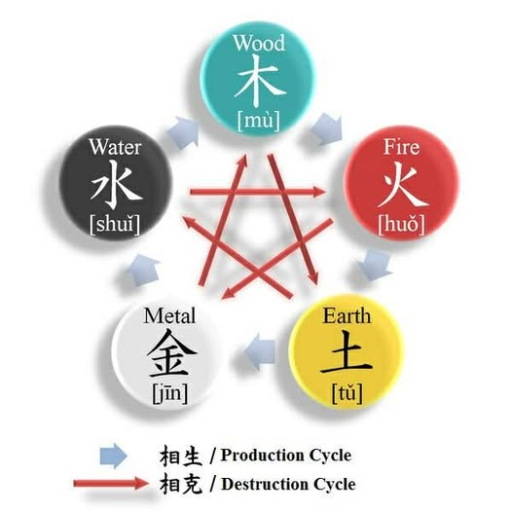
Your Day Master does not operate in isolation. The other elements in your Five Elements framework either nourish your flow, suppress it, or channel it into productive output.
Understanding these interactions is how you move from description to strategy.
| Element | Relationship to Yin Water | Effect | Practical Meaning |
|---|---|---|---|
| Metal | Producing (Resource) | Generates and refines Water | Structure, precision, and learning strengthen you |
| Water | Supporting (Companion) | Adds depth | Collaboration and community boost your energy |
| Wood | Produced by Water (Output) | Channels flow | Creativity and expression use your energy; productive but draining |
| Fire | Controlling (Power) | Threatens to evaporate | Authority and visibility challenge you; too much creates instability |
| Earth | Controlling (Wealth) | Absorbs and blocks | Wealth and discipline opportunities; excessive Earth dams your flow |
Metal: Your Source of Precision
Metal is the most important supporting element for the yin water personality. In BaZi, Metal represents structure, discipline, and refinement. For Gui Water, this translates to: systems, routines, clear boundaries, and intellectual frameworks. Metal turns mist into focused rain.
If your chart is low on Metal, you may feel chronically unstructured regardless of your actual circumstances. The solution is not to change your environment wholesale. It is to intentionally add Metal-like inputs: daily routines, calendar blocking, systematic note-taking, and clear decision criteria.
Fire: Your Primary Challenge
Fire controls Water. For the yin water personality, already the most Yin of all elements, excessive Fire is particularly destabilizing. In practical terms, this shows up as pressure to be visible, performative, or constantly expressive. High-conflict environments, aggressive leadership styles, and cultures that reward loudness over depth all function as excess Fire.
You cannot eliminate Fire from your life. No chart is perfectly balanced. But you can manage your exposure. If you are in a role dominated by constant visibility demands or punitive authority figures, you are fighting your own element.
Earth: Your Productive Tension
Earth represents a controlling relationship to Water, but for the yin water personality, this can be highly productive. Earth provides the banks that channel your flow. Without Earth, you drift. With too much Earth, you stagnate.
The key is proportion. A small amount of Earth focuses your energy. Too much blocks it entirely. This is why Yin Water people often do well with gentle structure — clear deadlines, defined scopes, and supportive managers — but poorly under rigid micromanagement.
How to Balance and Optimize Your Yin Water Energy
Knowing your yin water personality is useful. Knowing what to do with that knowledge is transformative.
Here are five specific strategies to optimize your Gui Water energy:
1. Schedule recovery like you schedule work. Your perceptiveness does not regenerate automatically. You need deliberate rest, solitude, and low-stimulation environments to process the emotional and sensory data you absorb. Block recovery time on your calendar with the same priority as meetings.
2. Build boundary rituals. Your empathy is an asset until it becomes a leak. Create specific practices that separate your energy from others’: a closing ritual at the end of work, a physical boundary (door, headphones, separate space), or a decision framework that asks “Is this mine to carry?” before you absorb someone else’s stress.
3. Limit high-conflict exposure. You are more vulnerable to emotional turbulence than most Day Masters. This does not mean avoiding all conflict. It means choosing your battles and exiting environments where hostility is the default culture.
4. Add Metal structure to your routine. Calendar blocking, decision criteria, and systematic review processes are not constraints on your creativity. They are channels for it. Metal turns your mist into rain that reaches the ground.
5. Track your depletion signals. For the yin water personality, burnout rarely arrives suddenly. It builds through gradual emotional saturation. Your early warning signs may include: increased difficulty making decisions, withdrawing from people you normally enjoy, and a sense that your work no longer feels meaningful. When you notice these, treat them as system alerts, not personal failures.
Yin Water Personality FAQ
What is a yin water personality in BaZi?
A yin water personality, or Gui Water (癸水), is the Yin expression of the Water element in the Four Pillars system. Symbolized by rain, mist, and gentle streams, it represents deep perception, creative adaptability, and quiet influence rather than broad, outward energy.
What is the difference between yin water and yang water?
Yang Water (Ren) is like the ocean: vast, public, strategic, and restless. Yin Water (Gui) is like mist or rain: subtle, private, intuitive, and reflective. Both are intelligent and adaptable, but Yang Water moves outward while Yin Water moves inward.
Is Gui Water weak or strong?
Neither. The gui water personality is not weaker than Yang Water — it is a specialized operating system. Within Gui Water itself, strength depends on birth season and element balance. Strong Gui Water shows confident insight; Weak Gui Water shows hesitation that stabilizes with Metal structure and support.
What careers suit a yin water personality?
Roles rewarding perceptiveness, creative depth, and quiet influence suit Gui Water best. Modern examples include UX researcher, data analyst, content strategist, therapist, strategic consultant, writer, and intelligence analyst.
What elements support Yin Water?
Metal generates and refines Yin Water through structure and learning. Water companions add depth. Wood channels Water into productive creativity. Excessive Fire or Earth can destabilize or block the flow.
How do I know if my Gui Water is strong or weak?
Check your BaZi chart. If you were born in autumn or winter with Metal and Water elements dominating, your Gui Water is likely strong. If born in spring or summer with heavy Fire and Earth, it is likely weak.
Conclusion
The yin water personality is not a diminished version of Water. It is a specialized version.
You are not built to dominate rooms. You are built to see what others miss. You are not built for shallow networks. You are built for transformative depth. Your sensitivity is not a weakness. It is the sensor array that makes your insight possible.
The key is alignment. When your role, environment, and relationships match your gui water personality, you perform at levels that surprise even you. When they do not, you exhaust yourself trying to be someone you were never designed to be.
Your BaZi chart does not determine your future. It maps your tendencies. And when you understand your yin water personality and those tendencies, you stop fighting yourself and start leveraging yourself.
That is the real power of knowing your Day Master.
Want to explore how Yin Water compares to other Day Masters? Read our complete guide to the Yang Water (Ren Water) personality or dive deeper into the Ten Gods framework to understand how your Day Master interacts with every other element in your chart. For timing insights, explore how Luck Pillars shift your energy across different life cycles.