


The Day Master — or day master bazi — is the single most important character in your BaZi chart. Every other element, relationship, and timing cycle is interpreted relative to it.
Most people learn BaZi in fragments. They hear about the Four Pillars, the Ten Gods, and Luck Pillars, but they miss the central reference point that ties everything together. Without the Day Master, a chart reading becomes a collection of disconnected symbols. With it, the chart becomes a coherent map of tendencies, timing, and choice.
In this guide, you’ll learn what a Day Master is, how to find yours in any BaZi chart, how to assess whether it’s strong or weak, and how to connect that knowledge to the Ten Gods, Useful God, and real-life decisions. This is the central hub of our Day Master content cluster. Each section links to a deeper guide you can read next.
If you haven’t generated your chart yet, start there. You’ll see your Day Master clearly once the Eight Characters appear.
Key Takeaways
- The Day Master is the Heavenly Stem of your Day Pillar and represents the core “you” in any BaZi chart.
- Day Master analysis means finding your self element, assessing its strength, and reading all other chart relationships through it.
- A strong Day Master is supported by season, roots, and helpful stems; a weak Day Master needs support to perform at its best.
- The same Ten God produces different outcomes depending on whether your Day Master is strong or weak.
- Your Day Master strength points toward your Useful God, or favorable element, which shapes career, health, and timing choices.
Day Master BaZi: What It Is and Why It Matters
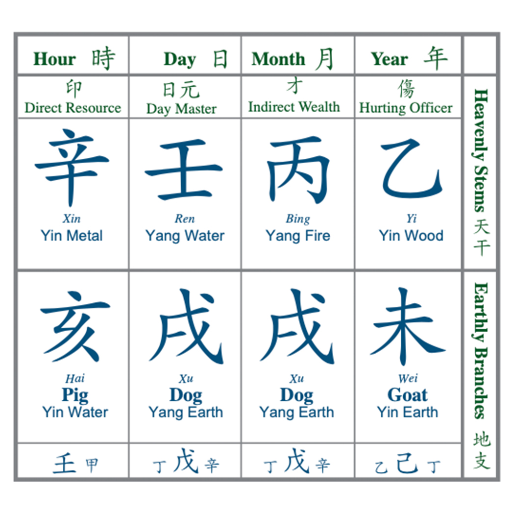
The Day Master (Ri Zhu, 日主) is the Heavenly Stem of the Day Pillar in your Four Pillars chart. It’s the character that represents you: your identity, your nature, and the lens through which every other element is read.
Think of your BaZi chart as a landscape. The mountains, rivers, weather, and roads all matter. But the Day Master is the traveler moving through that landscape. Without knowing the traveler, you can’t judge whether the path ahead is helpful or challenging.
In classical BaZi, the Day Pillar wasn’t always the center of analysis. Early systems emphasized the Year Pillar. During the Song dynasty, the scholar Xu Zipin shifted the focus to the Day Pillar, a transition documented in classical texts such as the Ziping Mingli Xue. Modern BaZi has followed that approach ever since.
This shift matters. It moved interpretation from clan and background to individual design. Your Day Master is one of ten possible stems: five elements, each in Yang and Yin form. Each combination carries a distinct temperament, set of strengths, and pattern of balance.
But the Day Master isn’t the whole story. Its meaning depends on the relationships around it, and those relationships are determined by its strength.
For a complete beginner introduction, see (what is a Day Master in BaZi). If you’re new to chart structure, our complete guide to Four Pillars gives you the foundation first.
How to Find Your Day Master: A Day Master BaZi Tutorial
Finding your day master bazi is simple once you know where to look. The challenge is making sure you start with the right birth data.
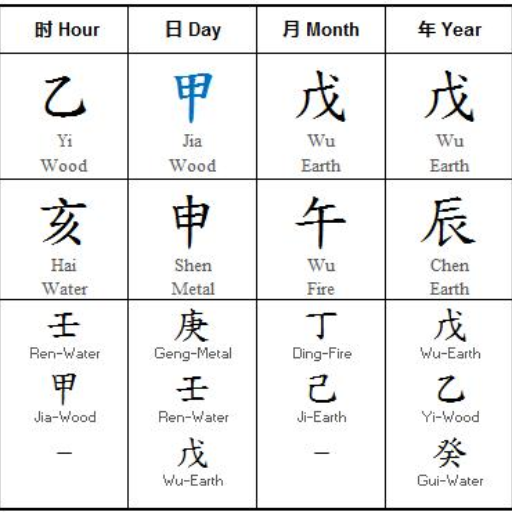
- Generate your Four Pillars chart using your birth year, month, day, and time. BaZi uses the solar calendar, not the lunar calendar. If you enter a lunar date by mistake, your Day Pillar will be wrong.
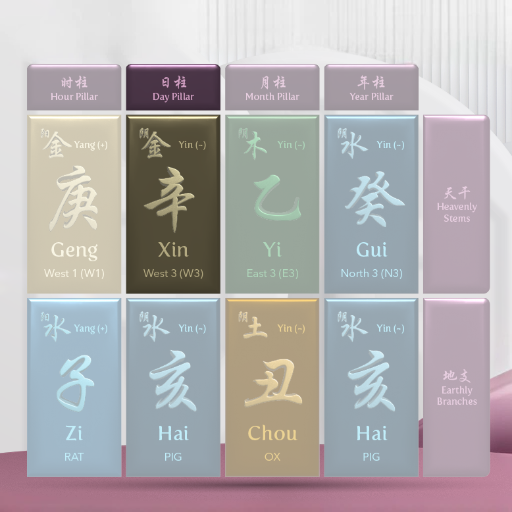
- Locate the Day Pillar. It sits in the center-right of the chart, between the Month Pillar and the Hour Pillar.
- Identify the top character. The top character of the Day Pillar is the Heavenly Stem. This is your Day Master.
- Note the element and polarity. The stem tells you which of the Five Elements you carry and whether it is Yang or Yin.
For example, if the top character of your Day Pillar is Jia Wood (甲), your Day Master is Yang Wood. If it’s Gui Water (癸), your Day Master is Yin Water. The bottom character, the Earthly Branch, adds context but doesn’t change your Day Master.
James studied BaZi for six months before he realized his mistake. He had been reading his Year Pillar as if it were the center of his chart. His predictions never matched his life.
Once he switched to his Day Master, the Ten Gods lined up with his actual decisions, relationships, and career patterns. The chart didn’t change. His reference point did.
If you want a detailed walkthrough, read our step-by-step guide on (how to find your Day Master in any BaZi chart). Then generate your free BaZi chart and follow along.
Strong vs. Weak Day Master: The Foundation of Interpretation
Day Master strength is not a judgment. Strong does not mean good. Weak does not mean bad. In day master bazi, strength measures how supported or unsupported your Day Master is within the chart.
A strong Day Master has plenty of support. It can handle pressure, competition, and challenge without collapsing. A weak Day Master needs allies, structure, and favorable timing to perform at its best.
Both designs produce success. They simply require different strategies.
Four factors determine Day Master strength:
- Season (De Ling): The month of birth is the most important factor. A Wood Day Master born in spring is in season and naturally strong. The same Wood Day Master born in autumn is out of season and weaker.
- Roots (De Di): Hidden stems inside the Earthly Branches can support the Day Master. A Fire Day Master with a Wood branch nearby has fuel to burn.
- Stem support (De Shi): Other Heavenly Stems that resource or companion the Day Master add strength. A Metal Day Master with another Metal stem nearby gains support.
- Draining forces: Output stars, Wealth stars, and Officer stars draw energy away from the Day Master. Too many of these without support weakens it.
Most charts fall clearly into strong or weak. Truly balanced charts are rare, perhaps 10 to 15 percent of cases, according to common estimates in traditional BaZi literature.
Lisa assumed her weak Day Master was a problem. She had spent years forcing herself into solo entrepreneurship, believing independence was the only path to success.
When she learned that her weak Day Master thrived with structure and support, she shifted to a team-based practice. Within two years, her income doubled and her stress dropped. Her chart hadn’t changed. Her strategy did.
For a deeper reframe, read our guide on (strong vs weak Day Master meanings). For the technical calculation, see our (bazi day master strength guide).
The Ten Day Masters at a Glance
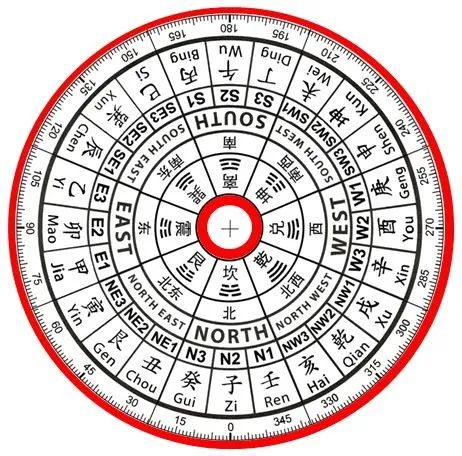
In day master bazi, every Day Master belongs to one of five elements, each with a Yang and Yin expression. The table below gives you a quick reference.
| Day Master | Element | Polarity | Symbol | Core Trait |
|---|---|---|---|---|
| Jia Wood (甲) | Wood | Yang | Towering Tree | Principled, visionary, structured |
| Yi Wood (乙) | Wood | Yin | Vine | Adaptive, diplomatic, creative |
| Bing Fire (丙) | Fire | Yang | Sun | Bold, generous, charismatic |
| Ding Fire (丁) | Fire | Yin | Candle | Refined, subtle, quietly influential |
| Wu Earth (戊) | Earth | Yang | Mountain | Steady, dependable, resilient |
| Ji Earth (己) | Earth | Yin | Soil | Caring, empathetic, detail-oriented |
| Geng Metal (庚) | Metal | Yang | Sword | Decisive, competitive, just |
| Xin Metal (辛) | Metal | Yin | Jewel | Elegant, strategic, refined |
| Ren Water (壬) | Water | Yang | Ocean | Ambitious, independent, broad-thinking |
| Gui Water (癸) | Water | Yin | Mist | Perceptive, intuitive, subtle |
Each pairing reveals a polarity within the same element. Yang forms tend to express outwardly and lead. Yin forms tend to adapt, refine, and influence indirectly.
Neither is better. Both need balance through the right environment and timing.
Wood Day Masters
Jia Wood is the towering tree. It grows straight, reaches high, and needs space. Yi Wood is the vine. It wraps around structures, finds openings, and thrives through flexibility.
Fire Day Masters
Bing Fire is the sun. It illuminates widely and generously. Ding Fire is the candle. It focuses warmth on a smaller circle with precision.
Earth Day Masters
Wu Earth is the mountain. It anchors and protects. Ji Earth is the soil. It nourishes and cultivates details.
Metal Day Masters
Geng Metal is the sword. It cuts through confusion and defends principle. Xin Metal is the jewel. It polishes, perfects, and attracts through refinement.
Water Day Masters
Ren Water is the ocean. It moves across vast distances and thinks in broad patterns. Gui Water is the mist or rain. It seeps into small spaces and reads what others miss.
How the Day Master Shapes the Ten Gods
The Ten Gods are not random labels. They are relationships calculated from your Day Master. Each God describes how another element in your chart interacts with you.
- Wealth stars are elements controlled by your Day Master.
- Power stars control your Day Master.
- Resource stars generate or support your Day Master.
- Output stars are produced by your Day Master.
- Companion stars share your element.
Here is the key insight most guides miss: the same Ten God means different things depending on whether your Day Master is strong or weak.
A strong Day Master can handle Wealth and Power stars. Money and authority become tools. A weak Day Master may be overwhelmed by the same stars. In that case, Resource and Companion stars become more valuable because they build the foundation first.
For example, Direct Officer represents discipline, authority, and structure. For a strong Day Master, Direct Officer can channel energy into leadership.
For a weak Day Master, too much Direct Officer pressure without support can feel like constant external control.
Wealth stars represent money and opportunities. For a strong Day Master, Wealth is approachable and manageable. For a weak Day Master, Wealth can drain energy unless Resource stars are also present to sustain the effort.
This is why Day Master analysis must come before Ten God interpretation. The symbol is the same. The outcome depends on the strength of the self element.
From Day Master to Useful God (Yong Shen)
Useful God, or Yong Shen, is the element your chart needs to create balance. It is one of the most practical outputs of Day Master analysis.
The first step in finding your Useful God is determining your Day Master strength. Once you know whether your Day Master is strong or weak, you can identify which elements support, suppress, mediate, or regulate it.
A common mistake is assuming your missing element is your needed element. If your chart has little Fire, that doesn’t automatically mean Fire is your Useful God. The correct element depends on your Day Master’s condition and the overall balance of the chart.
There are three common approaches:
- Support or suppress: A weak Day Master needs support. A strong Day Master benefits from being challenged or drained.
- Mediation: When two elements clash, a third element can harmonize them.
- Temperature regulation: Some charts run too hot or too cold and need an element to moderate temperature.
Once you know your Useful God, you can apply it to career choice, environment design, timing decisions, and even health habits. The element isn’t magic. It’s a practical filter for where your energy flows best.
For a complete method, read our guide on (Day Master and Useful God). It explains how to move from strength assessment to selecting your favorable element.
Using Your Day Master in Real Life
Day Master analysis is not a theoretical exercise. It becomes useful when you apply it to decisions.
Career alignment
Your Day Master element points toward environments where your energy is supported. A Wood Day Master often thrives in growth-oriented fields like education, planning, or startups. A Metal Day Master may do better in structured environments like law, engineering, or finance. The goal is not a single prescribed career. It is a category of conditions where your design functions well.
Decision-making style
A strong Day Master tends to decide quickly and act directly. A weak Day Master often benefits from gathering input, building consensus, and waiting for supportive timing. Neither style is wrong. Both become problems only when used in the wrong context.
Relationship strategy
Day Master polarity and element influence how you relate. Some combinations flow easily. Others require more negotiation. Compatibility is never about one element alone, but the Day Master gives you a starting point for understanding where harmony or friction may appear.
Health and energy
Each Day Master has renewal needs. Fire Day Masters need outlets for expression. Earth Day Masters need stability. Water Day Masters need mental space and movement. Ignoring these patterns leads to burnout. Honoring them restores balance.
Timing
Your Luck Pillars and annual cycles interact with your Day Master. A supportive cycle amplifies your strengths. A challenging cycle asks you to be more strategic. Knowing your Day Master lets you read those cycles in context.
Marcus was a Geng Metal Day Master. He kept accepting leadership roles because they looked like success. But generic management drained him.
When he learned that Geng Metal needs clear boundaries, justice-oriented work, and decisive problems, he moved into compliance consulting. The stress dropped. The results improved. His chart had always pointed in that direction. He just needed the right map.
For relationship applications, see our (Day Master compatibility guide.)
Day Master FAQ
What is the Day Master in BaZi?
The day master bazi is the Heavenly Stem of your Day Pillar. It represents your core identity and serves as the reference point for all other analysis in your chart.
How do I find my Day Master?
Generate your Four Pillars chart using your solar birth date and time. Locate the Day Pillar in the center-right column. The top character is your Day Master.
Is a weak Day Master bad?
No. Weak means your Day Master needs support to perform well. Many successful charts have weak Day Masters that thrive through teamwork, timing, and favorable elements.
What are the 10 Day Masters?
They are the ten Heavenly Stems: Jia Wood, Yi Wood, Bing Fire, Ding Fire, Wu Earth, Ji Earth, Geng Metal, Xin Metal, Ren Water, and Gui Water.
How do you know if your Day Master is strong or weak?
You evaluate four factors: season of birth, roots in Earthly Branches, supportive Heavenly Stems, and draining forces like Wealth, Power, and Output stars.
What does the Day Master represent?
It represents your core nature, decision style, energy patterns, and the lens through which all other chart elements are interpreted.
How does the Day Master relate to the Ten Gods?
Every Ten God is calculated from its relationship to the Day Master. The same Ten God produces different effects depending on Day Master strength.
Can your Day Master change?
No. Your Day Master is fixed at birth. However, your expression of it can evolve through awareness, environment, and timing.
Which Day Master is the best?
None. Each Day Master has balanced and excessive expressions. Success depends on understanding your design and working with it.
What is the Day Master used for?
It is used to assess personality, choose favorable elements, interpret Ten Gods, evaluate compatibility, and time decisions through Luck Pillars.
Start Your Day Master Analysis
Your Day Master is the traveler. The rest of your chart is the terrain. Once you know the traveler, every mountain, river, and crossroads makes more sense.
Mastering day master bazi gives you a structured way to read your own chart. You start by finding your Day Master. You assess its strength. You read its personality through the Ten Day Masters.
Then you connect it to the Ten Gods and Useful God. Finally, you apply that knowledge to career, relationships, health, and timing.
If you’re new to this, begin with our beginner guide to the Day Master. If you already know your Day Master and want to calculate its strength, use our Day Master strength guide or the instant strength tool.
The clearest next step is to generate your free BaZi chart, find your Day Pillar, and identify your self element. The chart is already there. You just need to read it from the right starting point.