


The ten gods meaning in BaZi refers to ten relational archetypes that describe how every element in your chart interacts with your Day Master. They are not deities. They are behavioral patterns. Each one reveals a specific role you play, from creator to competitor, from student to leader. Understanding them transforms your birth chart from a grid of elements into a precise psychological profile.
Rachel had heard it her whole life. “You are too independent.” “You do not collaborate well.” “You need to be more of a team player.” For years, she believed them. The group project required her to participate, which made her give up everything she had achieved, and she had to suppress her natural behavior to make others comfortable. The BaZi chart she created showed a clear pattern when she completed the process. The eight characters of her chart showed an overwhelming presence of Friend and Rob Wealth stars, which belong to the Companion category that controls self-reliance and competitive behavior and independent decision-making. Her independence did not constitute a weakness because it represented her fundamental nature. The Ten Gods simply gave her language for what she had always felt.
Most guides describe the Ten Gods in the abstract. They list definitions. They explain categories. But they never show you how to find them in your own chart or what your dominant ones actually mean for your daily decisions. This guide will. By the end, you will be able to identify every Ten God in your chart, spot your dominant archetypes, and understand what they reveal about your natural behavior. If you have not generated your chart yet, use our free BaZi calculator first, then follow along.
For a complete foundation on what these eight characters represent, see our complete guide to Four Pillars of Destiny.
Key Takeaways
- The Ten Gods (Shi Shen) are ten relational archetypes derived from how each element in your chart relates to your Day Master through element interaction and Yin-Yang polarity.
- Same polarity creates Indirect gods (偏); different polarity creates Direct gods (正).
- The five categories are Resource, Output, Wealth, Officer, and Companion, each containing two gods that represent distinct behavioral expressions.
- Your dominant Ten Gods are found through frequency count, Month Branch weight, Heavenly Stem visibility, and Useful God alignment.
- Classical combination patterns like Food God Generating Wealth modify basic meanings and reveal advanced chart dynamics.
What Are the Ten Gods?
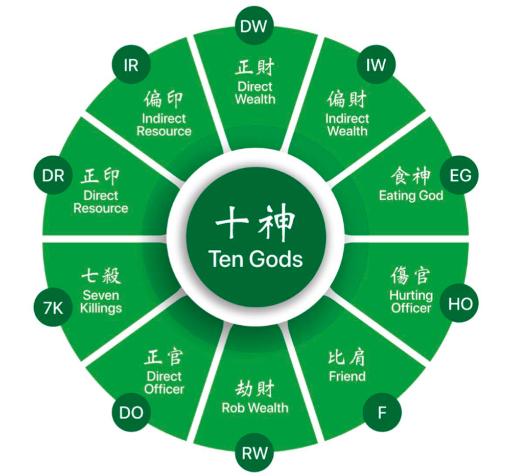
The Ten Gods (Shi Shen, 十神) are the interpretive engine of BaZi. While the Five Elements describe what energy is present, the Ten Gods describe how that energy relates to you. They answer the questions that actually matter. Who supports you? Who challenges you? What do you create? What do you pursue?
The system is elegant. It requires only two variables: the Five-Element interaction between your Day Master and another element, and the Yin-Yang polarity of that element relative to yours. From these two inputs, every element in your chart receives a specific label. That label tells you its role in your life.
DeepOracle’s modern framework maps these archetypes to detailed personality profiles, confirming what classical texts described centuries ago. The Ten Gods are not mystical forces. They are observable behavioral patterns that repeat across careers, relationships, and life decisions.
Think of your chart as a theater production. The Five Elements are the props and scenery. The Ten Gods are the cast of characters. Some play leading roles. Others are supporting actors. A few might be missing entirely. Understanding who is on stage and who is absent is the fastest way to understand the drama of your life.
How to Identify the Ten Gods in Your Chart
Reading the Ten Gods is a skill, not a gift. Anyone can learn it. You need only three things: your Day Master’s element and polarity, the Five-Element interaction rules, and the polarity check.
Step 1: Identify Your Day Master
Your Day Master is the Heavenly Stem of your Day Pillar. It represents you. Note its element (Wood, Fire, Earth, Metal, Water) and its polarity (Yang or Yin). For a deeper explore this central concept, read our (detailed Day Master guide).
Step 2: Map the Five Relationships
For every other element in your chart, determine its relationship to your Day Master:
| Relationship | Description |
|---|---|
| Same Element | Same element as Day Master |
| Produces Me | The element that nourishes your Day Master |
| I Produce | The element that your Day Master generates |
| Controls Me | The element that controls your Day Master |
| I Control | The element that your Day Master controls |
Step 3: Check Yin-Yang Polarity
Compare the polarity of the element to your Day Master:
- Same polarity = Indirect god (偏)
- Different polarity = Direct god (正)
Step 4: Assign the Ten God
Combine relationship + polarity to get the specific Ten God.
| Relationship | Same Polarity (Indirect) | Different Polarity (Direct) |
|---|---|---|
| Same Element | Friend (比肩) | Rob Wealth (劫财) |
| Produces Me | Indirect Resource (偏印) | Direct Resource (正印) |
| I Produce | Eating God (食神) | Hurting Officer (伤官) |
| Controls Me | Seven Killings (七杀) | Direct Officer (正官) |
| I Control | Indirect Wealth (偏财) | Direct Wealth (正财) |
Step 5: Count Hidden Stems
Each Earthly Branch contains one to three hidden elements. These count too. The Tiger (Yin, 寅) branch, for example, contains Jia Wood, Bing Fire, and Wu Earth. Each hidden stem receives its own Ten God label relative to your Day Master.
Example Walkthrough
If your Day Master is Jia Wood (Yang Wood, 甲):
| Element | Relationship | Polarity | Ten God |
|---|---|---|---|
| Jia (甲) – Yang Wood | Same | Same | Friend |
| Yi (乙) – Yin Wood | Same | Different | Rob Wealth |
| Ren (壬) – Yang Water | Produces Me | Same | Indirect Resource |
| Gui (癸) – Yin Water | Produces Me | Different | Direct Resource |
| Bing (丙) – Yang Fire | I Produce | Same | Eating God |
| Ding (丁) – Yin Fire | I Produce | Different | Hurting Officer |
| Wu (戊) – Yang Earth | I Control | Same | Indirect Wealth |
| Ji (己) – Yin Earth | I Control | Different | Direct Wealth |
| Geng (庚) – Yang Metal | Controls Me | Same | Seven Killings |
| Xin (辛) – Yin Metal | Controls Me | Different | Direct Officer |
Once you label every stem and hidden stem in your chart, you have your complete Ten God map. For a complete step-by-step chart reading methodology, see our guide on how to read your BaZi chart.
The Five Categories: Complete Profiles

Here is what each category looks like in its balanced, excessive, and weak states.
Resource (Direct Resource / Indirect Resource)
Resource stars represent learning, support, and nourishment. They are how you replenish your energy and build your knowledge base.
Direct Resource (Zheng Yin, 正印): The Scholar. Benevolent wisdom, formal education, maternal care, and nurturing support. Direct Resource people value credentials, traditions, and structured learning. They are the wise counselors in any group.
Indirect Resource (Pian Yin, 偏印): The Mystic. Unconventional wisdom, intuition, eccentric depth, and niche knowledge. Indirect Resource people learn through isolation, experimentation, and alternative paths. They are the independent researchers and creative outsiders.
| State | Expression |
|---|---|
| Balanced | Studious, thoughtful, resourceful, protective |
| Excessive | Overly cautious, dependent on credentials, rigid thinking |
| Weak/Missing | Lacks support, undervalues learning, struggles with mentorship |
Career alignment: Academia, research, healthcare, counseling, education, library science.
Output (Eating God / Hurting Officer)
Output stars represent creativity, expression, and what you produce. They are how you manifest your inner world into external reality.
Eating God (Shi Shen, 食神): The Gentle Creator. Refined creativity, teaching, calm expression, and sustainable productivity. Eating God people bring warmth and comfort. They are the nurturers who create beauty and share knowledge gently.
Hurting Officer (Shang Guan, 伤官): The Rebel Innovator. The combination of disruptive creativity with intellectual rebellion allows people to create new ideas by breaking established rules. Hurting Officer people challenge authority and cut through convention. The group consists of people who use their charm to criticize society while they think in ways that break from traditional patterns.
| State | Expression |
|---|---|
| Balanced | Creative, expressive, articulate, innovative |
| Excessive | Reckless, argumentative, burns bridges, scattered |
| Weak/Missing | Blocked expression, fear of visibility, creative stagnation |
Career alignment: Arts, design, writing, teaching, consulting, journalism, performance, therapy.
Wealth (Direct Wealth / Indirect Wealth)
Wealth stars show three aspects of material wealth which includes resources and results and material mastery. They reflect your relationship with money, assets, and tangible outcomes.
Direct Wealth (Zheng Cai, 正财): The Earner. The Direct Wealth pathway leads to financial success through consistent employment which requires people to develop their financial understanding and economic management abilities. Direct Wealth people value security and reliability. They are the diligent managers who build wealth methodically.
Indirect Wealth (Pian Cai, 偏财): The Venturer. The path to Indirect Wealth leads to financial success through investment opportunities and business skills and unexpected financial gains and successful contract negotiations. Indirect Wealth people spot opportunities others miss. The people who work in this field build their success through developing connections with others.
| State | Expression |
|---|---|
| Balanced | Financially aware, resourceful, practical, generous |
| Excessive | Materialistic, anxious about money, hoarding or overspending |
| Weak/Missing | Poor financial boundaries, undervalues resources, struggles with stability |
Career alignment: Accounting, banking, entrepreneurship, sales, real estate, investment, asset management.
Officer (Direct Officer / Seven Killings)
Officer stars represent authority, structure, and discipline. They govern how you handle pressure, rules, and social status.
Direct Officer (Zheng Guan, 正官) The Executive establishes authority through his legitimate power and acts as a responsible leader who maintains social order. Direct Officer people respect rules and climb structured ladders. The managers serve as judges and administrators who maintain institutional standards.
Seven Killings (Qi Sha, 七杀) The Warlord establishes his operational foundation through methods that include decisive action and competitive pressure and crisis management and transformative challenges. Seven Killings people thrive under extreme pressure. The group consists of crisis leaders and surgeons and strategists who make decisions when others hesitate.
| State | Expression |
|---|---|
| Balanced | Disciplined, responsible, authoritative, fair |
| Excessive | Rigid, anxious, controlling, fearful of failure |
| Weak/Missing | Lacks structure, avoids responsibility, rebels against all authority |
Career alignment: Management, law, government, military, medicine, corporate leadership, quality assurance.
Companion (Friend / Rob Wealth)
Companion stars represent your relationship with peers, competition, and yourself. They describe how you navigate equality and rivalry.
Friend: The Independent. Self-reliance with upheld determination and integrity, healthy competitiveness, guided independence. Friend people chose to walk paths less-trodden. They find Lone-Pioneers, Solitary-Proponents, and Autonomic-Crusaders amongst themselves.
Rob Wealth: The Mobilizer. Charismatic networkers, intensely loyal, fast, fiercely competitive. Rob Wealth people rally allies and seize opportunities. They are the big sales leaders, captains of good teams, and movers and shakers who are in a hurry.
| State | Expression |
|---|---|
| Balanced | Confident, collaborative when needed, self-assured, loyal |
| Excessive | Stubborn, overly competitive, resistant to feedback, territorial |
| Weak/Missing | Lacks self-confidence, easily influenced, struggles with boundaries |
Career alignment: Entrepreneurship, sales, sports, partnership businesses, competitive fields, hardware and machinery.
How to Find Your Dominant Ten Gods
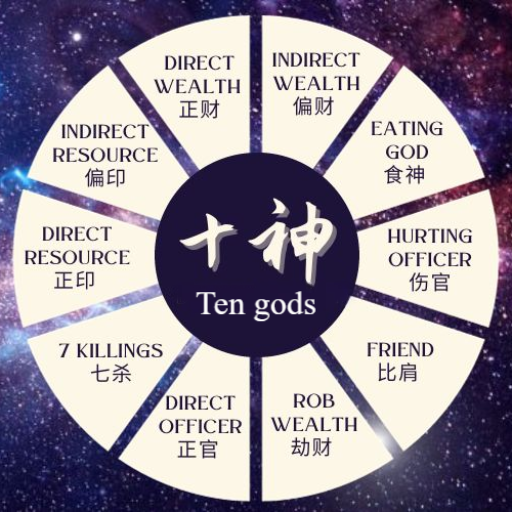
Not all Ten Gods in your chart carry equal weight. Some appear once and fade into the background. Others dominate your personality and life themes. Here is how to find the ones that matter most.
Method 1: Frequency Count
Count how many times each Ten God appears across all stems, branches, and hidden stems. The highest totals are your dominant archetypes. A chart with four Eating God references and one Direct Officer reference is clearly output-driven.
Method 2: Month Branch Weight
The hidden stems inside your Month Branch carry extra significance. The Month Branch represents your career palace and seasonal environment. Whatever Ten Gods hide there shape your professional trajectory more than gods hidden elsewhere.
Method 3: Heavenly Stem Visibility
Ten Gods that appear in the Heavenly Stems are the most visible and active in your life. They shape your outward personality, career expression, and how others perceive you. Gods that appear only in hidden stems influence your inner world and private tendencies.
Method 4: Useful God Alignment
The most important Ten God in your chart is not necessarily the most frequent. It is the one that serves as your Useful God (Yong Shen), the element that balances your chart’s specific imbalance. This god may appear only once or twice, but its role is critical.
Michael discovered this the harder way. His chart was completely dominated by the Output stars Variable Eating God and Hurting Officer in particular. He changed jobs four times within a decade, all related to creative development. Was he ever referred to as jumped-up by his friends, and, to add insult to injury, unfocused by family? Mapping his ten gods suggested the truth: rather than a broken and useless chart, it was only expressing itself correctly. Output’s dominance was all that was to blame: it made him want to be creative, detesting the binding rhythms of routine and always prompted toward new expressions. Indeed, realization that he was set to be as depicted instead of being flawed was what put an end to the battle with himself. And so his portfolio career, where he was engaged in multiple simultaneous creative scenes, made him soar twofold financially within two years.
For a deeper exploration of how timing modifies Ten God expression, see our Luck Pillars and 10-year cycles guide.
Ten God Combinations and Patterns
Individual Ten Gods tell part of the story. But combinations tell the full story. Classical texts describe dozens of important patterns formed when specific Ten Gods appear together.
Food God Generating Wealth (食神生财)
When Eating God appears alongside Wealth stars, talent converts directly into income. This is one of the most praised patterns in classical BaZi. It describes people who monetize their creativity effortlessly. Writers who sell books. Chefs who open restaurants. Consultants who package expertise.
Hurting Officer + Indirect Wealth (伤官配偏财)
When the Rebel Innovator meets the Venturer, creativity combines with risk-taking to produce entrepreneurship. This pattern describes people who disrupt industries and build unconventional businesses. Startups, trading, innovation-driven ventures.
Direct Officer + Direct Resource (官印相生)
When the Executive meets the Scholar, authority is protected by knowledge. This pattern describes smooth corporate advancement, stable management roles, and careers built on credentials and reputation. The classic civil servant or corporate ladder climber.
Seven Killings + Indirect Resource (杀印相生)
When the Warlord meets the Mystic, crisis is managed through unconventional strategy. This pattern describes military strategists, crisis managers, surgeons, and anyone who performs best under extreme pressure with unorthodox methods.
Shi Shen Controlling Seven Killings (食神制杀)
When the Gentle Creator tames the Warlord, refined skill controls aggressive force. This is a classic power pattern. It describes people who achieve remarkable influence not through dominance, but through mastery. The advisor who guides the leader. The diplomat who prevents war.
CosmicTao’s library provides detailed technical coverage of these classical combinations and their historical interpretations.
Ten Gods Across the Four Pillars
Where a Ten God appears matters as much as which Ten God it is. Each pillar governs a different life domain.
| Pillar | Domain | What It Reveals |
|---|---|---|
| Year | Background, ancestry, early environment | Inherited tendencies, family influence, childhood patterns |
| Month | Career, parents, social structure | Professional expression, work style, relationship with authority |
| Day | Core self, spouse, values | Your identity, marriage patterns, inner world |
| Hour | Children, later life, legacy | Future direction, creative output, hidden potential |
A Wealth star in your Month Pillar suggests career paths where financial management or entrepreneurship is natural. A Direct Officer in your Day Branch indicates a structured approach to marriage and partnerships. Heavy Resource in your Hour Pillar might mean late-life focus on teaching, mentoring, or intellectual pursuits.
Read the pillars as a story. Your origins. Your formation. Your core identity. Your legacy. Together they form the narrative arc of your life.
Practical Application: What to Do With This Knowledge

Knowing your Ten Gods is only valuable if you use them. Here is how to translate archetype knowledge into real decisions.
Career Alignment
Your dominant Ten Gods point toward natural career expressions. Heavy Output? Explore creative or communication-driven paths. Heavy Officer? Structure and management roles fit best. Heavy Wealth? Financial, commercial, or entrepreneurial tracks align. Heavy Resource? Learning, teaching, and support roles suit you. Heavy Companion? Independent or competitive fields thrive.
Relationship Patterns
Ten Gods also reveal relationship dynamics. In traditional BaZi, Direct Officer represents the husband for women. Wealth represents the wife for men. But more broadly, Officer stars indicate how you relate to authority and structure in partnerships. Resource stars indicate how you give and receive support. Understanding these patterns helps you choose compatible partners and navigate relationship friction.
When to Develop Weak Gods vs. use Strong Ones
You do not need to fix every gap. A missing Ten God is not always a problem. If the missing god is unfavorable for your Day Master, its absence may actually be healthy. But if a favorable god is weak, you can strengthen it through career choices, daily habits, and environmental design.
Priya learned this through painful experience. Her chart showed strong Eating God and Indirect Wealth, but almost no Officer stars. For years, she forced herself into management roles, believing that leadership was the only path to success. Every promotion made her miserable. When she finally understood her Ten God pattern, she stopped fighting it. She left management, built a freelance consulting practice, and use her creative Output and opportunistic Wealth stars. Within 18 months, she was earning more than her old salary while working half the hours.
Nova Masters Consulting’s career framework maps Ten God dominance to specific industry clusters, showing how archetype patterns predict professional satisfaction.
For a deeper exploration of timing your career moves, see our (Bazi Career Analysis Guide).
Frequently Asked Questions
What are the Ten Gods in BaZi?
The Ten Gods (Shi Shen, 十神) are ten relational archetypes that describe how each element in your BaZi chart interacts with your Day Master. They fall into five categories (Resource, Output, Wealth, Officer, Companion), each with a Direct and Indirect expression based on Yin-Yang polarity.
How do you identify Ten Gods in a chart?
First, identify your Day Master’s element and polarity. Then, for every other element in your chart, determine its Five-Element relationship to your Day Master and whether its polarity matches or differs. The combination gives you the specific Ten God.
What does Eating God mean in BaZi?
Eating God (Shi Shen) is the element your Day Master produces with the same polarity. It represents gentle creativity, teaching, refined expression, and sustainable productivity. It is often called the “happiest star” in BaZi.
Which Ten God represents career?
The Officer stars (Direct Officer and Seven Killings) most directly represent career, authority, and professional structure. However, Wealth stars indicate financial careers, Output stars indicate creative careers, and Resource stars indicate academic or support careers.
What does Seven Killings mean in BaZi?
Seven Killings (Qi Sha) is the element that controls your Day Master with the same polarity. It represents competitive pressure, crisis, decisive action, and transformative challenges. When properly directed, it creates exceptional achievement under pressure.
How do Ten Gods relate to the Day Master?
The Day Master is the reference point for all Ten Gods. Every other element in the chart is interpreted relative to it. The same element can be a Wealth star for one person and an Officer star for another, depending on their Day Master.
Can you have multiple dominant Ten Gods?
Yes. Most charts show a mix of Ten Gods with one to three dominant archetypes. The combination of dominant gods creates unique personality profiles. For example, Eating God + Indirect Wealth describes a creative entrepreneur.
Conclusion
Your BaZi chart is not a random collection of elements. It is a cast of characters. Each Ten God plays a role. Some lead. Some support. Some are missing entirely. And that is fine.
The goal is not to have every god present. The goal is to understand who is on your stage and what they are doing. When you know your dominant Ten Gods, you understand your natural casting. When you know your weak ones, you understand your blind spots. When you know the combinations, you understand the plot.
Your chart is not a prison. It is a script. And the Ten Gods are the characters who bring it to life.
Ready to meet your cast?
Generate your free BaZi chart now and identify the Ten Gods that shape your decisions.
Your archetypes are already there. You just need to read them.