


The Day Master in BaZi is the Heavenly Stem of your Day Pillar, the single character that represents “you” in your Four Pillars chart. Every other element, every Ten God, and every Luck Pillar is interpreted relative to this one stem, making it the analytical center of your entire chart.
James had studied BaZi for six months. He knew his Four Pillars, his Ten Gods, and his Luck Pillars. But his predictions never matched reality. The problem was simple: he had been using his Year Pillar as his reference point. His Day Master told a completely different story. The moment he switched to the correct reference point, the patterns he had been struggling to read suddenly made sense. He was not bad at BaZi. He was reading from the wrong center.
Most beginners make this mistake. The students learn eight characters together with Five Elements and Ten Gods but they fail to understand the single rule which connects all elements through their Day Master function as their main perspective. The entire system of BaZi requires this element for complete comprehension. The guide begins with an explanation of the Day Master which shows readers how to identify their Day Master through chart analysis. The free BaZi calculator offers chart creation for users who need it before they can continue with the process.
For a complete foundation on what these eight characters represent, see our complete guide to Four Pillars of Destiny.
Key Takeaways
- The Day Master functions as your Day Pillar’s Heavenly Stem which establishes the basis for analyzing all components of your BaZi chart.
- There are 10 Day Masters which create unique personality traits through their combination of the Five Elements with either Yin or Yang.
- The strength of Day Master (strong vs. weak) depends on seasonal support and hidden stem roots and surrounding elemental forces instead of “good” or “bad” destiny.
- The same Ten God means different things depending on whether your Day Master is strong or weak, which is why generic interpretations often fail.
- Knowing your Day Master element and strength helps you align your career, relationships, and daily decisions with your natural design.
What Is the Day Master?
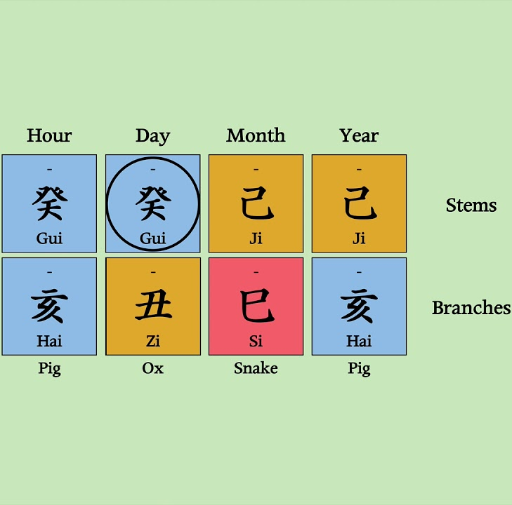
Your BaZi chart contains eight characters arranged across four pillars. Each pillar has a Heavenly Stem on top and an Earthly Branch below. The Day Pillar sits in the center-right of your chart, and its Heavenly Stem is your Day Master.
Think of your chart as a landscape. Mountains, rivers, forests, and cities surround you. The Day Master is the traveler moving through that terrain. Every feature in the landscape is judged by how it affects the traveler, not by any absolute quality of its own. A steep mountain might challenge one traveler and shelter another. A wide river might nourish one traveler and block another. The landscape does not change. The traveler does.
This is why the Day Master is non-negotiable. It is the “self” element (Ri Yuan, 日元) that every classical BaZi text uses as its starting point. The Song dynasty master Xu Zipin refined this methodology by shifting analytical emphasis from the Year Pillar to the Day Pillar, an innovation so significant that BaZi is sometimes called the “Ziping methodology” (子平術).
Master Sean Chan emphasizes that this shift was not arbitrary. The Year Pillar describes your background and inherited tendencies. The Day Pillar describes your core identity. Reading a chart from the Year Pillar is like describing a painting by its frame. The Day Master is the image inside.
How to Find Your Day Master
You do not need years of study to locate your Day Master. You need five minutes and a correctly generated chart.
Step 1: Generate Your Four Pillars Chart
Use your exact birth date and time. The critical detail most beginners miss: BaZi uses the solar calendar, not the lunar calendar. If you input a lunar birth date, your Day Master will be wrong. Most modern calculators handle this automatically, but it is worth confirming.
Step 2: Locate the Day Pillar
Your chart displays four pillars in this order:
| Pillar | Position | Represents |
|---|---|---|
| Year Pillar | Far left | Background, ancestors, early environment |
| Month Pillar | Center-left | Career palace, parents, social structure |
| Day Pillar | Center-right | You, core identity, spouse palace |
| Hour Pillar | Far right | Children, later life, hidden potential |
The Day Pillar is always the third column from the left.
Step 3: Identify the Heavenly Stem
Each pillar has two characters. The top character is the Heavenly Stem. The bottom character is the Earthly Branch. The top character of your Day Pillar is your Day Master.
Step 4: Note the Element and Polarity
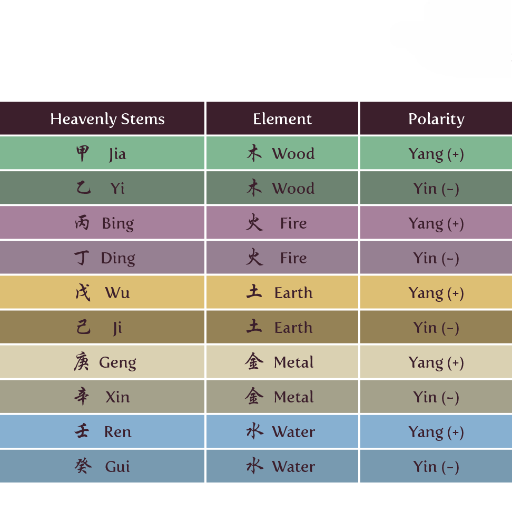
Each Heavenly Stem has an element and a polarity:
| Stem | Polarity | Element |
|---|---|---|
| Jia (甲) | Yang | Wood |
| Yi (乙) | Yin | Wood |
| Bing (丙) | Yang | Fire |
| Ding (丁) | Yin | Fire |
| Wu (戊) | Yang | Earth |
| Ji (己) | Yin | Earth |
| Geng (庚) | Yang | Metal |
| Xin (辛) | Yin | Metal |
| Ren (壬) | Yang | Water |
| Gui (癸) | Yin | Water |
That is it. One character. One element. One polarity. And from that single stem, the entire interpretive framework of your chart unfolds.
The Ten Day Masters: Complete Profiles
There are not five personality types in BaZi. There are ten. Each Day Master combines an element with a polarity, producing distinct behavioral patterns.
Wood Day Masters
Jia Wood (甲), The Towering Tree
Jia Wood is principled, visionary, and structured. Like a tall tree, it grows upward with single-minded determination. Jia Wood people build things from the ground up. They need long-term goals, visible progress, and a sense of purpose that transcends daily tasks.
Yi Wood (乙), The Vine
Yi Wood is adaptive, diplomatic, and creative. Like a vine, it finds paths around obstacles rather than crashing through them. Yi Wood people excel at reading the room, timing their moves, and finding elegant solutions that others miss.
Fire Day Masters
Bing Fire (丙), The Sun
Bing Fire is bold, generous, and charismatic. Like the sun, it radiates warmth and visibility across a wide area. Bing Fire people thrive on recognition, purpose, and leadership. They light up rooms without trying.
Ding Fire (丁), The Candle
Ding Fire is refined, subtle, and quietly influential. Like a candle, its warmth is intimate, not broadcast. Ding Fire people connect deeply one-on-one. They are persuasive, nurturing, and bring precision to everything they touch.
Earth Day Masters
Wu Earth (戊), The Mountain
Wu Earth is steady, dependable, and resilient. Like a mountain, it does not flinch under pressure. Wu Earth people are the backbone of any team. They protect, stabilize, and endure.
Ji Earth (己), The Soil
Ji Earth is caring, empathetic, and detail-oriented. Like fertile soil, it nurtures everything that grows within it. Ji Earth people notice what others miss. They are the ones who remember birthdays, fix processes, and keep relationships alive.
Metal Day Masters
Geng Metal (庚), The Sword
Geng Metal is decisive, competitive, and just. Like a blade, it cuts through complexity with clarity. Geng Metal people value fairness, directness, and results. They do not tolerate ambiguity.
Xin Metal (辛), The Jewel
Xin Metal is elegant, strategic, and refined. Like a jewel, it brings aesthetic sensibility to everything it touches. Xin Metal people excel at precision work, branding, and quality control.
Water Day Masters
Ren Water (壬), The Ocean
Ren Water is ambitious, independent, and broad-thinking. Like the ocean, it sees patterns across vast distances. Ren Water people think in systems. They are drawn to strategy, consulting, and intellectual exploration.
Gui Water (癸), The Mist
Gui Water is perceptive, intuitive, and subtle. Like mist or rain, it processes information deeply and reads between the lines effortlessly. Gui Water people are natural analysts, therapists, and strategists.
For a complete breakdown of element interactions, see our (five elements bazi) guide.
Strong vs. Weak Day Master: How to Determine Yours
Here is where most guides stop describing and start confusing. They tell you that Day Masters can be strong or weak, but they do not show you how to figure out which one you are.
Let me be direct: strong does not mean good, and weak does not mean bad. These are technical measurements of support, not value judgments. A strong Day Master has plenty of elemental backing. A weak Day Master operates with less natural support. Both can succeed. Both can struggle. The difference is what they need from their environment.
Nova Masters Consulting frames this well: strength is about constitution, not destiny. It is the difference between a bodybuilder and a long-distance runner. Neither is superior. Each thrives in different conditions.
Factor 1: Season (De Ling, 得令)
This is the most heavily weighted factor. Each element has a season where it is naturally dominant:
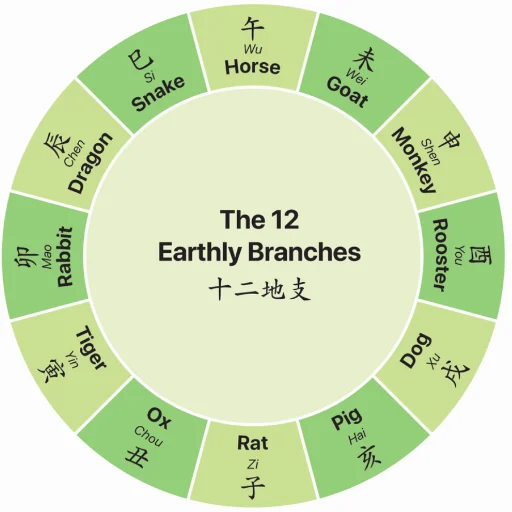
- Wood → Spring (Yin, Mao, Chen branches)
- Fire → Summer (Si, Wu, Wei branches)
- Metal → Autumn (Shen, You, Xu branches)
- Water → Winter (Hai, Zi, Chou branches)
- Earth → Transitional months (Chen, Xu, Chou, Wei, with support in Si and Wu)
If your Day Master is born in its supporting season, especially in the Month Branch, it gains massive natural strength. A Jia Wood Day Master born in the Month of Yin (Tiger/Spring) is “in season” and likely strong.
Factor 2: Roots (De Di, 得地)
Does your Day Master have hidden stems inside any Earthly Branch that match or support its element? A “rooted” Day Master has hidden reserves of strength.
For example, a Yi Wood Day Master with Mao (Rabbit), Chen (Dragon), or Wei (Goat) in the branches is considered rooted because these branches contain Wood hidden stems. Even one root can prevent an otherwise extremely weak chart from being classified as a Follow Pattern, which completely changes the reading rules.
Factor 3: Stem Support (De Shi, 得势)
Look at the other three Heavenly Stems (Year, Month, Hour). Are they Resource stars (elements that produce your Day Master) or Companion stars (elements identical to your Day Master)? If several stems support you, your Day Master gains momentum.
Factor 4: Draining, Consuming, and Controlling Forces
These are the elements that weaken your Day Master:
- Output (elements you produce), drains your energy
- Wealth (elements you control), consumes your energy
- Officer (elements that control you), restricts your energy
If these dominate the chart while support is absent, your Day Master is weak.
Quick 5-Point Assessment
- Supportive characters: Of the 7 non-Day Master characters, count how many are your element or your Resource element. Four or more generally indicates strength. Three or fewer suggests weakness.
- Born in season: Is the Month Branch your element’s season? If yes, this alone often tips the scale toward strong.
- Rooted: Does your Day Master appear in the hidden stems of any branch?
- Stem allies: Are the other Heavenly Stems mostly Resource or Companion stars?
- Dominant opposition: Are Output, Wealth, and Officer stars overwhelming the chart?
| Indicator | Strong Day Master | Weak Day Master |
|---|---|---|
| Season | Born in supportive season | Born in hostile or neutral season |
| Branches | Has roots in Earthly Branches | No roots; isolated |
| Stems | Supported by Resource and Companion | Surrounded by Officer, Wealth, Output |
| Needs | Benefits from challenge and drainage | Benefits from support and nourishment |
| Favorable | Officer, Output, Wealth | Resource, Companion |
Lisa assumed her “weak” Day Master was a problem. For years, she had avoided leadership roles because she thought weak meant incapable. When she learned that a weak Day Master simply thrives with structure and support, she stopped forcing herself into solo entrepreneurship and built a thriving team-based consulting practice instead. She was not broken. She was designed for collaboration.
What Day Master Strength Means for You
Knowing your Day Master element is only half the story. Knowing its strength changes everything.
Strong Day Master
A strong Day Master is self-sufficient, direct, and independent. It can handle pressure, competition, and challenge without collapsing. The risk is rigidity. A strong Day Master that never faces resistance can become overconfident, domineering, or blind to its own blind spots.
Career alignment: Leadership, entrepreneurship, high-pressure roles, competitive fields.
Relationship style: Takes assertive roles naturally. Benefits from learning patience and delegation.
Decision pattern: Acts quickly, trusts instincts, may benefit from gathering more input before major moves.
Weak Day Master
A weak Day Master is collaborative, strategic, and responsive. It reads environments well and knows when to lean on others. The risk is dependency. A weak Day Master without adequate support can become indecisive, passive, or overly reliant on external validation.
Career alignment: Specialist roles, team environments, structured organizations, advisory positions.
Relationship style: Benefits from dependable partners and mentors. Builds deep loyalty.
Decision pattern: Gathers input, considers context, may benefit from trusting instincts more often.
The Critical Link: Strength Determines Your Useful God
Your Useful God (Yong Shen, 用神) is the single most important concept in classical BaZi. It is the element or Ten God that restores balance to your chart and enables your Day Master to function optimally. And it is determined almost entirely by your Day Master strength.
DeepOracle’s technical framework explains this clearly: a weak Day Master generally needs Resource and Companion elements for support. A strong Day Master generally benefits from Officer, Wealth, or Output elements that drain, control, or challenge its excess energy.
This is why generic BaZi advice fails so often. The same element can be helpful for one person and harmful for another, depending entirely on Day Master strength.
The Day Master and the Ten Gods
The Ten Gods are not fixed labels. They are relational categories derived from how each element in your chart relates to your Day Master.
- The element your Day Master produces = Output (Eating God, Hurting Officer)
- The element that produces your Day Master = Resource (Direct Resource, Indirect Resource)
- The element your Day Master controls = Wealth (Direct Wealth, Indirect Wealth)
- The element that controls your Day Master = Officer (Direct Officer, Seven Killings)
- The element identical to your Day Master = Companion (Friend, Rob Wealth)
This means the same Ten God behaves differently depending on your Day Master strength. Take Direct Officer, which represents authority, structure, and discipline:
- For a strong Day Master, Direct Officer brings needed order and focus. It channels excess energy productively.
- For a weak Day Master, Direct Officer can feel overwhelming. The pressure may exceed the capacity to handle it.
Or consider Wealth:
- For a strong Day Master, Wealth is generally manageable. There is enough energy to pursue and hold resources.
- For a weak Day Master, Wealth can be draining. The opportunities exist, but capturing them exhausts the system.
For a complete breakdown of what each Ten God represents, see our detailed Ten Gods meaning guide.
Practical Application: Using Your Day Master Daily
Knowing your Day Master is not an intellectual exercise. It is a decision tool.
Career Alignment
Choose environments that match your Day Master element, not just your skills. A Ren Water Day Master needs variety, intellectual depth, and strategic scope. Repetition kills their energy. A Wu Earth Day Master needs stability, clear routines, and supportive teams. Chaos drains them.
Nova Masters Consulting maps Day Masters to modern professional roles with surprising precision. Geng Metal Day Masters gravitate toward law, surgery, and trading. Xin Metal Day Masters excel in branding, luxury, and investor relations. The pattern is not mystical. It is behavioral.
For a deeper exploration of timing your career moves, see our (Bazi Career Analysis Guide).
Decision-Making
Strong Day Masters act quickly and trust their instincts. Their growth edge is learning when to pause and gather input. Weak Day Masters gather input naturally and read context well. Their growth edge is learning when to decide and move forward.
Relationship Strategy
A strong Day Master often leads naturally. The challenge is learning when to support rather than direct. A weak Day Master often supports naturally. The challenge is learning when to lead rather than defer.
Health and Energy
Each Day Master has specific renewal needs. Wood needs movement and nature. Fire needs social connection and creative expression. Earth needs routine and grounding practices. Metal needs structure and clear boundaries. Water needs solitude and intellectual stimulation.
Marcus achieved the status of Geng Metal Day Master. He worked through multiple standard leadership positions which resulted in his work burnout. He believed that he needed to become more flexible and more collaborative and more easygoing. Geng Metal requires him to establish boundaries which link to justice work and to use direct communication methods so he switched to compliance consulting. The first time in ten years he experienced renewed energy after one year of work. He had not been failing at leadership. He had been leading in the wrong terrain.
For timing your biggest moves, see our Luck Pillars and 10-year cycles guide.
Frequently Asked Questions
What is the Day Master in BaZi?
In a BaZi chart your Day Pillar contains your Day Master which functions as your Heavenly Stem. The core identity of a person together with their personality traits and elemental characteristics are represented by this element which serves as the basis for interpreting all other chart elements.
How do I find my Day Master?
Generate your Four Pillars chart using your birth date and time (solar calendar). Locate the Day Pillar (center-right column). The top character, the Heavenly Stem, is your Day Master.
Is a weak Day Master bad?
No. Weak does not mean bad, unsuccessful, or unlucky. It simply means your Day Master has less natural elemental support and typically benefits from structure, collaboration, and nurturing environments. Many highly successful people have weak Day Masters.
How do you know if your Day Master is strong or weak?
Assess four factors: season of birth (does the Month Branch support your element?), roots (do hidden stems contain your element?), stem support (do other Heavenly Stems support you?), and draining forces (do Output, Wealth, and Officer stars dominate?).
How does Day Master relate to Ten Gods?
The Ten Gods are calculated based on how each element in your chart relates to your Day Master. The same element creates a different Ten God for different Day Masters, which is why the Day Master must be identified first.
What is the difference between strong and weak Day Master?
A strong Day Master is well-supported by surrounding elements and generally benefits from challenge, competition, and drainage. A weak Day Master has less support and generally benefits from nourishment, collaboration, and stable structure.
Can your Day Master change?
No. Your Day Master is fixed at birth and never changes. However, your Luck Pillars and Annual Pillars introduce new elemental influences that can temporarily strengthen or challenge your Day Master throughout life.
Which Day Master is the best?
There is no “best” Day Master. Each of the 10 has distinct strengths and challenges. Success depends on understanding your specific Day Master’s needs and aligning your environment and decisions accordingly.
What does the Day Master represent in relationships?
For men, the Wealth star (controlled by the Day Master) often represents the spouse. For women, the Officer star (controlling the Day Master) often represents the spouse. The Day Master’s strength affects how these relationship dynamics play out.
Conclusion
Your Day Master is the traveler. Your chart is the terrain. And most people are trying to read the map without knowing who is walking.
You now have a framework:
- Identify your Day Master in your Day Pillar’s Heavenly Stem.
- Know its element and polarity, one of 10 distinct profiles.
- Assess its strength using season, roots, stem support, and draining forces.
- Understand what strength means for your career, relationships, and decisions.
- Apply the Ten Gods relative to your Day Master, not in isolation.
- Use your Day Master knowledge to align your environment with your natural design.
James fixed his readings by changing his reference point. Lisa stopped fighting her need for support and built something better. Marcus stopped bending himself into the wrong shape and found work that fit.
Your Day Master is not a label. It is a lens. And once you know which one is yours, you will see your chart, and yourself, with a clarity that changes how you decide.
Ready to identify your Day Master?
Generate your free BaZi chart now and find the Heavenly Stem in your Day Pillar. Your reference point is already there. You just need to read it.