


Your Day Master and Ten Gods are the two lenses that turn a BaZi chart from a set of eight characters into a readable life map. The Day Master is your core identity. The Ten Gods are the relational roles every other element plays. Together, they form the interpretive foundation of BaZi.
James had just found his Day Master, Jia Wood. He felt like he’d unlocked a door. Then he looked at the rest of his chart and saw Geng Metal appearing twice. Was it pressure? Opportunity? Noise? The answer depended on his Day Master. For a Jia Wood person, Geng Metal is Seven Killings, the intense authority star. Once James understood that relationship, his recurring clashes with senior leaders stopped feeling random. They became a pattern he could work with.
This guide bridges the gap between identifying your Day Master and reading the rest of your chart. You’ll learn the two rules that generate every Ten God. You’ll see how to calculate ten gods from day master. And you’ll understand why the same star means different things depending on whether your Day Master is strong or weak.
Key Takeaways
- Your Day Master is the reference point; your Ten Gods are the relational labels every other element receives.
- Ten Gods are derived from two rules: the Five Element relationship (same, produces me, I produce, controls me, I control) and Yin-Yang polarity (same polarity = Indirect, opposite = Direct).
- The same element can be a different Ten God for different Day Masters. For example, Water is Resource for Wood Day Masters but Output for Metal Day Masters.
- Day Master strength decides whether a Ten God supports or challenges you. A strong Day Master handles Output, Wealth, and Officer stars better; a weak Day Master needs Resource and Companion support.
- Earthly Branch hidden stems also carry Ten God labels, so a complete reading includes both visible and hidden characters.
What Is the Relationship Between Day Master and Ten Gods?
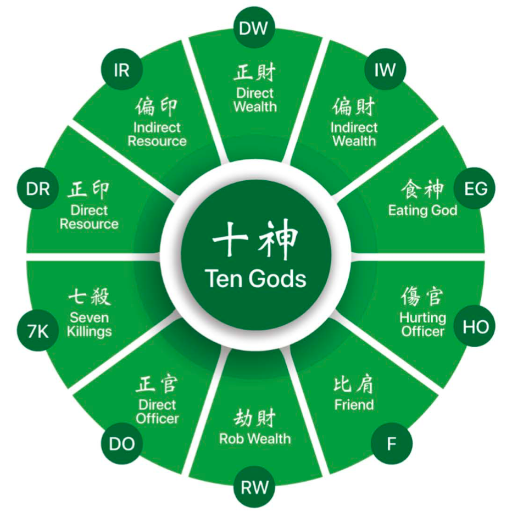
In BaZi, your chart contains eight visible characters arranged in four pillars. Each pillar has a Heavenly Stem on top and an Earthly Branch below. Every one of those characters, except your Day Master’s Heavenly Stem, gets a Ten God label. Understanding the day master ten gods meaning starts with this simple rule.
The Day Master is the central character. It represents your core self, your natural tendencies, and your elemental identity. The Ten Gods (Shi Shen, 十神) describe how every other element relates to that core.
Think of it like a company. The Day Master is the CEO. The Ten Gods are the roles: finance, marketing, operations, legal, R&D. The same person might thrive as a CFO in one company and struggle in another. It depends on the CEO’s leadership style and the company’s health. In BaZi, the “company’s health” is your Day Master strength.
This is why the same element means different things for different people. A strong Water influence in one chart might be Officer pressure for a Wood Day Master. In another chart, it might be Output expression for a Metal Day Master. The element hasn’t changed. The relationship has.
Lisa is a Bing Fire Day Master. Water controls Fire, so the strong Water in her chart shows up as Officer pressure. She thrives in structured environments with clear expectations, but too much Water feels like constant scrutiny.
Priya is a Xin Metal Day Master. Metal produces Water, so the same strong Water in her chart appears as Output expression. She processes pressure through writing, teaching, and creative problem-solving. The same Water energy that structures Lisa drains through Priya as ideas and communication.
The Two Rules That Generate Every Ten God
You don’t need to memorize 100 combinations. You only need two rules.
Rule 1: The Five Element Relationships
Every Ten God comes from one of five possible relationships between an element and your Day Master:
| Relationship | Category | Core Idea |
|---|---|---|
| Same element as me | Companion | Self, peers, competition, identity |
| Produces me | Resource | Support, learning, nourishment |
| I produce | Output | Expression, creativity, talent |
| Controls me | Officer | Authority, pressure, discipline |
| I control | Wealth | Resources, money, material control |
For example, if your Day Master is Bing Fire:
- Another Fire element is Companion
- Wood produces Fire, so Wood is Resource
- Fire produces Earth, so Earth is Output
- Water controls Fire, so Water is Officer
- Fire controls Metal, so Metal is Wealth
This rule gives you the category. The next rule gives you the flavor.
Rule 2: Direct vs. Indirect by Yin-Yang Polarity
Within each category, the Ten God is either Direct (正) or Indirect (偏), based on polarity:
- Same polarity as your Day Master = Indirect (偏)
- Opposite polarity as your Day Master = Direct (正)
If your Day Master is Yang, another Yang element in the same category is Indirect. A Yin element in the same category is Direct.
This polarity distinction matters enormously. Direct Officer is structured, gentle authority. Seven Killings (Indirect Officer) is intense, competitive pressure. Both are Officer stars, but they behave differently.
For a deeper look at the building blocks, read our guide to Heavenly Stems and Earthly Branches.
How to Calculate Ten Gods from Day Master in 3 Steps
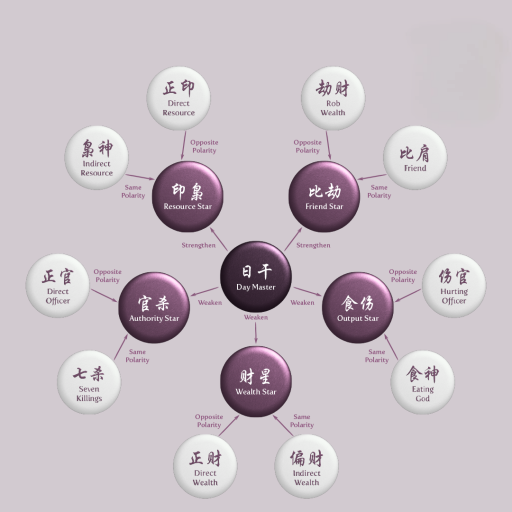
Once you know your Day Master, you can label every other element in your chart. Here is the exact process.
Step 1: Identify Your Day Master’s Element and Polarity
Your Day Master is the Heavenly Stem of your Day Pillar. Note its element and whether it is Yin or Yang.
For example, Jia (甲) is Yang Wood. Bing (丙) is Yang Fire. Xin (辛) is Yin Metal.
Step 2: Determine the Relationship for Each Other Element
For every other Heavenly Stem and hidden stem in your chart, ask: Is it the same element as me? Does it produce me? Do I produce it? Does it control me? Or do I control it?
This gives you the category: Companion, Resource, Output, Officer, or Wealth.
Step 3: Check Polarity to Label Direct or Indirect
Compare the polarity of the other element to your Day Master.
- Same polarity → Indirect Ten God
- Opposite polarity → Direct Ten God
Worked Example: Jia Wood (Yang Wood) Day Master
| Other Stem | Element | Polarity vs. Jia | Relationship | Ten God |
|---|---|---|---|---|
| Jia 甲 | Wood | Same (Yang) | Same element | Friend (比肩) |
| Yi 乙 | Wood | Opposite (Yin) | Same element | Rob Wealth (劫财) |
| Ren 壬 | Water | Same (Yang) | Produces me | Indirect Resource (偏印) |
| Gui 癸 | Water | Opposite (Yin) | Produces me | Direct Resource (正印) |
| Bing 丙 | Fire | Same (Yang) | I produce | Eating God (食神) |
| Ding 丁 | Fire | Opposite (Yin) | I produce | Hurting Officer (伤官) |
| Wu 戊 | Earth | Same (Yang) | I control | Indirect Wealth (偏财) |
| Ji 己 | Earth | Opposite (Yin) | I control | Direct Wealth (正财) |
| Geng 庚 | Metal | Same (Yang) | Controls me | Seven Killings (七杀) |
| Xin 辛 | Metal | Opposite (Yin) | Controls me | Direct Officer (正官) |
This is the complete Ten God mapping for a Jia Wood Day Master. Every other Day Master follows the same logic with different labels.
The Five Categories and What They Reveal
The Ten Gods fall into five categories. Each category describes a different life domain and set of behavioral patterns.
Resource: Support and Learning
Direct Resource (正印) is gentle, traditional support. Think mentors, formal education, nurturing figures, and stable wisdom.
Indirect Resource (偏印) is unconventional, intuitive knowledge. It favors specialists, researchers, and people who learn outside formal systems.
For a strong Day Master, too much Resource can create dependency or overthinking. For a weak Day Master, Resource is restorative. It builds the strength needed to handle everything else.
Output: Expression and Creativity
Eating God (食神) is refined, sustainable creativity. It shows talent that flows naturally, often in teaching, writing, design, or culinary arts.
Hurting Officer (伤官) is intense, disruptive expression. It challenges authority and convention. It can be brilliant, but it can also burn bridges if unchecked.
A strong Day Master produces Output well. A weak Day Master may feel drained by too much Output, because creating requires energy you don’t have.
Wealth: Resources and Material Control
Direct Wealth (正财) is stable, earned income. It favors discipline, saving, and predictable growth.
Indirect Wealth (偏财) is opportunistic, investment-oriented wealth. It favors deal-making, entrepreneurship, and windfalls.
Wealth stars represent what you can control and accumulate. A strong Day Master can hold Wealth. A weak Day Master may struggle to retain it, like a small cup under a waterfall.
Officer: Authority and Pressure
Direct Officer (正官) is structured, legitimate authority. It shows discipline, reputation, and rule-bound leadership.
Seven Killings (七杀) is intense, competitive pressure. It can bring power and decisiveness, but also conflict and risk.
Officer stars represent what controls you. A strong Day Master can handle Officer pressure and turn it into achievement. A weak Day Master may feel overwhelmed by it.
Companion: Self and Peers
Friend (比肩) is self-reliance and steady identity. It shows confidence, independence, and sometimes stubbornness.
Rob Wealth (劫财) is social competition and collaboration. It shows charisma, popularity, and the ability to mobilize others, but also financial fluctuation.
Companion stars represent your relationship with yourself and your peers. They are most useful when balanced; too many can create conflict or self-absorption.
Complete Ten Gods by Day Master Reference Table
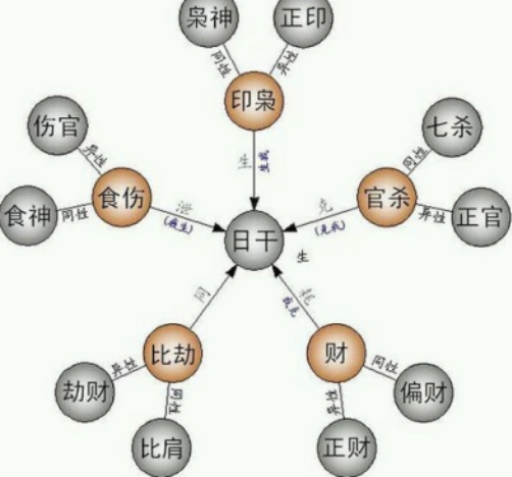
Use this table to find the Ten God for any stem relative to any Day Master.
| Day Master | Jia 甲 | Yi 乙 | Bing 丙 | Ding 丁 | Wu 戊 | Ji 己 | Geng 庚 | Xin 辛 | Ren 壬 | Gui 癸 |
|---|---|---|---|---|---|---|---|---|---|---|
| Jia Wood (甲) | Friend | Rob Wealth | Eating God | Hurting Officer | Indirect Wealth | Direct Wealth | Seven Killings | Direct Officer | Indirect Resource | Direct Resource |
| Yi Wood (乙) | Rob Wealth | Friend | Hurting Officer | Eating God | Direct Wealth | Indirect Wealth | Direct Officer | Seven Killings | Direct Resource | Indirect Resource |
| Bing Fire (丙) | Indirect Resource | Direct Resource | Friend | Rob Wealth | Eating God | Hurting Officer | Indirect Wealth | Direct Wealth | Seven Killings | Direct Officer |
| Ding Fire (丁) | Direct Resource | Indirect Resource | Rob Wealth | Friend | Hurting Officer | Eating God | Direct Wealth | Indirect Wealth | Direct Officer | Seven Killings |
| Wu Earth (戊) | Seven Killings | Direct Officer | Indirect Resource | Direct Resource | Friend | Rob Wealth | Eating God | Hurting Officer | Indirect Wealth | Direct Wealth |
| Ji Earth (己) | Direct Officer | Seven Killings | Direct Resource | Indirect Resource | Rob Wealth | Friend | Hurting Officer | Eating God | Direct Wealth | Indirect Wealth |
| Geng Metal (庚) | Indirect Wealth | Direct Wealth | Seven Killings | Direct Officer | Indirect Resource | Direct Resource | Friend | Rob Wealth | Eating God | Hurting Officer |
| Xin Metal (辛) | Direct Wealth | Indirect Wealth | Direct Officer | Seven Killings | Direct Resource | Indirect Resource | Rob Wealth | Friend | Hurting Officer | Eating God |
| Ren Water (壬) | Eating God | Hurting Officer | Indirect Wealth | Direct Wealth | Seven Killings | Direct Officer | Indirect Resource | Direct Resource | Friend | Rob Wealth |
| Gui Water (癸) | Hurting Officer | Eating God | Direct Wealth | Indirect Wealth | Direct Officer | Seven Killings | Direct Resource | Indirect Resource | Rob Wealth | Friend |
This 10×10 matrix is the classical foundation of BaZi interpretation. Master Sean Chan offers a detailed Day Master × Ten Gods matrix for readers who want a traditional reference.
Why Day Master Strength Changes Ten God Meaning
This is where many beginners get stuck. They read that Direct Wealth means stable income and assume it is always positive. It isn’t. The meaning of every Ten God shifts based on Day Master strength.
Strong Day Master: Drain, Control, or Express
A strong Day Master has enough support to handle demanding stars. It can:
- Use Wealth stars to accumulate resources
- Handle Officer pressure without collapsing
- Express Output stars without burning out
- Sometimes tolerate excess Companion energy
For a strong Day Master, Wealth, Officer, and Output often become favorable. Resource and Companion may become excessive if overabundant.
Weak Day Master: Support or Unite
A weak Day Master lacks internal support. It needs:
- Resource stars to nourish and stabilize it
- Companion stars to reinforce identity and confidence
For a weak Day Master, Wealth, Officer, and Output can be draining. They demand energy the Day Master doesn’t have. This doesn’t make those stars “bad.” It means they require careful management.
Example: Direct Wealth for Strong vs. Weak Day Master
Lisa has a strong Geng Metal Day Master with a prominent Direct Wealth star. She builds steady income through disciplined work. The star supports her naturally.
David has a weak Ji Earth Day Master with the same Direct Wealth star. He earns well but feels constantly depleted. For him, Wealth is not the first priority. Building Resource and Companion support comes first. Once his Day Master is stronger, Wealth becomes easier to hold.
This is why BaZi is not a labeling system. It is a balancing system. To learn how to assess your own Day Master strength, read our strong vs. weak Day Master guide.
Hidden Stems and Ten Gods
So far we have focused on the visible Heavenly Stems. But each Earthly Branch contains one to three hidden stems, and each hidden stem also receives a Ten God label.
For example, the Earthly Branch Zi (子, Rat) contains only Gui Water. If your Day Master is Jia Wood, Gui Water is Direct Resource. So a Zi branch in your chart contributes Direct Resource energy, even if you don’t see Gui Water on the surface.
The branch Yin (寅, Tiger) contains Jia Wood, Bing Fire, and Wu Earth. For a Jia Wood Day Master, those hidden stems become Friend, Eating God, and Indirect Wealth. One branch can carry multiple Ten God influences.
This is why a complete Ten God reading includes both visible and hidden characters. The visible stems show what is obvious. The hidden stems show what is working beneath the surface.
For a deeper exploration of how the Four Pillars structure works, read our Four Pillars of Destiny guide.
Practical Application: From Day Master to Life Theme
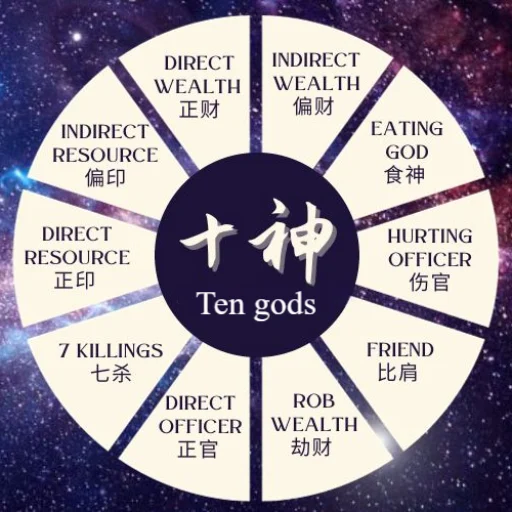
Here is a five-step method for turning your Day Master and Ten Gods into usable insight.
Step 1: Find your Day Master.
Use a calculator or manual lookup to identify the Heavenly Stem of your Day Pillar.
Step 2: Label every visible and hidden stem.
Apply the two rules to each of the eight visible characters and the hidden stems within each Earthly Branch.
Step 3: Count frequency and note dominance.
Which Ten Gods appear most often? Which categories dominate your chart?
Step 4: Adjust for Day Master strength.
Determine whether your Day Master is strong or weak. This changes which Ten Gods are supportive and which are demanding.
Step 5: Map to a life theme.
- Heavy Output → creative or communication-focused path
- Heavy Wealth → finance, business, or resource management
- Heavy Officer → leadership, structure, or authority roles
- Heavy Resource → learning, teaching, or advisory roles
- Heavy Companion → independent or peer-driven work
This method turns abstract symbols into concrete direction.
Frequently Asked Questions
How do Ten Gods relate to the Day Master?
The Ten Gods describe how every other element in your BaZi chart relates to your Day Master. They are derived from the Five Element relationship (same, produces me, I produce, controls me, I control) and Yin-Yang polarity. The Day Master is the reference point; the Ten Gods are the relational labels.
How do you calculate Ten Gods from the Day Master?
Use three steps: (1) identify your Day Master’s element and polarity, (2) determine the Five Element relationship for each other element, and (3) check polarity to label the Ten God as Direct or Indirect.
Why is the Day Master the reference point for Ten Gods?
The Day Master represents your core self. Every other element in the chart is interpreted relative to you. Without the Day Master, there is no way to assign consistent meaning to the other characters.
Can the same element be a different Ten God for different people?
Yes. The same element has different relationships to different Day Masters. For example, Water is Resource for Wood Day Masters but Output for Metal Day Masters.
How does Day Master strength affect Ten God meaning?
A strong Day Master can handle Output, Wealth, and Officer stars. A weak Day Master needs Resource and Companion support. The same Ten God can be favorable for one person and demanding for another depending on Day Master strength.
What are the five categories of Ten Gods?
The five categories are Resource, Output, Wealth, Officer, and Companion. Each category contains one Direct and one Indirect Ten God.
What is the difference between Direct and Indirect Ten Gods?
Direct Ten Gods come from opposite polarity to the Day Master and tend to be more balanced, orthodox expressions. Indirect Ten Gods come from the same polarity and tend to be more intense, unconventional, or challenging.
Which Ten God represents wealth?
Direct Wealth (正财) represents stable, earned income. Indirect Wealth (偏财) represents investment, business, and opportunistic wealth.
Which Ten God represents career?
Direct Officer (正官) and Seven Killings (七杀) represent authority, discipline, and career structure. Direct Officer is gentle and rule-bound; Seven Killings is intense and competitive.
How do hidden stems get Ten God labels?
Each Earthly Branch contains one to three hidden stems. Each hidden stem is evaluated against the Day Master using the same two rules and receives a Ten God label.
Conclusion
Your Day Master and Ten Gods are not separate topics. They are two sides of the same reading process. The Day Master gives you the central character. The Ten Gods give every other character a role in the story.
The system is simpler than it looks. Two rules generate every label: the Five Element relationship and Yin-Yang polarity. One factor, Day Master strength, decides whether those labels support or challenge you.
Start with your Day Master. Label the other characters. Count what dominates. Adjust for strength. Then map the pattern to career, relationships, and decisions.
Ready to read your own chart? Use our free BaZi calculator to generate your chart with every Ten God labeled instantly. Then explore our complete Ten Gods guide to go deeper into each archetype. Your chart is already written. Now you know how to read it.