


How to Determine BaZi Day Master Strength: A 4-Step Method
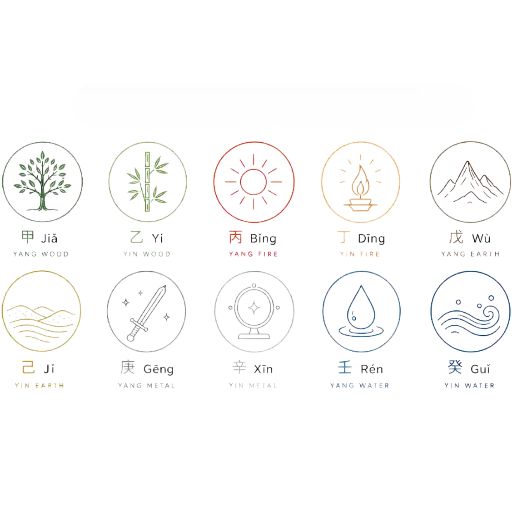
To determine your bazi day master strength, check four things in order: the season of your birth month, the roots hidden in your Earthly Branches, the support or pressure from other stems, and whether any special pattern reverses the normal rules. This single judgment shapes every other interpretation in your chart.
Most people don’t realize how much rides on this one step. They jump straight to reading wealth stars, career signs, or relationship clues. But if your Day Master strength is misread, those readings point in the wrong direction. Worse, two calculators can give you two different answers. Without a clear method, you won’t know which one to trust.
This guide gives you a repeatable way to assess Day Master strength yourself. You’ll learn the three hinges classical BaZi uses, a 4-step process you can apply to any chart, and the hidden reasons automated tools sometimes disagree. By the end, you’ll read your chart with more confidence and less confusion.
Key Takeaways
- Day Master strength is the foundation of BaZi interpretation; misread it and your favorable elements flip.
- The three hinges are De Ling (season), De Di (roots), and De Shi (momentum of support).
- Season carries the most weight, roughly 40-50% of the strength assessment.
- Hidden stems inside Earthly Branches can turn a weak-looking chart into a supported one.
- Special patterns like Follow Chart (从格) reverse the normal strong/weak logic.
If you want a fast starting point, you can check your Day Master strength with our free calculator first. Then come back to this guide to understand the logic behind the result.
What Is Day Master Strength?
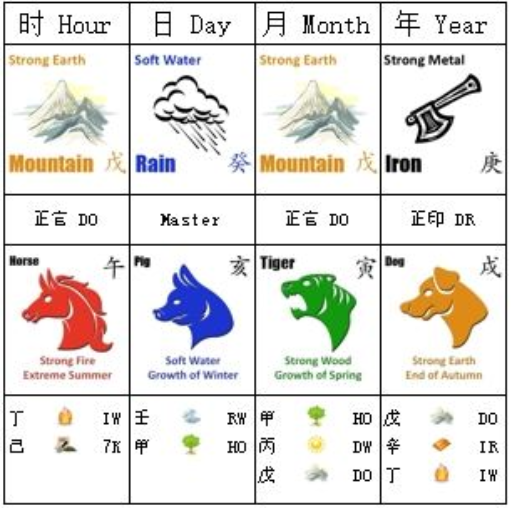
In a BaZi chart, your Day Master is the Heavenly Stem of your Day Pillar. It represents you, your core identity, and the reference point for everything else. Learn more about what the Day Master represents.
Day Master strength measures how supported that central element is within your Four Pillars. A strong Day Master has season, roots, and allies on its side. A weak Day Master lacks these supports and faces more draining or controlling energy.
This is not a personality label. Strong doesn’t mean confident, successful, or healthy. Weak doesn’t mean timid, unlucky, or fragile. It’s a structural reading about balance and flow. It tells you what your chart needs to perform well.
Once you know the strength, you can identify your favorable elements (Yong Shen) and your unfavorable elements (Ji Shen). That distinction drives career choices, relationship timing, health habits, and financial strategy.
For a broader comparison of what strong and weak Day Masters look like in daily life, see our strong vs. weak Day Master guide.
The 3 Hinges of Day Master Strength
Classical BaZi judges strength using three hinges. Think of them as a three-legged stool. Each leg matters, but the first one carries the most weight.
De Ling: Commanding the Season
De Ling means your Day Master is born in a season that supports its element. The Month Branch, which represents the month of birth, is the single most important factor in your bazi day master strength calculation.
Why? Because the month sets the climate of the entire chart. A Wood Day Master born in spring has the wind at its back. A Metal Day Master born in summer is already working against the heat.
| Day Master Element | Strong Season (In Command) | Weak Season (Out of Command) |
|---|---|---|
| Jia/Yi Wood | Yin, Mao (Spring) | Shen, You (Autumn Metal) |
| Bing/Ding Fire | Si, Wu (Summer) | Zi, Hai (Winter Water) |
| Wu/Ji Earth | Chen, Xu, Chou, Wei (Earth months) | Heavy Wood or Metal months |
| Geng/Xin Metal | Shen, You (Autumn) | Yin, Mao (Spring Wood) |
| Ren/Gui Water | Zi, Hai (Winter) | Si, Wu (Summer Fire) |
If your Day Master matches the season, you have De Ling. That alone doesn’t make you strong, but it gives you a major structural advantage.
De Di: Rooting in the Branches
De Di means your Day Master has roots in the Earthly Branches. A root is a hidden stem that matches your Day Master’s element or the element that produces it.
Each Earthly Branch contains 1-3 hidden stems. These aren’t visible in the main chart, but they supply real support. A chart that looks weak on the surface can be much stronger once you account for what’s hidden underneath.
For example, a Jia Wood Day Master finds roots in:
- Yin branch (contains Jia Wood, the same element)
- Mao branch (contains Yi Wood, also Wood)
- Hai branch (contains Ren Water, which produces Wood)
- Chen branch (contains Yi Wood as a residual root)
If your Day Master has roots in one or more branches, it has De Di. More roots mean a more stable constitution.
De Shi: Momentum of Support
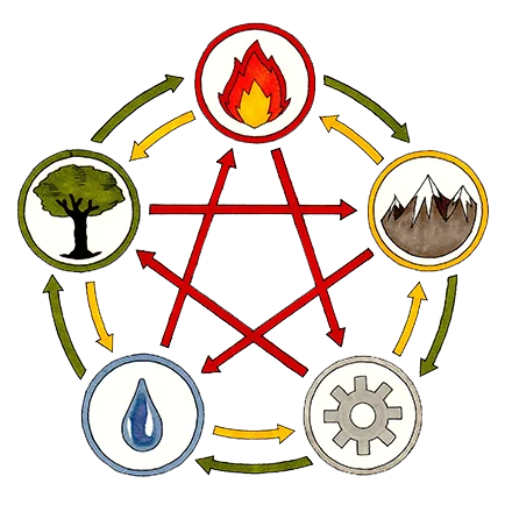
De Shi measures the overall balance of supportive versus draining forces across all four pillars. It looks at the Ten Gods and how they relate to your Day Master.
Supportive forces strengthen the Day Master:
- Companion stars (Friend, Rob Wealth) — same element
- Resource stars (Direct Resource, Indirect Resource) — generating element
Draining or pressuring forces weaken the Day Master:
- Output stars (Eating God, Hurting Officer) — element produced by the Day Master
- Wealth stars (Direct Wealth, Indirect Wealth) — element controlled by the Day Master
- Officer stars (Direct Officer, Seven Killings) — element that controls the Day Master
When supportive forces dominate, the Day Master is strong. When draining forces dominate, it’s weak.
How to Determine Day Master Strength: The 4-Step Method

Now that you understand the hinges, here’s a practical process you can use to determine any Day Master’s strength. Keep a copy of your chart in front of you. If you don’t have one yet, generate your free chart first.
This sequence follows the same logic used in most classical self-strength assessments, including the step-by-step method outlined by Shen-Shu for telling if your Day Master is strong or weak.
Step 1: Identify Your Day Master
Your Day Master is the top character of your Day Pillar. It’s one of the ten Heavenly Stems, each with an element and a polarity.
| Heavenly Stem | Element | Polarity |
|---|---|---|
| Jia | Wood | Yang |
| Yi | Wood | Yin |
| Bing | Fire | Yang |
| Ding | Fire | Yin |
| Wu | Earth | Yang |
| Ji | Earth | Yin |
| Geng | Metal | Yang |
| Xin | Metal | Yin |
| Ren | Water | Yang |
| Gui | Water | Yin |
Write your Day Master down. Everything else in this assessment refers back to it.
Step 2: Check the Month Branch for Season
Look at the bottom character of your Month Pillar. That’s your Month Branch. Compare it to the season table above.
If the branch supports your Day Master’s element, give yourself a point for De Ling. If it weakens your element, the chart starts with a disadvantage.
For example, a Bing Fire Day Master born in a Si or Wu month has De Ling. A Bing Fire born in a Zi or Hai month does not.
Step 3: Look for Roots in All Branches
Now examine all four Earthly Branches: Year, Month, Day, and Hour. Look for hidden stems that are the same element as your Day Master or the element that produces it.
If you find at least one strong root, you have De Di. If you find two or more, your Day Master is well-rooted. If you find none, the Day Master is rootless or only weakly supported.
Here’s a quick root reference table:
| Day Master | Strong Root Branches | Producing-Element Roots |
|---|---|---|
| Jia Wood | Yin, Mao | Hai, Zi (Water) |
| Yi Wood | Mao, Yin | Hai, Zi (Water) |
| Bing Fire | Yin, Wu, Xu | Yin, Mao (Wood) |
| Ding Fire | Mao, Wei, Xu | Yin, Mao (Wood) |
| Wu Earth | Chen, Xu, Chou, Wei | Si, Wu (Fire) |
| Ji Earth | Chen, Xu, Chou, Wei | Si, Wu (Fire) |
| Geng Metal | Shen, You | Chen, Xu, Chou, Wei (Earth) |
| Xin Metal | Shen, You, Chou, Xu | Chen, Wei (Earth) |
| Ren Water | Hai, Zi | Shen, You (Metal) |
| Gui Water | Hai, Zi, Chen | Shen, You (Metal) |
Step 4: Count Support vs. Pressure
Now scan the entire chart. Count how many stems and branches support your Day Master versus how many drain or control it.
A simple scoring method:
- Born in season (De Ling): +2 points
- Has a strong root (De Di): +1 point
- Has two or more roots: +2 points
- Majority of stems/branches are Companion or Resource: +1 point
- Majority of stems/branches are Output, Wealth, or Officer: -1 point
Interpretation:
- 4+ points: Strong Day Master
- 2-3 points: Moderate to strong, context-dependent
- 0-1 point: Weak Day Master
- Negative score: Very weak, possibly a Follow Pattern
This scoring is a guide, not a law. Use it to start the conversation with your chart, not to end it.
Step 5: Check for Special Patterns
Some charts break the normal rules. If your Day Master is extremely weak and the entire chart is dominated by one type of energy, you may have a Follow Pattern (从格). In that case, supporting the weak Day Master would actually harm the chart. Instead, you follow the dominant force.
Signs of a possible Follow Pattern:
- Day Master is out of season
- No roots or only very weak roots
- Almost every other stem and branch supports one non-Day-Master element
- No significant clashes or combinations that disrupt the dominant energy
If you suspect a Follow Pattern, this is where automated calculators often fail. A skilled human reader or advanced system is usually needed to confirm it.
Why Different BaZi Calculators Disagree
One of the most frustrating parts of learning BaZi is seeing two calculators label the same chart differently. One says strong. One says weak. Both claim to use classical methods.
Here’s why that happens.
Different Weighting Systems
Some systems give the Month Branch 40% weight. Others give it 60%. Some count hidden stems equally. Others discount residual hidden stems. These small differences add up, especially in borderline charts.
Hidden Stems Are Treated Differently
Not every system agrees on which hidden stems count as full roots. A branch’s main hidden stem might count as strong support in one system and only partial support in another.
Special Patterns Are Often Ignored
Basic calculators rarely detect Follow Patterns, Transformation Patterns, or unusual combinations. They apply a standard formula and miss the bigger picture.
True Solar Time Matters
Your legal birth time may not match your true solar time. If your Hour Pillar shifts because of a longitude or time zone correction, your entire chart, including your Day Master strength assessment, can change.
The takeaway: use calculators as a starting point, not the final word. A reliable Day Master strength calculator gives you a useful first reading. Your own judgment, using the method above, gives you understanding.
Special Cases That Change the Rules
Balanced Day Master
Some charts are neither clearly strong nor clearly weak. Support and pressure are roughly equal. These balanced charts are less common, maybe 10-15% of cases, and they require a different approach.
Your Chinese Astrology covers the distinction between strong, weak, and balanced BaZi charts in more detail, including how each type shapes the reading.
In a balanced chart, the question isn’t “what does it need?” It’s “what is the flow?” Look for which element the chart naturally moves toward and use that as your guide.
Rooted Weak vs. Rootless Weak
A rooted weak Day Master has at least one hidden root but is still out of season and surrounded by draining energy. It can be resilient. It has a base to return to during difficult Luck Pillars.
A rootless weak Day Master has no roots at all. It’s more vulnerable to unfavorable cycles and more likely to behave like a Follow Pattern under pressure.
Follow Pattern (从格)
A Follow Pattern occurs when the Day Master is so weak that the chart’s dominant energy takes over. The usual rules reverse. Instead of supporting the Day Master, you support the dominant element.
Follow Patterns are rare but powerful. Misidentifying one is one of the most expensive mistakes in BaZi reading.
From Strength to Action: What to Do Next
Once you’ve determined your bazi day master strength, the next step is to find your favorable elements. This is where the abstract becomes practical.
Finding Your Favorable Elements
- Strong Day Master: benefits from Output, Wealth, and Officer stars. It needs something to do with its excess energy.
- Weak Day Master: benefits from Resource and Companion stars. It needs nourishment and support.
For example, a strong Geng Metal Day Master may favor Water (Output) and Wood (Wealth). A weak Geng Metal would favor Earth (Resource) and Metal (Companion).
Learn more about this in our Five Elements personality guide and our Ten Gods overview.
Career and Timing Applications
Your Day Master strength helps you choose paths that fit your constitution. A strong Day Master often handles responsibility, pressure, and leadership well. A weak Day Master often succeeds through collaboration, timing, and leverage.
Relationship and Health Considerations
Strength also affects how you relate to others and manage your energy. Strong Day Masters may need boundaries to avoid burnout. Weak Day Masters may need supportive environments to avoid depletion.
Common Mistakes Beginners Make
- Ignoring hidden stems. A chart can look weak on the surface but be strong underneath.
- Counting elements without checking season. Ten supportive stems in the wrong season are less powerful than three in the right one.
- Confusing strength with personality. Strong does not mean confident. Weak does not mean incapable.
- Assuming more of the same element always helps. If those elements are not rooted or in season, they may not count.
- Treating season as the only factor. A Wood Day Master born in spring can still be weak if the rest of the chart is flooded with Metal.
- Missing Follow Patterns. Extreme weakness with no roots is a warning sign, not a standard weak chart.
Frequently Asked Questions
How do you determine Day Master strength in BaZi?
You determine Day Master strength by evaluating the season of birth, the roots in the Earthly Branches, and the balance of supportive versus draining forces across the chart. This is often summarized as De Ling, De Di, and De Shi.
What is the most important factor in Day Master strength?
The Month Branch, which represents the season of birth, carries the most weight, roughly 40-50% of the assessment. If your Day Master is in command of the season, the rest of the reading starts from a position of strength.
Why do different BaZi calculators show different strength results?
Calculators use different weighting systems, hidden stem rules, and special-pattern detection. Some also use different birth time corrections. This is why automated results should be treated as a starting point, not a final answer.
Can a Day Master be both strong and weak?
A single chart cannot be both, but some charts are borderline or balanced. In those cases, small changes in interpretation, such as hidden stem weighting, can shift the conclusion. Context matters.
What does “rooted” mean in Day Master strength?
Rooted means your Day Master’s element, or its producing element, appears as a hidden stem inside one or more Earthly Branches. Roots provide stability and support even when the Day Master looks weak on the surface.
How does the Month Branch affect Day Master strength?
The Month Branch sets the seasonal climate of the chart. A Day Master that matches the season is in command. One that does not must work harder to maintain its strength.
What is a Follow Pattern in Day Master strength?
A Follow Pattern occurs when the Day Master is extremely weak and the chart is dominated by one type of energy. The normal rules reverse, and the favorable elements become those that support the dominant force rather than the Day Master.
How do hidden stems change Day Master strength?
Hidden stems can add roots, support, or pressure that is not visible in the main chart. They often explain why two people with similar surface charts can have very different readings.
What is the 3-hinge method for Day Master strength?
The 3-hinge method evaluates De Ling (season), De Di (roots), and De Shi (momentum of support). Together, these three factors give a complete picture of Day Master strength.
How do you find favorable elements after determining strength?
A strong Day Master favors Output, Wealth, and Officer stars. A weak Day Master favors Resource and Companion stars. Special patterns like Follow Chart reverse this logic.
Conclusion
Your bazi day master strength is the first filter every BaZi reading passes through. Get it right, and your favorable elements, career guidance, and timing advice fall into place. Get it wrong, and even a detailed chart can lead you in the opposite direction.
The good news is that you don’t need years of study to make a solid first assessment. Start with the season. Look for roots. Count support and pressure. Then check for special patterns that change the rules.
If you want to skip the manual work, use our free Day Master strength calculator to get an instant reading. Then come back to this guide to understand what the result means and how to act on it.
Your chart isn’t a fixed fate. It’s a structured map. And the better you read it, the better your decisions become.