


Your five elements personality bazi profile is defined by the distribution of Wood, Fire, Earth, Metal, and Water across your Four Pillars chart. Each element appears in both Yin (receptive) and Yang (active) forms, creating ten distinct personality archetypes that shape how you think, decide, and relate to others.
Most personality tests give you a label. “You are an introvert.” “You are a visionary.” These words mean something, but they do not explain how you operate under pressure, why you clash with certain people, or which careers will energize you instead of draining you.
BaZi offers something more precise.
Your chart contains a measurable elemental blueprint. It shows not just who you are, but how you think, decide, and respond to stress. The Five Elements, each appearing in Yin and Yang form across your Four Pillars, create ten distinct personality archetypes. Once you learn to read them, you stop guessing about your strengths and start using them.
Want to follow along with your own chart? Calculate your free BaZi chart first, then return here to identify your elemental personality.
For a complete foundation on what these eight characters represent, see our complete guide to Four Pillars of Destiny.
Key Takeaways
- The Five Elements in BaZi create ten distinct personality archetypes, not five, because each element expresses differently in Yin and Yang form.
- Your dominant element shapes your default behavior, while missing elements reveal blind spots that are not always negative.
- Element interactions follow the Production Cycle (support) and Control Cycle (regulation), which explain compatibility and tension.
- Career fit, relationship harmony, and daily energy all map to your elemental blueprint.
- Not every missing element needs to be fixed; some missing elements are unfavorable for your specific Day Master and should stay absent.
What the Five Elements Personality in BaZi Reveals About You
The five elements personality bazi system, or Wu Xing, dates back over 3,000 years to the Zhou Dynasty. They were codified in texts like the Yi Jing and later refined in Zi Ping BaZi theory during the Song Dynasty. Modern practitioners still use this five elements bazi framework because it works. DeepOracle’s stem-by-stem breakdown confirms what traditional texts described centuries ago, mapping each stem to detailed personality profiles.
The Five Elements as Energetic Patterns
In the five elements bazi framework, the elements are not literal. They are not wood you burn or water you drink. They are patterns of energy. Each one describes a specific way that force moves, interacts, and expresses itself in a person.
- Wood expands upward and outward. It is growth, vision, and initiative.
- Fire radiates. It is expression, passion, and visibility.
- Earth anchors. It is stability, nurturing, and reliability.
- Metal concentrates. It is structure, precision, and discipline.
- Water descends and flows. It is wisdom, adaptability, and depth.
How Elements Map to Behavior, Not Just Fate
Each element correlates with specific organs in Traditional Chinese Medicine. Wood maps to the liver and gallbladder. Fire maps to the heart and small intestine. Earth maps to the spleen and stomach. Metal maps to the lungs and large intestine. Water maps to the kidneys and bladder. Research on Five Elements theory in TCM confirms these organ-element mappings have been used in clinical practice for centuries. This is why your elemental balance often shows up in your physical tendencies as well as your personality.
Why There Are 10 Personalities, Not 5
Each element has two faces. Yang is active, outgoing, and assertive. Yin is receptive, internal, and responsive. Yang Wood is a towering tree. Yin Wood is a vine. Both are Wood, but they behave differently.
This is why bazi element personality analysis identifies ten archetypes, not five. Each polarity creates a distinct expression of the same elemental force.
| Stem | Element | Polarity | Archetype | Core Trait |
|---|---|---|---|---|
| Jia (甲) | Wood | Yang | The Visionary | Upright, principled, long-term |
| Yi (乙) | Wood | Yin | The Diplomat | Adaptive, creative, timing-driven |
| Bing (丙) | Fire | Yang | The Sun | Charismatic, generous, visible |
| Ding (丁) | Fire | Yin | The Candle | Refined, persuasive, intimate |
| Wu (戊) | Earth | Yang | The Mountain | Steady, resilient, protective |
| Ji (己) | Earth | Yin | The Soil | Caring, detail-oriented, nurturing |
| Geng (庚) | Metal | Yang | The Sword | Decisive, just, direct |
| Xin (辛) | Metal | Yin | The Jewel | Elegant, strategic, refined |
| Ren (壬) | Water | Yang | The Ocean | Ambitious, independent, systemic |
| Gui (癸) | Water | Yin | The Mist | Perceptive, intuitive, subtle |
Alex had always been told he was “bad at planning.” For years, he blamed himself. He tried every productivity system, every planner, every app. Nothing stuck. When he finally generated his BaZi chart, the pattern was unmistakable: his eight characters were almost entirely Water and Metal, with almost no Earth.
Earth is the element of structure, routine, and grounding. Alex was not bad at planning. His chart simply lacked the elemental pattern that makes planning feel natural. Once he understood this, he stopped forcing himself to use rigid systems and built flexible, fluid routines that matched his Water-dominant design. His productivity doubled within three months.
This is the power of reading your five elements personality bazi profile. It tells you how you work, not who you should become.
The Ten Stem Personalities: Yang vs. Yin
The ten Heavenly Stems are the building blocks of your element personality bazi profile. Your Day Master, the stem in your Day Pillar, is the most important. It represents your core identity. But every stem in your chart contributes to your overall elemental profile.
Wood — Jia (Yang) and Yi (Yin)
Yang Wood (Jia) is like a towering tree. Principled, visionary, structured, and upright. Yang Wood people build things from the ground up. They need long-term goals and visible progress. When balanced, they are resilient and compassionate. When excessive, they become rigid and impatient.
Yin Wood (Yi) is like a vine or flower. Adaptive, diplomatic, creative, and timing-driven. Yin Wood people excel at reading the room and finding elegant paths around obstacles. When balanced, they are graceful and resourceful. When weak, they become indecisive and scattered.
Learn more about the (Yang Wood (Jia) personality) and (Yin Wood (Yi) personality).
Fire — Bing (Yang) and Ding (Yin)
Yang Fire (Bing) is like the sun. Bold, generous, charismatic, and far-reaching. Yang Fire people light up rooms. They thrive on recognition and purpose. When balanced, they inspire everyone around them. When excessive, they burn out or become ego-driven. Discover what defines the (yang fire personality) and how to keep its brightness sustainable.
Yin Fire (Ding) is like a candle. Refined, subtle, persuasive, and quietly influential. Yin Fire people connect deeply one-on-one. Their warmth is intimate, not broadcasted. When balanced, they are deeply perceptive. When weak, they struggle with low energy and motivation. Learn more about the (yin fire personality) and its quiet, lasting influence.
Earth — Wu (Yang) and Ji (Yin)
Yang Earth (Wu) is like a mountain. Steady, dependable, resilient, and protective. Yang Earth people are the backbone of any team. They do not flinch under pressure. When balanced, they are grounded and trustworthy. When excessive, they become stubborn and resistant to change. See our complete profile of the (yang earth personality )to understand its quiet strength.
Yin Earth (Ji) is like fertile soil. Caring, empathetic, adaptable, and detail-oriented. Yin Earth people nurture relationships and environments. They notice what others miss. When balanced, they are patient and practical. When weak, they feel scattered and insecure. Explore the (yin earth personality) for a deeper look at its nurturing nature.
Metal — Geng (Yang) and Xin (Yin)
Yang Metal (Geng) is like a sword. Decisive, competitive, just, and direct. Yang Metal people cut through complexity. They value fairness and clarity above all. When balanced, they are disciplined and organized. When excessive, they become harsh and emotionally cold. Dive into the (yang metal personality) to see how this decisive energy works.
Yin Metal (Xin) is like a jewel. Elegant, strategic, refined, and poised. Yin Metal people excel at precision work. They bring aesthetic sensibility to everything they touch. When balanced, they are clear and principled. When weak, they struggle with poor boundaries and inconsistency. Read our guide to the (yin metal xin personality) for more on its refined precision.
Water — Ren (Yang) and Gui (Yin)
Yang Water (Ren) is like the ocean. Ambitious, independent, broad, and deep. Yang Water people think in systems. They see patterns others miss. When balanced, they are flexible and insightful. When excessive, they become evasive and overthinking. Explore the (yang water personality) to understand its expansive, systemic mind.
Yin Water (Gui) is like mist or rain. Perceptive, intuitive, graceful, and subtle. Yin Water people process information deeply. They read between the lines effortlessly. When balanced, they are resourceful and strategic. When weak, they feel rigid and disconnected. Learn more about the (yin water personality) and its quiet, intuitive depth.
How to Read Your Five Elements Personality Balance
Knowing what the elements mean is only half the work. The other half is learning to count them in your own chart.
Step 1: Count Visible Elements (Heavenly Stems)
Your BaZi chart contains four pillars. Each pillar has one Heavenly Stem on top. These are visible elements. They are the most direct expressions of your elemental personality.
Step 2: Count Hidden Elements (Earthly Branches)
Each Earthly Branch contains one to three hidden elements. These are not visible at first glance, but they count. For example, the Tiger (Yin) branch contains Jia Wood, Bing Fire, and Wu Earth. These hidden stems shape your underlying tendencies.
Step 3: Factor in Season of Birth
The season of your birth affects element strength. Spring strengthens Wood. Summer strengthens Fire. Late summer strengthens Earth. Autumn strengthens Metal. Winter strengthens Water. A Wood element born in spring is stronger than the same Wood element born in autumn.
What Dominant, Balanced, and Weak Look Like
A dominant element appears when 3 or more of your 8 chart characters carry the same element. A missing element appears in 0 visible characters. A weak element appears in 1 or 2 characters.
| Pattern | Count | Meaning |
|---|---|---|
| Dominant | 3+ total | Shapes your default tendencies |
| Balanced | 1-2 each | Even distribution across elements |
| Weak | 1-2 total | Present but underdeveloped |
| Missing | 0 total | Creates a blind spot |
| Excessive | 6+ total | Can overwhelm the chart |
Your dominant element is your default mode. It is what comes naturally, what you do without thinking, and what others notice first about you. A Water-dominant person processes information before acting. A Fire-dominant person acts before processing. Neither is wrong. But knowing your dominant element helps you understand why certain tasks feel effortless and others feel draining.
For a step-by-step method to identify your chart’s strongest force, read our (complete guide to dominant element in BaZi).
When an Element Is Missing or Weak in Your Element Personality BaZi
A missing element gets attention, but it is not automatically a problem.
Common Effects of Missing Each Element
| Missing Element | Common Effect |
|---|---|
| Missing Wood | Difficulty starting new projects, lack of long-term vision |
| Missing Fire | Low visibility, difficulty expressing enthusiasm, social reserve |
| Missing Earth | Unstable routines, scattered energy, difficulty nurturing others |
| Missing Metal | Poor boundaries, indecisiveness, lack of structure |
| Missing Water | Rigid thinking, poor adaptability, difficulty processing emotion |
The Missing Element Remedy Framework
If a missing element is favorable for your Day Master, you can strengthen it through targeted choices:
- Direction: Each element has a directional affinity. Wood = East, Fire = South, Earth = Center, Metal = West, Water = North.
- Color: Wood = green, Fire = red, Earth = yellow/brown, Metal = white/gold, Water = black/blue.
- Activity: Wood = gardening and creative work, Fire = social events, Earth = cooking and organizing, Metal = structured planning, Water = swimming and journaling.
- Career alignment: Choose industries that express the missing element.
- Timing: Certain hours, days, and Luck Pillars bring elemental energy.
Maria was a Yang Fire Day Master with weak Water in her chart. She had spent three years in a high-pressure sales role that demanded constant social performance. Fire was already strong in her chart, and the job poured gasoline on it. She was burning out.
Water is the element that controls Fire. Without enough Water, her Fire ran unchecked. She switched to a strategic planning role that required deep thinking and analysis, Water-type activities. Within six months, her energy stabilized. She was still a Fire person, but now she had the right environment to contain it.
Not every missing element needs to be fixed. Some missing elements are unfavorable for your specific Day Master and should stay absent. Forcing balance where none is needed creates problems.
For the complete framework on weak and missing elements across all five elements, see our (guide to weak element in BaZi).
Element Combinations and Compatibility in BaZi
No element exists in isolation. Their power comes from how they relate to each other.
Production Cycle Pairings
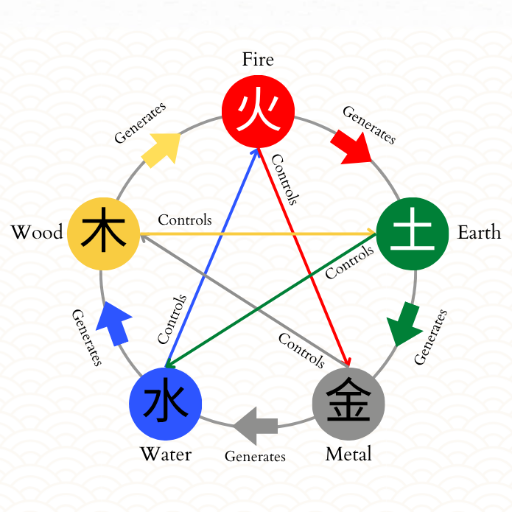
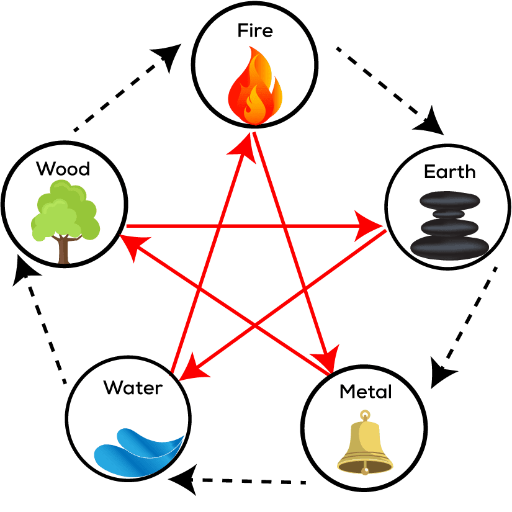
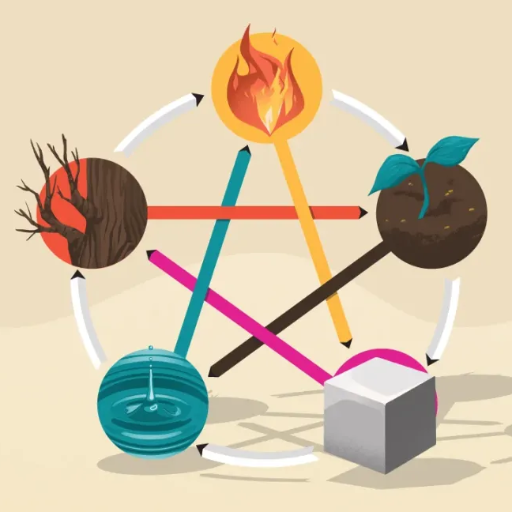
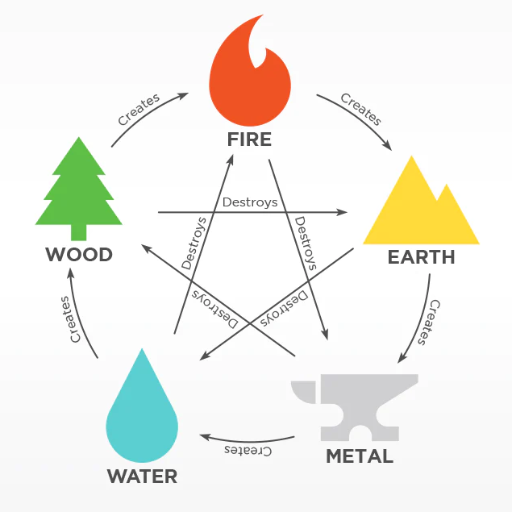
The Production Cycle shows how elements support each other. Wood produces Fire. Fire produces Earth. Earth produces Metal. Metal produces Water. Water produces Wood.
Think of it as a relay. Each element fuels the next. When this cycle flows smoothly in your chart, you experience natural momentum. Wood-dominant people who also have strong Fire find that their ideas translate into action easily.
In relationships, Production Cycle pairings create natural harmony. A Wood person feels supported by a Water partner. A Fire person feels grounded by an Earth partner.
Control Cycle Tensions
The Control Cycle shows how elements regulate each other. Wood controls Earth. Earth controls Water. Water controls Fire. Fire controls Metal. Metal controls Wood.
Control is not destruction. It is necessary discipline. Without Metal to control it, Wood grows wild and unstructured. Without Water to control it, Fire burns out.
Lisa’s chart told this story perfectly. She was a Wood-dominant creative who had spent five years in corporate finance, a Metal-heavy environment. Metal controls Wood, and the control was excessive. Every idea she proposed was analyzed, critiqued, and delayed. She blamed herself for feeling stifled. Her chart revealed the truth: the environment was structurally incompatible with her elemental design. When she moved into a design role at a startup, her creativity returned within months.
| Wood | Fire | Earth | Metal | Water | |
|---|---|---|---|---|---|
| Wood | — | Produces | Controls | Controlled by | Produced by |
| Fire | Produced by | — | Produces | Controls | Controlled by |
| Earth | Controlled by | Produced by | — | Produces | Controls |
| Metal | Controls | Controlled by | Produced by | — | Produces |
| Water | Produces | Controlled by | Controlled by | Produced by | — |
For a deeper look at how these interactions show up in relationships, see our BaZi compatibility guide.
Element Personality and Career Fit
Your elemental blueprint is one of the most reliable indicators of career alignment. Not because it predicts success, but because it predicts energy. Nova Masters Consulting provides detailed career-path mapping by element, showing how specific industries either amplify or deplete your natural energy.
| Element | Best Career Paths | Work Environment Needs |
|---|---|---|
| Wood | Education, design, healthcare, startups, strategic planning | Growth potential, autonomy, creative output |
| Fire | Marketing, media, leadership, technology, coaching, performance | Visibility, dynamic pace, recognition |
| Earth | Real estate, HR, accounting, government, logistics, wellness | Stability, clear routines, supportive teams |
| Metal | Finance, law, engineering, surgery, data analysis, quality assurance | Structured systems, measurable outcomes, high standards |
| Water | Consulting, research, writing, diplomacy, therapy, intelligence analysis | Variety, intellectual depth, strategic scope |
How to Use Element Knowledge for Career Decisions
James was a Metal-dominant engineer with missing Wood. He had spent a decade in mechanical engineering, a Metal-aligned field, but felt increasingly restless. His chart showed strong Metal and almost no Wood. Wood is the element of growth, vision, and expansion.
Instead of leaving engineering entirely, he pivoted into strategic planning within the same company. The role required him to design long-term growth strategies, a Wood-type function, while still using his Metal precision. He finally felt balanced.
The goal is not to match your job title to your element. The goal is to make sure your daily tasks express your dominant element while your weaker elements get enough exercise to keep you growing.
Frequently Asked Questions
What element am I in BaZi?
Your “element” in BaZi is usually your Day Master, the Heavenly Stem of your Day Pillar. It could be Yang Wood, Yin Wood, Yang Fire, Yin Fire, Yang Earth, Yin Earth, Yang Metal, Yin Metal, Yang Water, or Yin Water. Your chart also contains a distribution of all five elements across the four pillars, so your overall elemental personality is a blend, not a single type.
Can I have more than one dominant element?
Yes. Many charts show two elements tied for dominance. This creates a more complex personality. For example, a Wood-Fire dominant person is both visionary and expressive. Ideas come easily, and communicating them feels natural. The challenge is usually follow-through, because Earth, the element of grounding, may be weaker.
Does my element change over time?
Your natal chart elements are fixed at birth. However, your Luck Pillars, which change every 10 years, bring new elemental influences into your life. A Water-dominant person entering a strong Fire Luck Pillar will experience a temporary shift in energy and priorities, even though their core personality remains the same.
How accurate is element personality analysis?
Element personality analysis is highly accurate for describing natural tendencies, energy patterns, and behavioral defaults. It is less accurate for predicting specific events. The framework works best as a tool for self-awareness and decision support, not as a fortune-telling system.
What if my Day Master element differs from my dominant element?
This is common and often confusing. Your Day Master is your core identity, while your dominant element is the most frequent energy in your chart. If your Day Master is Yin Water but your dominant element is Fire, you are fundamentally a deep, intuitive person who operates in a visible, expressive environment. The tension between these two forces is part of your unique design.
Can missing elements be completely fixed?
No, and they do not need to be. A missing element in your natal chart is permanent. What you can do is supplement the favorable missing element through environment, career, and routine. But if the missing element is unfavorable for your Day Master, leaving it absent is the healthier choice.
Which element is best for leadership?
There is no single best leadership element. Yang Fire leaders inspire through vision and charisma. Yang Metal leaders lead through structure and fairness. Yang Wood leaders build organizations from the ground up. Yang Water leaders navigate complexity and see systemic solutions. The best leader is the one who understands their own elemental style and builds a team that complements it.
How do elements affect relationships?
Elements affect relationships through the Production and Control Cycles. Production Cycle pairings, like Water and Wood or Fire and Earth, tend to feel supportive and natural. Control Cycle pairings, like Metal and Wood or Earth and Water, can create productive tension or conflict, depending on the balance. Two Fire-dominant people may compete for visibility. A Fire-Earth pairing often creates mutual support.
Conclusion
Your personality is not random. It is elemental.
The five elements personality bazi system gives you a language for understanding your natural design. Wood expands. Fire radiates. Earth anchors. Metal structures. Water flows. Each one plays a role in your chart, and no single element is better than another.
The goal is not perfection. The goal is awareness.
When you know which elements dominate your chart, you understand your default mode. When you know which are missing, you understand your blind spots. When you know how they interact, you understand why certain environments energize you and others drain you.
Your chart is not a prison. It is a map.
Ready to see your own elemental blueprint?
Generate your free BaZi chart now and discover which elements shape your decisions.
Your pattern is already there. You just need to read it.