


The accuracy of your Bazi chart relies on your precise birth time. Most people go by the clock time mentioned on their birth certificate. This is wrong. Time kept by the clock is devoid of time zones, longitude, and the use of DST. All of these factors can be responsible for shifting your Hour Pillar or even your Day Pillar. When these shift keep in mind, your four-pillar readings have effectively changed.
This guide will teach you the importance of your tentative birth time for determining your Bazi chart. You will come to understand why solar time matters, the role of longitude latitude location on your birth data, and then time-saving measures in your readings. In assenting to this point, you will be able to determine the modified precise birth time.
What Is BaZi and Why Birth Time Matters
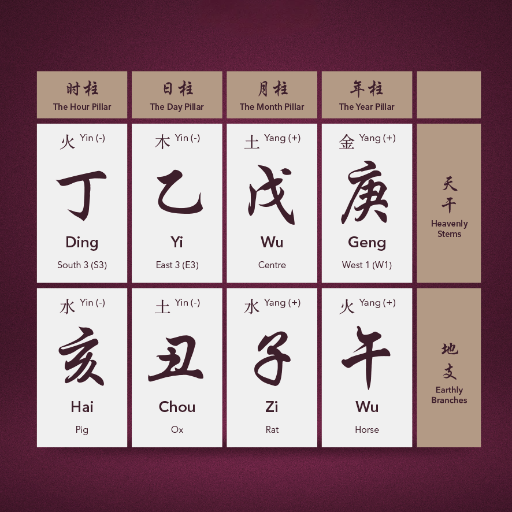
The Four Pillars System
BaZi, also known as the Four Pillars of Destiny, is a systematized Chinese metaphysics system. It constructs your life pattern through eight characters drawn from your year, month, day and hour of birth, these characters derive from an interaction between the Celestial/Heavenly Stems and Terrestrial Branches.
In your chart you will find out your strengths and daylight blind spots, and your timing cycle. This is not simply fortune-telling. This is a decision support system to help you align your measures with your inborn patterns.
The Hour Pillar: Your Hidden Influence
Birth time sets your Hour Pillar. This is the fourth and final pillar in your chart. It governs your unconscious traits, your later-life path, and key areas like wealth, children, and career direction.
Key Point: The Hour Pillar holds deep insight into your later years. An incorrect birth time places the wrong stem and branch in this pillar. That skews your entire analysis.
When all four pillars are accurate, you get a complete picture. When the birth time is off, you are reading someone else’s chart.
Why Clock Time Is Not Enough for BaZi
Understanding Solar Time
Solar time follows the actual position of the sun in the sky. Clock time doesn’t. Clock time are political conventions. It groups wide swaths as if in the same hour, regardless of the sun’s true position.
Since the latter denotes actual celestial energy, BaZi takes solar time into consideration. The sun at the time of your birth sets the boundaries of your Day and Hour pillars. To set this to rights, you need to convert clock time to solar time.
In converting solar time, you would need to make two key alterations:
- Longitudinal correction-your distance east or west from the standard meridian of your time zone
- Equation of time-it is simply the difference between mean solar time and apparent solar time due to Earth’s elliptical orbit
For most everyday BaZi calculations, longitudinal correction is the major issue while the equation of time is on the order of minutes, easily solved with good calculators.
Time Zone Differences
Most countries use standardized time zones. These are several tens of degrees wide. If you were born very far from the center of the time zone, there can be significant disparity between the time on your clock and your solar time.
For example, China follows only one time zone for the whole nation. Someone who is born in western China and forged with Beijing time as the sun is indeed in opposite directions. These are vital differences in BaZi.
Modern tools like time zone converters have come to your aid in determining the standard meridian for your birthplace. With this piece of information, you can ascertain the exact difference in longitude needed.
Daylight Saving Time (DST)
Daylight saving time adds a layer of complexity in DST though. In DST, your clock moves ahead by an hour. Your birth certificate might say said clock time on the birth time was what was meant. But in reality, the sun remains unaffected by this automatic alteration. The vector day does not change.
If you were born audited to DST, apply the extra hour to what would have been your reasonable BaZi calculations. DST has been practiced as per varying conditions prevailing at various times over years in different countries. Always make a point of checking whether DST was in effect for the date of your birth.
You can verify DST history through official sources like the IANA Time Zone Database or your national observatory.
Using Longitude for Accurate Time Adjustments
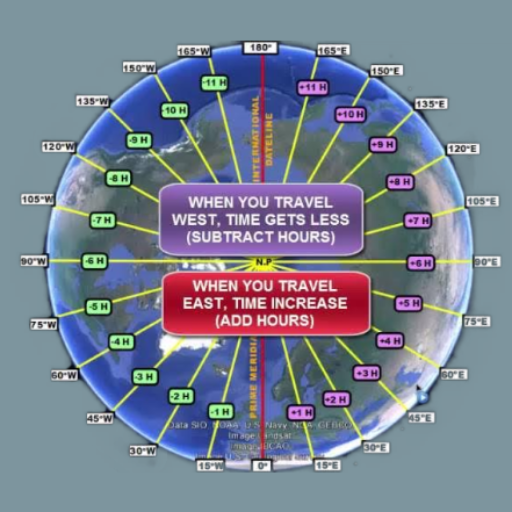
The Four-Minute Rule
Longitude is the key to precise birth time adjustment. Adjusting for time zones and longitude in BaZi starts with a simple fact: the earth rotates 360 degrees in 24 hours. That means each degree of longitude equals four minutes of time.
Every degree east of the standard meridian adds four minutes. Every degree west subtracts four minutes.
Here is the simple formula:
Solar time = Clock time + (Longitude difference x 4 minutes)
After this adjustment, you also add or subtract any DST offset. Then you have your true solar time.
A Worked Example: Singapore
Let us walk through a real example. Suppose you were born in Singapore.
- Singapore clock time uses UTC+8
- The standard meridian for UTC+8 is 120°E
- Singapore’s actual longitude is about 103.8°E
- The difference is roughly 16.2° west of the standard meridian
Calculation:
- 16.2 degrees x 4 minutes = 64.8 minutes earlier
- If your birth certificate says 14:00, your solar time is about 12:55
- That is more than an hour difference. It can easily shift your Hour Pillar.
This is why birth time adjustment for time zones and longitude in BaZi is not optional. It is essential.
Step-by-Step Adjustment Process
Follow these steps to convert your birth time for BaZi accuracy:
- Record your civil birth time from your birth certificate
- Find your birthplace longitude using a map or GPS tool
- Identify your time zone’s standard meridian (e.g., UTC+8 = 120°E)
- Calculate the longitude difference in degrees
- Multiply by 4 minutes per degree to get the time offset
- Apply the offset (add if east, subtract if west)
- Check for DST at your birth date and adjust if needed
- Convert the final time to Chinese solar hours (Zi, Chou, Yin, etc.)
How a BaZi Calculator Handles Time Corrections
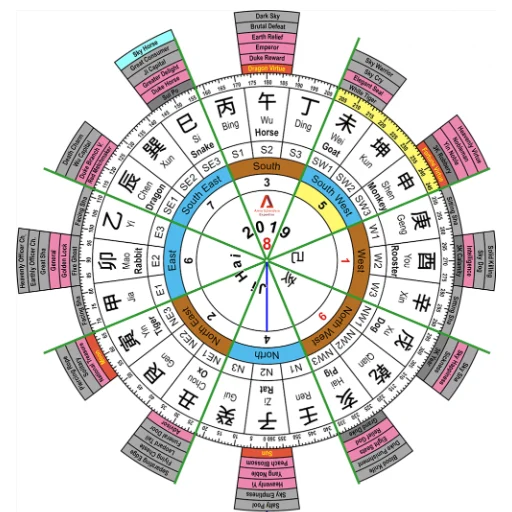
A quality BaZi calculator simplifies this entire process. You enter your birth date, clock time, and location. The calculator does the rest.
It looks up the longitude, applies the time zone offset, checks historical DST rules, and computes true solar time. Then it builds your Four Pillars chart using the corrected data.
This removes human error from the math. It also ensures you do not miss historical calendar quirks. Some regions changed time zones or DST rules decades ago. A good calculator has that data built in.
You can generate your birth element with our free BaZi calculator to see how time adjustments affect your chart.
Tips for Getting Precise Results
To get the most accurate reading, follow these tips:
- Gather the exact time, date, and location from your birth certificate
- Cross-check the time zone data with a reliable source
- Verify whether DST was active when you were born
- Use a calculator that includes longitude and DST corrections
- Review each pillar’s stem and branch to confirm the chart feels right
Why Accurate Time Data Changes Your BaZi Reading
How the Four Pillars Work Together
Your BaZi chart has four pillars:
| Pillar | Represents | Source |
|---|---|---|
| Year Pillar | Ancestry, early environment | Birth year |
| Month Pillar | Parents, career foundation | Birth month |
| Day Pillar | Self, spouse, core identity | Birth day |
| Hour Pillar | Children, later life, wealth | Birth hour |
Each pillar contains one Heavenly Stem and one Earthly Branch. Together, they create the eight characters that define your chart.
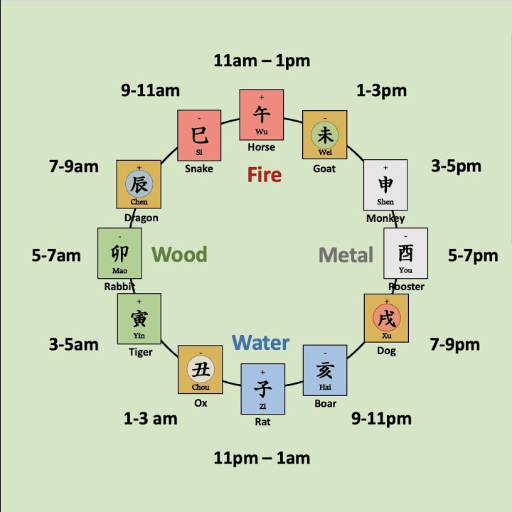
The Hour Pillar is especially sensitive to time. A shift of just a few minutes can move you into a different Chinese hour block. Chinese hours are two standard hours long (Zi is 23:00-01:00, Chou is 01:00-03:00, and so on). If your solar time correction crosses one of these boundaries, your Hour Pillar changes completely.
Element Balance and Timing
The Five Elements in your chart, Wood, Fire, Earth, Metal, and Water, reveal your natural patterns. Each element carries specific traits:
| Element | Core Traits |
|---|---|
| Wood | Growth, creativity, expansion |
| Fire | Passion, transformation, energy |
| Earth | Stability, nourishment, grounding |
| Metal | Structure, precision, refinement |
| Water | Wisdom, adaptability, flow |
When your birth time is wrong, the elements in your Hour Pillar may be wrong. That changes your element balance. It changes which elements are strong, which are weak, and how they interact with the rest of your chart.
Accurate time data gives you the real picture. You see your true strengths and the timing cycles that actually apply to you.
The Hour Pillar in Late Life
The Hour Pillar has special significance for your later years. It influences your retirement path, your relationship with children, and your wealth accumulation in later life.
You can read more about the importance of the Hour Pillar in late life to understand how this pillar shapes your long-term trajectory.
Common Time Adjustment Mistakes in BaZi Readings
Even experienced practitioners make errors with birth time. Here are the three most common mistakes and how to avoid them.
1. Ignoring Time Zone and Longitude
The most common mistake is using clock time directly. Birth certificates record civil clock time. They do not record solar time. If you skip the longitude adjustment, your Hour Pillar may be off by one or even two Chinese hour blocks.
Warning: Using unadjusted clock time is the single biggest source of error in BaZi chart calculations. Always convert to solar time first.
2. Forgetting Daylight Saving Time
DST is easy to overlook. It only applies to part of the year. But if you were born during a DST period, your clock time is one hour ahead of solar time. Failing to subtract that hour pushes your chart into the wrong pillar.
Check historical DST records for your birthplace. Do not assume the current DST rules applied when you were born.
3. Trusting Inaccurate Birth Records
Not all birth times are recorded precisely. Hospitals may round to the nearest five or ten minutes. Some older records only note the hour. In traditional settings, birth time was often estimated from memory.
If your recorded time seems rounded, consider that your actual birth moment could be earlier or later. For critical readings, some practitioners use rectification techniques to narrow down the exact time. This involves matching major life events to possible chart variations.
Frequently Asked Questions
What is the relevance of true solar time in my BaZi chart?
BaZi is an art that depends entirely on readings of the position of the sun. The Day and Hour pillars are both solar based. Standard twelve hours of the clock is a humanly defined notion; thus, it cannot coincide with the actual position of the sun unless you are exactly at your zone’s meridian. Converting my BaZi to solar time aligns my particulars with the actual ceremony of my nativity.
Was half-hour conversion relevant to countries like Malaysia or Singapore, where I was born?
Yes. Solar time and times of these countries could differ by a substantial number of degrees. Take Singapore, which lies at about 103.8° E. The standard UTC time for this zone is 20° higher than Singapore, at 120° E. This means that such a distance distance in terms of solar time should be around 16°. This approximately presents an error of 65 minutes off solar time from the time clock time. This, a major disruption to what will exist in your Hour Pillar.
What are the exact steps to calculate solar time for BaZi?
Follow this process:
- Note your civil birth time from your birth certificate
- Find your birthplace longitude with a reliable map or GPS tool
- Identify your time zone’s standard meridian
- Calculate the degree difference between your location and the meridian
- Multiply that difference by 4 minutes per degree
- Apply the result to your clock time (add if east, subtract if west)
- Check if DST was active and adjust if needed
- Convert the final solar time to Chinese hour blocks for your chart
Can a one-hour difference change my Hour Pillar or Day Master?
Yes. Chinese hours span two standard hours each. A one-hour offset can push your birth from one Chinese hour into another. That changes your Hour Pillar’s stem and branch. If the offset crosses midnight, it can even shift your Day Pillar. This affects your Day Master and the timing of your 10-year Luck Pillars.
How do calendars and sundials help identify solar time?
The calendar provides a civil date, with historically valid time corrections. Information from a sundial or solar ephemeris tells the sun’s position at a certain location. By combining the two, the difference between watch time and solar time can then be calculated. Modern tools do this blending automatically. Traditionally, solar tables are still used for a sure-handed confirmation.
Conclusion
Accurate birth time is the foundation of every reliable BaZi reading. Time zones, longitude, and daylight saving all create gaps between clock time and solar time. Those gaps matter. They can shift your Hour Pillar, alter your element balance, and change the timing of your Luck Pillars.
Here is what to remember:
- Clock time is not solar time
- Longitude adjustments use the 4-minute-per-degree rule
- DST requires subtracting the seasonal offset
- Even small time differences can change your chart
- A quality BaZi calculator handles these corrections automatically
Adjusting for time zones and longitude in BaZi is not complicated once you know the steps. Stop guessing. Start with a precise birth time, and your BaZi chart will give you the clarity you need to make better decisions.
Ready to see your accurate chart? Calculate your BaZi with true solar time adjustments and discover what your Four Pillars actually reveal.